
Avi-Go AI as an Intelligent Operating System for Business Aviation


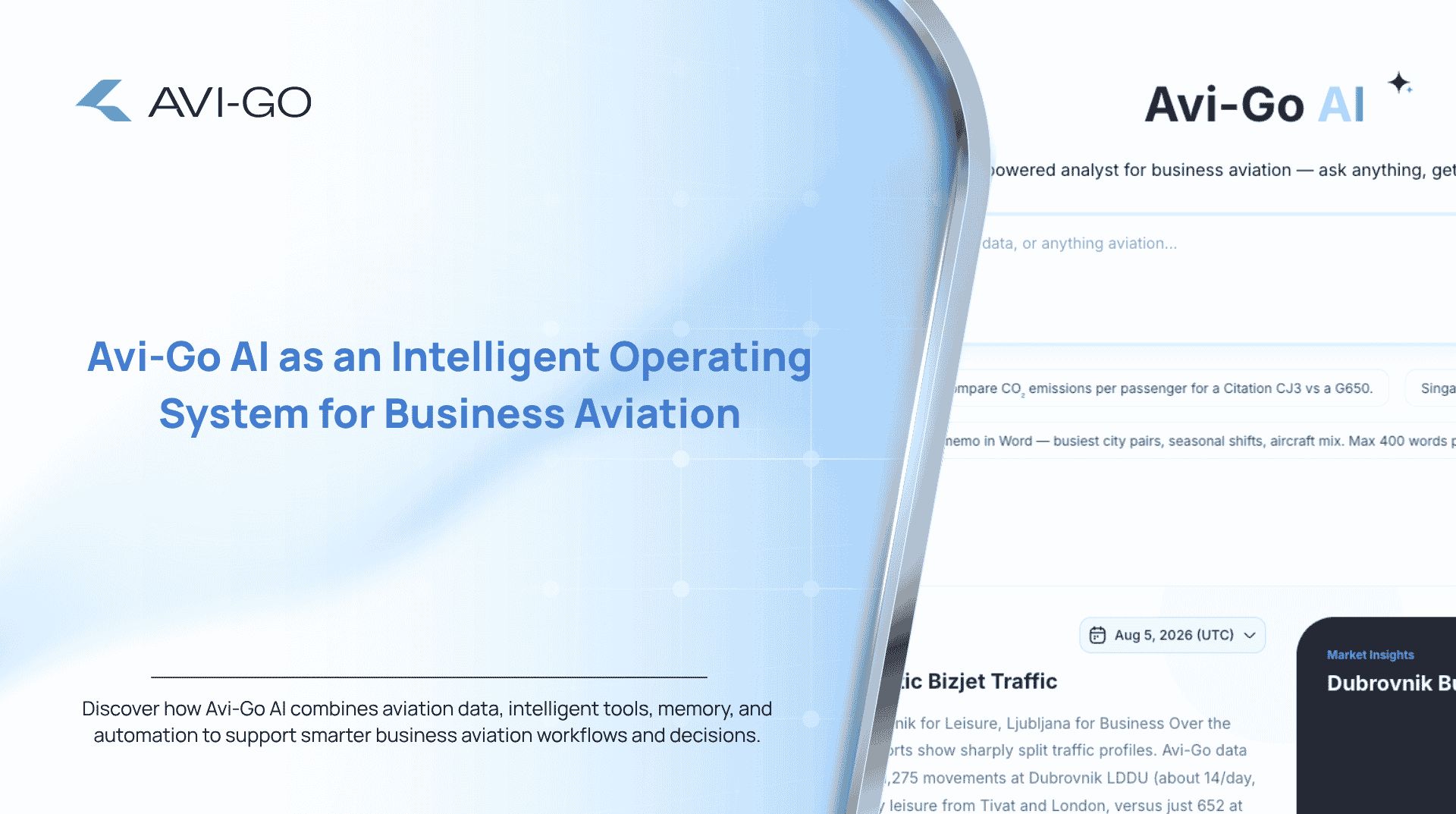
Artificial intelligence is changing how aviation professionals search for information, analyse markets, evaluate opportunities, and move from data to action.
However, general-purpose AI systems are not designed around the specific language, entities, data structures, commercial workflows, and operational requirements of business aviation.
That is where Avi AI comes in.
Avi AI is Avi-Go’s product category for artificial intelligence capabilities designed specifically for the business aviation industry. At present, the category consists of Avi-Go AI, Avi-Go’s unified aviation intelligence system. At the same time, the underlying AI technology is being progressively implemented across other Avi-Go tools and product experiences.
The objective is not simply to add a chatbot to an aviation platform. It is to create an intelligence layer that can understand aviation requests, connect them with relevant data and tools, support multi-step tasks, and deliver results that professionals can use.
What Is Avi-Go AI?

Avi-Go AI is an intelligent operating system built for business aviation.
It brings together multilingual interaction, aviation-specific entity recognition, long-context processing, cross-conversation memory, intelligent task planning, data tools, business actions, and document generation within one system.
Instead of functioning only as a question-and-answer interface, Avi-Go AI is designed to manage a broader workflow. A user can begin with a natural-language request, and the system can interpret the objective, identify the relevant aviation entities, select the appropriate tools, retrieve information, analyse the results, and prepare a usable response or deliverable.
This structure allows Avi-Go AI to connect four essential elements:
- Understanding the user’s request
- Accessing relevant aviation data
- Performing the appropriate actions
- Delivering information in a practical format
Avi-Go AI is therefore positioned as more than a standalone conversational product. It is the central intelligence system through which Avi-Go’s aviation data, tools, workflows, and future AI-powered products can work together.
Why Business Aviation Needs Industry-Specific AI
Business aviation questions are often more complex than they initially appear.
A request may refer to a city, airport, aircraft model, operator, registration number, route, charter requirement, empty leg, or market segment. The same term may also have different meanings depending on the commercial or operational context.
For example, a user searching for “London” may need results covering several airports. A reference to a Gulfstream aircraft may require the system to distinguish between a brand, model family, aircraft category, or specific registration. A charter search may also involve route suitability, indicative pricing, aircraft availability, operator information, and alternative airports.
Avi-Go AI is designed to translate natural-language requests into recognised aviation entities before using the relevant data tools. Its semantic layer can identify and standardise entities including:
- Cities and countries
- Airports and ICAO codes
- Aircraft types and manufacturers
- Operators and suppliers
- Aircraft registrations
- Routes and market regions
This aviation-specific understanding helps reduce ambiguity and improves the relevance of the information returned.
How Avi-Go AI Works
Avi-Go AI uses a multi-stage process to move from a user request to a finished result.
The system first processes the request, conversation context, identity information, and any uploaded files. It then detects the language, retrieves relevant memory and knowledge, identifies aviation entities, and determines whether the task requires a direct answer or a more advanced workflow.
For complex requests, Avi-Go AI can create a task plan and coordinate different system roles:
Planner: Breaks the objective into executable steps.
Thinker: Decides which action or tool should be used next.
Actor: Executes the selected tool with structured parameters.
Historian: Retrieves relevant previous workflows, industry methods, and entity information.
The results from each step are returned to the same task state, allowing the system to adjust its approach as new information becomes available.
This means Avi-Go AI does not have to rely on a single AI response generated in isolation. It can combine reasoning with specialised aviation tools and structured data to produce a more complete result.
Avi-Go AI Product Update
Avi-Go AI is being developed as the core intelligence engine behind Avi-Go’s expanding AI capabilities.
The current system includes access to ten internal runtime tools covering aviation data, market research, transactions, file processing, browser workflows, and visual content production.
These tools include capabilities for:
Historical Flight Intelligence
Avi-Go AI can work with historical flight data to support traffic analysis, route research, aircraft activity analysis, operator comparisons, and regional market insights.
This can help users examine questions such as:
- How has business aviation activity changed in a particular region?
- Which aircraft types are most active on a route?
- Which airports or operators are gaining activity?
- How does current flight activity compare with a previous period?
Charter Flight Search
The system can support searches for current or future charter aircraft based on routes, dates, aircraft requirements, budget considerations, and passenger preferences.
Results may include suitable aircraft candidates, operator information, route compatibility, and indicative pricing. As with any charter search, availability and final pricing must still be confirmed through the relevant supplier.
Empty Leg Search
Avi-Go AI can also identify future empty leg and repositioning opportunities.
Users can search according to route, date, aircraft type, and other requirements. The technology is intended to help users identify relevant opportunities more efficiently while preserving the distinction between an available search result and a confirmed booking.
Flight Carbon Emissions Estimates
The platform can calculate estimated flight emissions using factors such as route, aircraft type, distance, flight time, fuel assumptions, and journey structure.
The output is designed to present the assumptions and methodology behind the estimate, allowing users to better understand the potential carbon impact of a flight.
Inquiry Workflows
Avi-Go AI is being designed to help users move beyond a list of search results.
When users clearly select an aircraft or empty leg candidate, the system can connect that selection with Avi-Go’s existing inquiry workflow. This creates a more direct path from searching and comparing options to submitting a request for further commercial follow-up.
The platform uses verified candidate information from the current user session rather than allowing the AI to invent transaction identifiers or aircraft records.
Reports, Files, and Visual Deliverables
Avi-Go AI can convert research and aviation data into practical deliverables, including:
- Market reports
- Aircraft and fleet analysis
- Carbon emissions reports
- Management summaries
- Customer proposals
- Data files
- Visual insight cards
- Marketing images
- PDF and HTML documents
This reflects an important principle behind the product: the answer is not always the final output. In many cases, users need a report, presentation asset, file, analysis, or inquiry that can be used in the next stage of their work.
Multilingual Aviation Intelligence
Business aviation is a global industry, so Avi-Go AI has been built to process and respond across multiple languages.
The system currently supports 15 languages, including English, Chinese, Spanish, French, German, Japanese, Korean, Portuguese, Russian, Arabic, Persian, Italian, Turkish, Hindi, and Bahasa Indonesia.
Rather than operating only as a translation layer, language recognition is connected to task routing. Avi-Go AI can identify the user’s language while continuing to process aviation entities, files, data requests, and workflow instructions within the same system.
This helps users interact with specialized aviation intelligence in the language most relevant to their business.
Memory and Continuous Workflows
Aviation professionals often work on tasks that continue across multiple conversations.
They may refer to “the previous route,” “the aircraft we reviewed last time,” or “the earlier market report.” A basic chatbot may struggle to understand these references without the entire conversation being provided again.
Avi-Go AI includes a cross-conversation memory system intended to preserve useful task context, including previous objectives, conclusions, numbers, routes, aircraft, operators, dates, and relevant files.
Instead of treating every conversation as an isolated interaction, the system can use recent task history to support continuity and reduce repetitive input.
This creates the foundation for a more personalised aviation workflow in which the service becomes more useful as users continue working with it.
AI Technology Across the Avi-Go Platform
Avi-Go AI is currently the primary product within the Avi AI category, but the technology is not intended to remain limited to a single interface.
The same core capabilities can be applied across other Avi-Go tools and future products, including:
- Aviation market intelligence
- Charter and empty leg discovery
- Carbon emissions analysis
- Operator and fleet analysis
- Airport and FBO growth intelligence
- Event-driven opportunity identification
- Broker sales workflows
- Business aviation content production
- Enterprise aviation systems
This shared technology includes language processing, aviation entity recognition, data retrieval, task planning, memory, tool orchestration, and controlled output generation.
As these capabilities are progressively integrated into other Avi-Go tools, users may be able to access AI assistance directly within the workflow they are already using.
For example, an AI-enabled product page could understand the aircraft, airport, route, operator, or filter currently being viewed and help the user analyse the information or prepare the next action.
This approach allows Avi-Go to develop multiple AI-supported products without rebuilding the aviation intelligence engine each time.
From Aviation Data Platform to Aviation Intelligence Infrastructure
The long-term direction of Avi AI is to connect people, aviation data, workflows, and external systems through a shared intelligence layer.
For individual users, this means asking a question and receiving data, analysis, a document, or a practical next step.
For businesses, it creates the possibility of embedding Avi-Go’s aviation intelligence into sales, marketing, operations, analytics, and customer relationship systems.
For other AI agents and enterprise platforms, Avi-Go is also developing controlled access to selected aviation capabilities through the Model Context Protocol and tool-specific permissions.
The aim is to make Avi-Go’s specialised aviation capabilities accessible while maintaining clear boundaries around identity, subscriptions, data access, and permitted actions.
Explore Avi-Go AI
Discover how Avi-Go AI can support aviation research, flight searches, market analysis, emissions estimates, reports, and business workflows.
Explore Avi-Go AI and start turning business aviation questions into actionable intelligence.
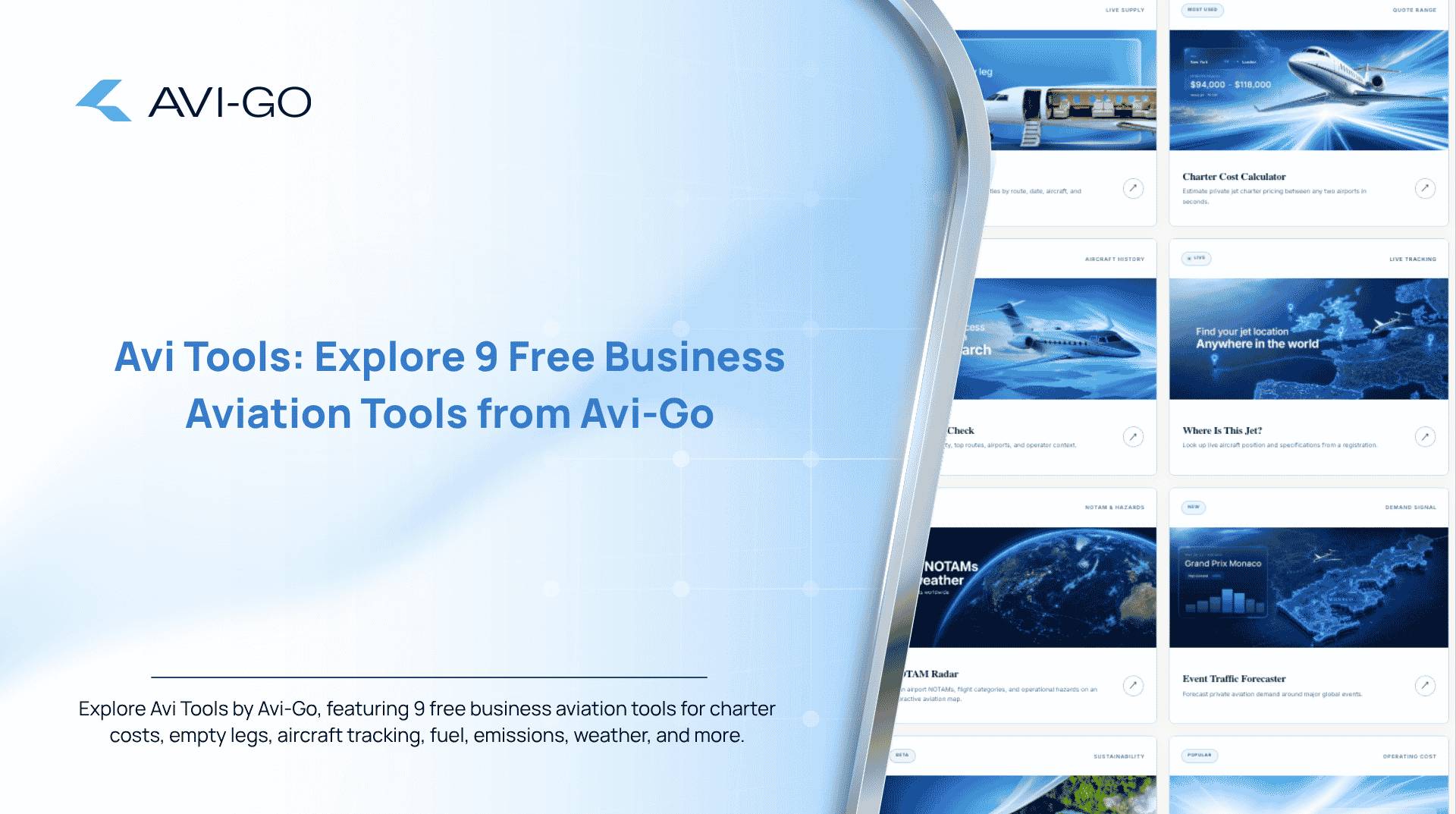
Avi Tools: Explore 9 Free Business Aviation Tools from Avi-Go

What Is Business Aviation and How Is It Different From Aviation?

What Are Aviation Business Brokers? Roles, Services and How to Choose One
Ready to Supercharge
Your Business Aviation Tech Stack with AI and Data?
Sign up free and start using the tools available in your chosen plan.
Discover how our aviation technology helps you work more efficiently and grow with confidence.
Subscribe to the Avi-Go Newsletter
Business aviation data, insights, and trends — trusted by 10,000+ professionals worldwide.