
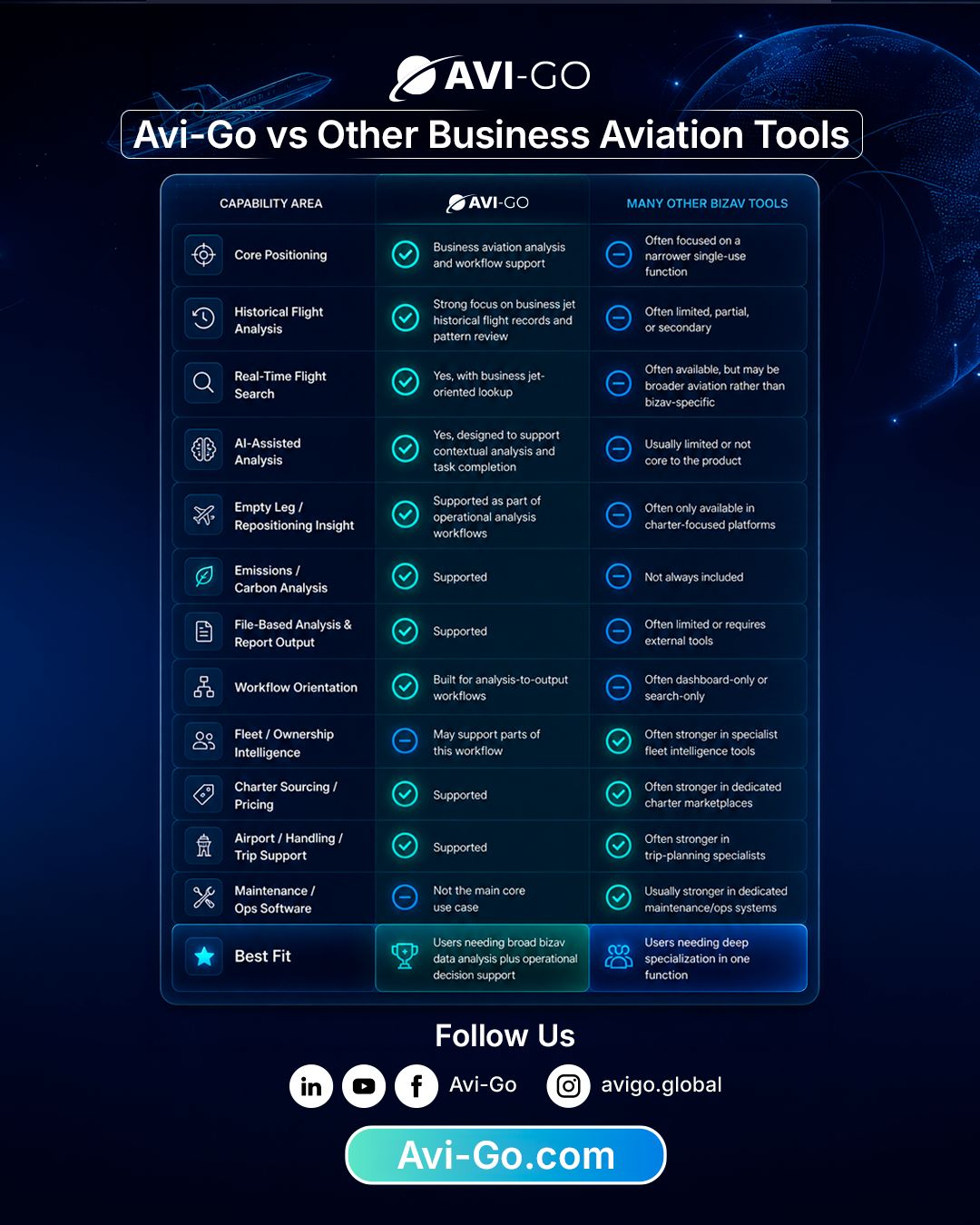
Avi-Go vs Other Business Aviation Platforms



Business aviation teams use digital platforms for many reasons: finding aircraft, tracking flights, reviewing operators, searching empty legs, preparing quotations, analyzing routes, and supporting client decisions. But not every business aviation platform is built for the same purpose.
Many tools focus on one specific function. Some are strong in flight tracking. Some are built mainly for charter sourcing. Others focus on fleet data, trip planning, maintenance, or operational management.
Avi-Go is different because it combines multiple business aviation workflows in one platform: flight data, aircraft search, trip board, empty legs, live flight tracking, aviation lookup, Avi-Go.AI, order management, and fleet tools.
Instead of helping users with only one part of the process, Avi-Go is designed to support the full journey from search to analysis, quotation, insight, and action.
Core Positioning: Broader Business Aviation Workflow Support
Many business aviation tools are designed around a narrow use case. A platform may be useful for tracking aircraft, checking fleet information, or sourcing charter options, but the user often needs other tools to complete the workflow.
Avi-Go is positioned as a broader business aviation platform. It supports data search, charter workflows, live tracking, empty legs, fleet visibility, and AI-assisted analysis in one connected environment.
This makes Avi-Go especially useful for users who do not only want to look up information. They want to understand the market, compare options, manage requests, and make faster decisions.
Historical Flight Analysis: Avi-Go Goes Deeper
Historical flight data is important because it helps users understand what has happened before: aircraft movements, route trends, airport activity, operator performance, and market demand.
Many other platforms may provide limited historical information, partial records, or data that needs to be interpreted manually.
Avi-Go gives stronger support for business jet historical flight analysis. Avi-Go.AI connects to a global database of historical business aviation flight records and can analyze departure and arrival trends, operator flight volume, airport traffic changes, aircraft utilization, route patterns, and event-related traffic anomalies.
This means users can move beyond “what happened?” and start asking “what does this pattern mean for the business?”
Real-Time Flight Search: Business Jet-Oriented Lookup
Real-time flight search is common in aviation platforms, but not all tools are built specifically around business aviation needs.
Some platforms show aircraft movement broadly across aviation. That can be useful, but business aviation users often need more context: aircraft status, operator information, airport activity, recent flights, and whether the aircraft is relevant for a charter or operational decision.
Avi-Go’s live flight tracking shows real-time global flight activity, aircraft status, flight paths, basic aircraft information, live operating status, and historical flights. Users can also search by city, airport, operator, or aircraft registration.
This makes the search experience more relevant for brokers, operators, and aviation teams that need business jet-focused information rather than general flight visibility.
AI-Assisted Analysis: From Search Results to Recommendations
Many platforms still work like databases. Users enter filters, receive results, and then need to analyze the information themselves.
Avi-Go.AI is designed to go further. It is positioned as an AI-native intelligence platform for business aviation, combining large language models, deep learning recommendations, and exclusive industry data.
The key difference is that Avi-Go.AI is not just a chatbot or a dashboard. It is designed to understand aviation questions, create an execution plan, use relevant tools, validate results, and produce structured answers.
For example, instead of only searching for available aircraft, a user can ask for a route analysis, aircraft recommendation, market trend, operator comparison, carbon calculation, or client-ready output.
Other tools may give data.
Avi-Go helps turn that data into decisions.
Empty Leg and Repositioning Insight: Built Into the Workflow
Empty leg opportunities are valuable in charter aviation, but they are often scattered across different sources or available only through charter-focused platforms.
Avi-Go includes empty leg search, filtering, inquiry submission, posting, and management. Users can search by conditions, filter by region, sort by price or departure date, review aircraft information, and submit inquiries directly.
Avi-Go.AI also includes Empty Leg Search, an intelligent matching tool connected to real-time empty leg inventory. It can broaden searches from city to country to region when needed and label match quality clearly.
This makes empty legs part of the broader decision workflow rather than a separate search activity.
Emissions and Carbon Analysis: Included for Smarter Aviation Decisions
Sustainability is becoming more important in business aviation. Some platforms do not include carbon analysis, while others may require separate tools or manual calculation.
Avi-Go.AI includes a flight carbon emissions calculator purpose-built for business aviation. It supports aircraft-type-specific emission factors, SAF reduction calculations, and ESG-compliant report formats.
This gives users a practical way to include emissions information in route analysis, client reporting, ESG discussions, and operational planning.
File-Based Analysis and Report Output: From Analysis to Deliverable
One major difference between Avi-Go and many other platforms is output.
Many tools stop at dashboards, tables, or search results. Users still need to copy data into documents, spreadsheets, or presentations.
Avi-Go.AI is designed to support file-based work and professional outputs. Users can upload files for analysis, export AI replies, and view data in table or chart formats.
Avi-Go.AI also includes a document generation suite for PDF, Word, Excel, and PPT outputs, supporting use cases such as client proposals, market analysis, ESG reports, internal memos, data tables, management briefings, and client presentations.
This is important because business aviation work often ends in a deliverable: a quote, a proposal, a report, or a management briefing.
Avi-Go supports that final step.
Workflow Orientation: Built for Analysis-to-Action
Some platforms are dashboard-only or search-only. They show information, but users still need to decide what to do next.
Avi-Go is more workflow-oriented. A broker can search aircraft, review a route report, submit inquiries, post to Trip Board, track quotation progress, search empty legs, and use Avi-Go.AI for deeper analysis.
This makes Avi-Go practical for real business aviation work, not just information lookup.
The platform is built around the idea that users should be able to move from question to result, and from result to action, with fewer disconnected steps.
Charter Sourcing and Pricing: Supported Within a Broader Platform
Dedicated charter marketplaces may be strong in sourcing and pricing, but they may not always include deeper market intelligence, AI analysis, historical flight review, emissions analysis, or report output.
Avi-Go supports charter workflows through Aircraft Search, Trip Board, quotation submission, inquiry tracking, and operator quotation management. Users can search for aircraft available to operate a trip, post requests to Trip Board, send inquiries, submit quotations, upload PDF quotations, and manage quotation status.
This gives Avi-Go a practical charter marketplace layer while still connecting it with broader flight data and intelligence features.
Fleet, Airport, Handling, and Trip Support: Useful, but Not the Only Focus
Some specialist tools may go deeper in areas such as fleet ownership intelligence, airport handling, trip planning, or maintenance software.
Avi-Go supports several of these areas, including aviation lookup for airport, operator, and aircraft data; FBO and ground handler information; fleet visibility; aircraft status; and operator profiles.
However, Avi-Go’s strongest value is not being a maintenance system or a single-function trip planning tool. Its strongest value is connecting business aviation data, charter workflows, AI insight, and operational decision support in one platform.
Conclusion: Avi-Go Is Built for Broader Business Aviation Decisions
Other business aviation platforms may be strong in one specific area: tracking, fleet data, charter sourcing, airport support, or maintenance operations.
Avi-Go stands out because it brings together many of the tools business aviation professionals need in one connected workflow.
It supports flight data, historical analysis, real-time search, charter marketplace activity, empty legs, emissions analysis, aviation lookup, fleet visibility, AI insights, and professional report output.
For users who need deep specialization in one narrow function, a specialist platform may still be useful.
But for brokers, operators, analysts, and aviation teams that need a broader platform for business aviation decisions, Avi-Go offers a more complete solution.
Avi-Go is not just another business aviation tool.
It is a business aviation platform built to help users search, analyze, compare, quote, report, and act with confidence.

Private Jet Charter Cost Estimator and Airline Price Predictor


Best Private Jet Charter Companies 2026

Private Jet Sustainability
Ready to Supercharge
Your Business Aviation Tech Stack with AI and Data?
Sign up free and start using the tools available in your chosen plan.
Discover how our aviation technology helps you work more efficiently and grow with confidence.
Subscribe to the Avi-Go Newsletter
Business aviation data, insights, and trends — trusted by 10,000+ professionals worldwide.