
Benefits of Sustainable Aviation Fuel and the Future of Alternative Fuel Aircraft


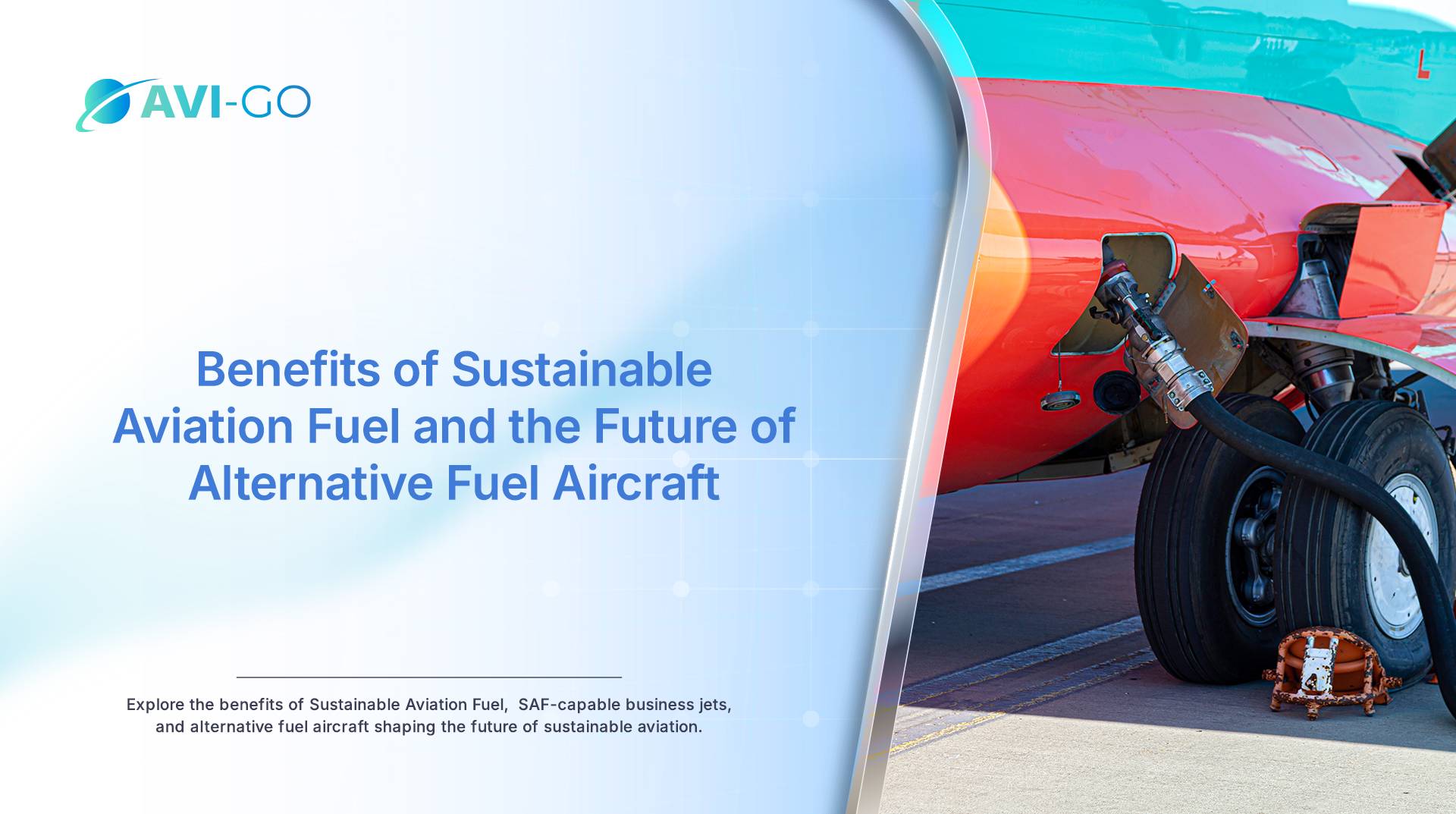
Sustainability is becoming one of the most important topics in aviation. For business aviation in particular, operators, aircraft owners, charter companies, and corporate flight departments are under growing pressure to reduce emissions while maintaining the flexibility, speed, and reliability that private aviation requires.
Two solutions are now at the center of this transition: Sustainable Aviation Fuel, often called SAF, and the development of alternative fuel aircraft. SAF is already being used in existing aircraft, while technologies such as hydrogen-powered aircraft are still developing for the longer term.
For business aviation, the practical question is not only what sounds sustainable, but what can actually work today. Based on current market conditions, SAF is the most realistic near-term decarbonization tool for private jets, while hydrogen and other alternative fuel aircraft concepts represent the next stage of aviation sustainability.
What Is Sustainable Aviation Fuel?
Sustainable Aviation Fuel is an alternative jet fuel made from renewable or lower-carbon feedstocks. These can include used cooking oil, agricultural waste, municipal waste, or other non-fossil sources depending on the production pathway.
The most important feature of SAF is that it is a drop-in fuel. This means approved SAF blends can be used in existing aircraft engines and airport fueling infrastructure without requiring major aircraft modifications. For business aviation, this is a major advantage because most private jet fleets can begin using SAF without waiting for a completely new aircraft generation.
Avi-Go’s business aviation glossary defines SAF as a sustainable aviation fuel used to reduce carbon emissions, and Avi-Go’s product positioning also highlights carbon and SAF-related analysis as part of business aviation sustainability planning.
Key Benefits of Sustainable Aviation Fuel
1. SAF Can Reduce Lifecycle Greenhouse Gas Emissions
The biggest benefit of Sustainable Aviation Fuel is its potential to reduce lifecycle greenhouse gas emissions. Depending on the feedstock and production pathway, SAF can deliver up to 80% lower lifecycle greenhouse gas emissions compared with conventional jet fuel.
This matters because aviation emissions are not only measured at the aircraft exhaust level. Lifecycle emissions also consider how the fuel is produced, processed, transported, and used. When SAF is produced from sustainable feedstocks and managed through certified pathways, it can significantly reduce the overall carbon footprint of flight operations.
For business aviation, where many flights are high-value and carbon reporting expectations are increasing, this makes SAF one of the most important sustainability tools available today.
2. SAF Can Improve Local Air Quality
SAF can also help reduce certain local air pollutants. Compared with conventional jet fuel, SAF generally produces lower particulate matter and sulfur oxide emissions.
This is especially relevant at airports, FBOs, and private aviation terminals where local air quality is part of broader environmental performance. While SAF does not eliminate all aircraft emissions, it can reduce some pollutants associated with traditional fossil jet fuel.
3. SAF Works With Today’s Aircraft
One of SAF’s strongest advantages is practical compatibility. Approved SAF blends can be used with existing aircraft, engines, fueling systems, and airport infrastructure.
That makes SAF especially important for business aviation. Private jet fleets are expensive, long-life assets. Operators cannot simply replace entire fleets overnight with new aircraft technology. SAF allows operators to reduce emissions using aircraft that are already in service.
This is why SAF-capable aircraft are currently the most commercially relevant category of alternative fuel aircraft for business aviation.
4. SAF Supports Business Aviation Sustainability Goals
Business aviation sustainability is no longer just about public image. It is increasingly connected to customer expectations, ESG reporting, corporate travel policies, regulatory pressure, and aircraft operating strategy.
Avi-Go data shows that SAF adoption in private aviation remains early-stage rather than mainstream, but adoption is strongest among major fractional, charter, and managed fleet operators. These include operators such as NetJets Aviation, Flexjet, NetJets Europe, VistaJet, Wheels Up, Solairus Aviation, Jet Linx Aviation, and flyExclusive, where scale, procurement leverage, and customer sustainability expectations are higher.
This pattern suggests that SAF adoption is likely to grow first among larger, more visible operators before spreading across the broader private aviation market.
Why SAF Matters for Business Aviation
Business aviation has a unique sustainability challenge. It serves high-value, time-sensitive missions, often with smaller passenger loads than commercial aviation. At the same time, many users of private aviation are corporations, executives, family offices, and high-net-worth travelers who are increasingly aware of carbon impact.
SAF is important because it offers a way to reduce emissions without changing the core operating model of business aviation.
According to Avi-Go’s supporting data, global business-flight departures in the database show a large addressable market for SAF. Sample monthly business-flight activity included 244,990 flights in March 2026 and 219,844 flights in April 2026, showing the scale of private aviation activity where even modest SAF penetration could have meaningful emissions impact.
Avi-Go data also shows that light jets have the largest pure jet movement volume, while heavy jets and ultra-long-range aircraft are especially relevant for SAF adoption because they typically have higher fuel burn, greater customer visibility, and stronger carbon reporting pressure.
In practical terms, this means SAF matters in two ways:
First, broad adoption among light and midsize jets can help scale sustainability across the market.
Second, targeted adoption among heavy and ultra-long-range aircraft can produce a larger emissions benefit per flight because these aircraft usually consume more fuel.
SAF Adoption Is Growing, But Still Limited
SAF use is increasing, but it is still far from universal. One of the strongest signs of market momentum is that major operators and manufacturers are already demonstrating SAF use in real-world operations. For example, Gulfstream’s fleet exceeded 3 million nautical miles flown on SAF blends by October 2025, showing that SAF is not only theoretical but already active in business aviation operations.
Regulation is also accelerating adoption. Under the EU ReFuelEU Aviation framework, the minimum SAF supply mandate starts at 2% in 2025 and rises progressively to 70% by 2050. This type of policy is expected to support supply agreements, airport-level availability, and broader industry adoption over time.
However, SAF still faces two major barriers.
The first is supply. SAF production remains less than 1% of global jet fuel demand, meaning availability is limited and uneven across airports.
The second is cost. SAF is typically around 2 to 4 times more expensive than conventional jet fuel. For operators, this means SAF adoption often depends on customer willingness to pay, corporate sustainability requirements, incentives, or book-and-claim programs.
Avi-Go’s SAF supplier analysis also shows that private jet users often need to distinguish between upstream producers and the FBOs or distributors that actually enable fuel uplift. For example, Neste is highlighted as a major upstream supplier, while Signature Aviation, Avfuel, and Jetex/Shell are especially relevant for real-world private aviation SAF access.
What Are Alternative Fuel Aircraft?
Alternative fuel aircraft are aircraft designed or approved to use fuels other than traditional fossil-based jet fuel. In the current aviation market, this category includes several different pathways:
- Existing aircraft using SAF blends
- Hydrogen-powered aircraft under development
- Electric or hybrid-electric aircraft for shorter missions
- Future aircraft concepts using advanced propulsion systems
For business aviation, the most important distinction is between what is available now and what may become viable in the future.
SAF-Capable Aircraft: The Alternative Fuel Aircraft Available Today
For private aviation, the most practical alternative fuel aircraft today is not necessarily a new aircraft design. It is an existing business jet operating on approved SAF blends.
This matters because no major airframe redesign is required. Operators can use current aircraft, current engines, existing airport fuel systems, and standard operating procedures.
That makes SAF-capable business jets the most commercially relevant alternative fuel aircraft category in the near term.
Avi-Go’s data shows that aircraft brands such as Bombardier, Gulfstream, Dassault, and Embraer are especially relevant to premium charter and long-range SAF programs, while Cessna and Hawker Beechcraft matter for broader market scale because of their high activity volume across the operating base.
Hydrogen-Powered Aircraft: A Longer-Term Alternative
Hydrogen is one of the most promising long-term alternative fuel pathways in aviation. Recent research indicates that hydrogen-based aircraft systems could reduce emissions by up to 74.7% while approaching conventional-fuel performance in some mission profiles.
The potential is significant. Hydrogen can be used either through combustion systems or fuel cells, depending on the aircraft design. If the hydrogen is produced using low-carbon methods, it could support major emissions reductions.
However, hydrogen-powered aircraft are not yet a near-term operational solution for most business aviation use cases.
There are several major challenges:
Hydrogen requires cryogenic storage, which means fuel must be stored at extremely low temperatures. This creates aircraft integration challenges.
Hydrogen also has lower volumetric energy density than conventional jet fuel, meaning it requires larger storage volume. For business jets, where cabin space, range, and payload are highly valuable, this is a major design issue.
Airport infrastructure is another challenge. Hydrogen aircraft would require new fueling systems, storage facilities, safety procedures, and maintenance standards.
Certification and operational maturity are also still developing. Aviation is highly regulated, and new propulsion systems must prove safety, reliability, and commercial practicality before widespread adoption.
SAF vs Hydrogen: Which Is More Practical for Business Aviation?
For business aviation, SAF and hydrogen should not be viewed as direct competitors in the short term. They are better understood as solutions for different time horizons.
SAF is the near-term solution. It works with today’s aircraft, engines, airports, and operating procedures. It can reduce lifecycle emissions now, even though cost and supply remain barriers.
Hydrogen is a longer-term solution. It has strong emissions-reduction potential, but it requires new aircraft designs, new infrastructure, new certification pathways, and a mature operational ecosystem.
From a practical business aviation perspective, SAF is the leading sustainability solution now through the late 2020s. Hydrogen may become more relevant in the medium to long term, but it is not yet ready to replace conventional jet fuel for most private jet operations.
Conclusion
Sustainable Aviation Fuel is currently the most practical sustainability solution for business aviation. It can deliver up to 80% lower lifecycle greenhouse gas emissions, improve certain local air-quality outcomes, and work with existing aircraft and airport infrastructure.
For private jet operators, this makes SAF the most realistic near-term pathway to lower-emission flying. The main barriers are still cost and supply, with SAF typically costing 2 to 4 times more than conventional jet fuel and representing less than 1% of global jet fuel demand.
Alternative fuel aircraft will also play an important role in the future. Hydrogen-powered aircraft are especially promising, with potential emissions reductions of up to 74.7%, but they still face major challenges around storage, aircraft design, airport infrastructure, certification, and commercial readiness.
For now, the business aviation sustainability roadmap is clear: SAF leads the near-term transition, while hydrogen and other alternative fuel aircraft technologies shape the longer-term future.
As adoption grows, platforms like Avi-Go can help aviation professionals understand where SAF matters most, which operators and aircraft segments are most relevant, and how sustainability decisions connect to real business aviation activity.
SAF Adoption Among Private Jet Operators Is Growing But Still Led by a Small Group of Major Players

Comparing Sustainable Aviation Fuel Suppliers for Private Jets
Top 5 Most Fuel Efficient Private Jets in 2026
Ready to Supercharge
Your Business Aviation Tech Stack with AI and Data?
Sign up free and start using the tools available in your chosen plan.
Discover how our aviation technology helps you work more efficiently and grow with confidence.
Subscribe to the Avi-Go Newsletter
Business aviation data, insights, and trends — trusted by 10,000+ professionals worldwide.