
Business Jet Activity During the Strike Window on Iran


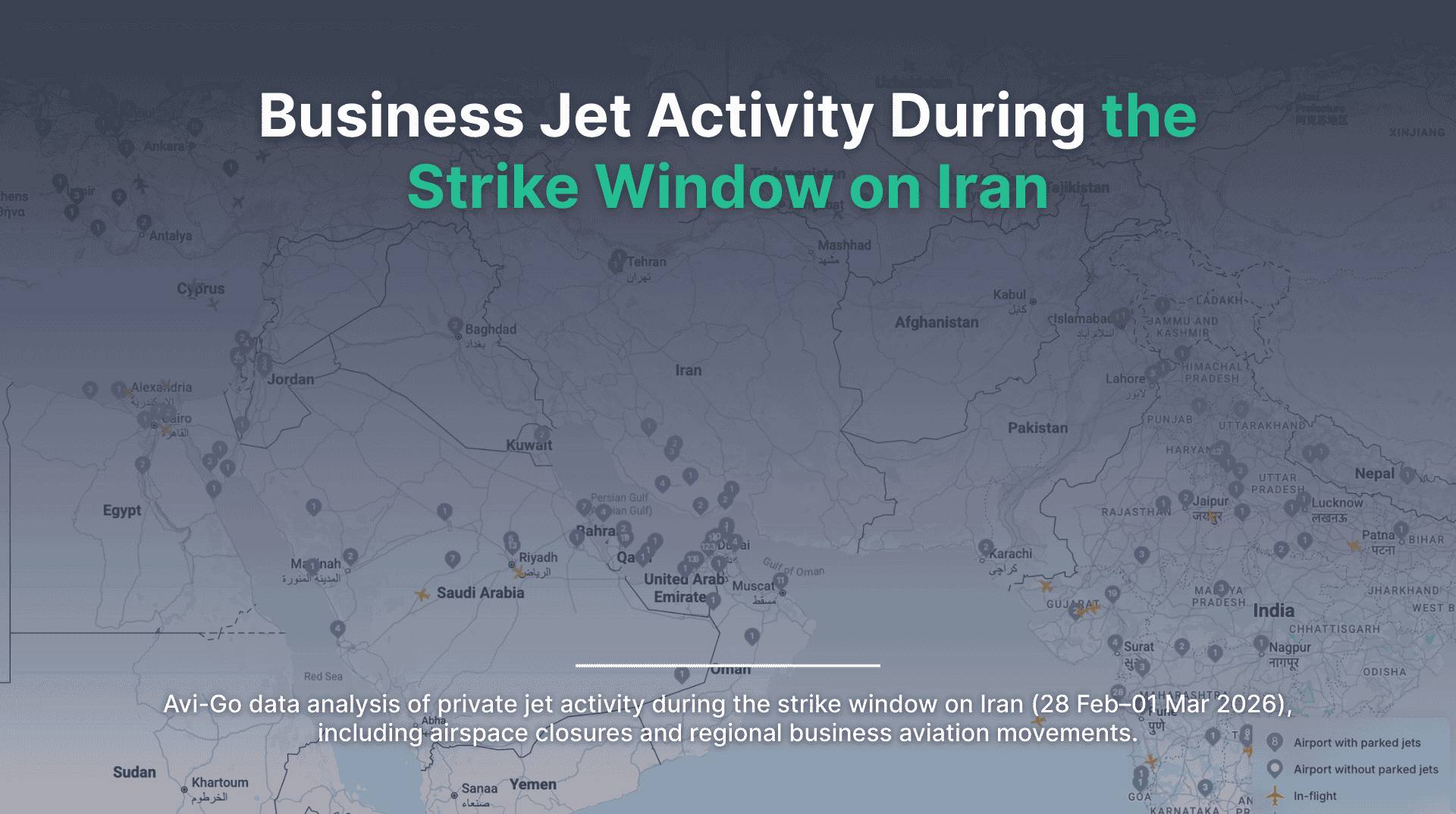
28 February – 01 March 2026 (UTC)
Source: Avi-Go Database
During the 48-hour window following the US–Israel strike activity involving Iran (28 Feb–01 Mar 2026 UTC), business aviation movement data indicates a significant suppression of realized traffic directly touching Iran, alongside widespread regional airspace restrictions.
Iran (Tehran) Realized Movements
According to Avi-Go movement data, there were zero recorded business jet departures and zero arrivals in Tehran on both 28 February and 1 March 2026 (UTC). In practical terms, no business aviation activity was captured in or out of Tehran during the two-day window.
In business aviation analysis, demand is typically proxied by actual flown movements. While underlying travel needs may still exist, the absence of recorded flights indicates that realized demand into Iran was effectively suppressed during this period.
Regional Airspace Restrictions
As of the same timeframe, multiple countries across the region were subject to flight suspensions or airspace closures due to active conflict conditions.
Iran
- Active military conflict following U.S.–Israel strikes with ongoing retaliatory attacks.
- Tehran and other major cities are experiencing bombardment.
- Civilian aviation operations are deemed extremely high risk.
- Effect time: Indefinite; conflict ongoing.
Iraq
- Airspace fully closed due to proximity to Iran and risk of missile or military activity.
- Flight tracking indicated empty overflight corridors.
- Effect time: Estimated minimum 1–2 weeks, subject to developments.
Syria
- Commercial carriers suspended operations due to regional spillover risk.
- Effect time: Suspended until at least Monday, subject to extension.
United Arab Emirates
- Dubai International (DXB) and Al Maktoum (DWC) airports closed following reported missile strikes.
- Airspace restrictions and airport shutdowns impacted inbound/outbound traffic.
- Effect time: Closure ongoing; reopening timeline pending security review.
Qatar
- Hamad International Airport suspended operations.
- The national carrier temporarily halted flights amid airspace closure.
- Effect time: Estimated 3–7 days pending stabilization.
Kuwait
- Kuwait International Airport operations suspended.
- Airspace was largely inactive during the period.
- Effect time: Estimated 5–10 days depending on de-escalation.
Bahrain
- Bahrain International Airport closed amid reported missile activity.
- Airspace deemed unsafe for civilian aviation.
- Effect time: Indefinite pending cessation of hostilities.
Nearby Alternates
In previous Middle East escalations, business aviation demand typically shifted toward alternate hubs such as Dubai, Abu Dhabi, Doha, Muscat, Riyadh, Jeddah, Larnaca, Athens, or Istanbul.
However, given that several Gulf hubs were simultaneously restricted during this window, traditional displacement corridors were themselves constrained.
Within the extracted 48-hour dataset, no measurable spike in recorded business-aviation arrivals or departures was captured across the listed alternates.
A short two-day window may not fully reflect displacement behavior. In similar scenarios, demand shifts often appear through pre-positioning 12–72 hours prior, short-notice clustering, or movements into more distant unaffected regions. A broader 7–14 day comparison would be required to quantify these effects.
Conclusion
For the 48-hour window of 28 February – 01 March 2026, business aviation activity touching Iran was effectively halted, with zero recorded movements in or out of Tehran. At the same time, multiple Gulf and neighboring states implemented airspace closures or operational suspensions, limiting immediate rerouting options within the region.
However, as of 2 March 2026, Avi-Go Live Flight Tracking has captured limited private jet activity gradually resuming within parts of the broader region.
For stakeholders seeking real-time visibility into aircraft movements, airspace conditions, and operational activity, Avi-Go Live Flight Tracking provides up-to-date monitoring of global business aviation traffic as situations evolve.
Our thoughts are with everyone affected by the situation. We sincerely hope for safety, stability, and a peaceful resolution.

Private Jet Charter Cost Estimator and Airline Price Predictor


Best Private Jet Charter Companies 2026

Private Jet Sustainability
Ready to Supercharge
Your Business Aviation Tech Stack with AI and Data?
Sign up free and start using the tools available in your chosen plan.
Discover how our aviation technology helps you work more efficiently and grow with confidence.
Subscribe to the Avi-Go Newsletter
Business aviation data, insights, and trends — trusted by 10,000+ professionals worldwide.