
Q1 2025 Snapshot: What’s Driving Europe’s Business Aviation Market?


Intro: Europe’s Jet Market Takes Off — But Where, and Why?
Business aviation in Europe opened 2025 with a steady, measured start.
Compared to Q1 2024, the market showed a slight upward trend year over year, signaling underlying resilience — but the overall pace remained modest. Activity pulled back from the busier Q4 2024, which had seen a seasonal lift from winter holiday travel, end-of-year business movement, and major events across the continent.
This Q1 slowdown isn’t unusual. It reflects the typical drop-off after the peak holiday period, especially in regions tied to luxury tourism and leisure travel. Still, the year-on-year numbers suggest that core demand — especially for business-driven charter flights — continues to hold steady or grow slightly, even in a cooling macroeconomic climate.
While the top-level numbers may look flat, the real story is in the detail. Some countries and cities are quietly gaining ground, others losing momentum. Aircraft preferences are shifting. Routes are evolving. And behind every trend is a mix of business activity, geopolitical movement, and changing traveler expectations.
We’ve unpacked the latest Q1 2025 data from Avi-Go Data Hub to explore what’s really happening — and where the next lift might come from.

Where the Demand is: Top 5 Countries and Cities for Private Charters
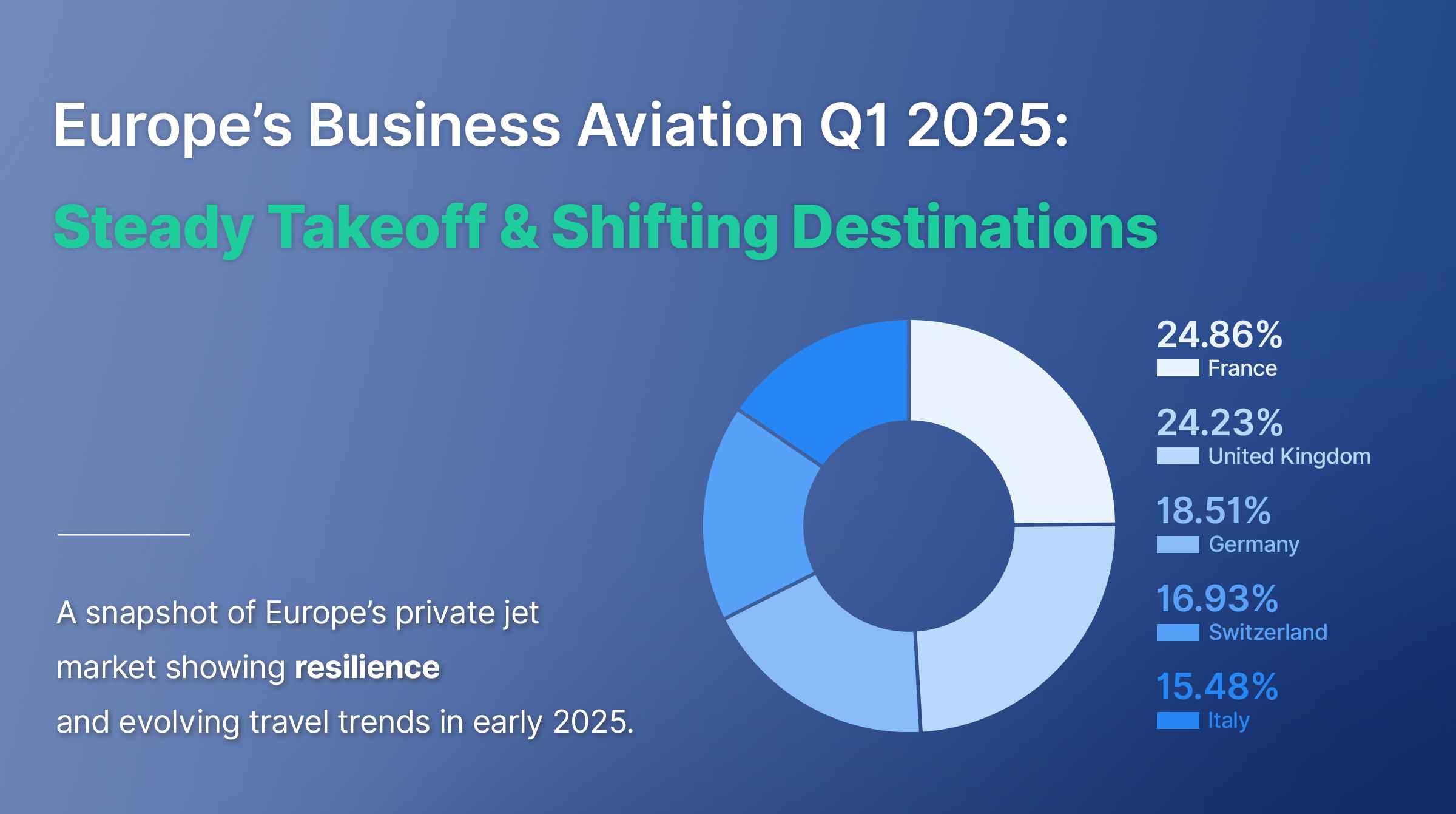
In Q1 2025, the European business aviation sector exhibited a nuanced landscape. While overall activity remained relatively steady compared to the previous year, certain cities and countries stood out as primary hubs for private charter departures. According to data from Avi-Go Data Hub, the top five departure cities were Paris, London, Geneva, Milan, and Nice, with France, the United Kingdom, Germany, Switzerland, and Italy leading at the country level.
Population and Market Base
Larger urban populations tend to correlate with higher concentrations of high-net-worth individuals and corporate activity — key drivers of private aviation. For example, Paris, which tops the departure city list, has a metro population estimated at over 11.3 million in 2025, making it the largest urban area in France (World Population Review, 2025). London, another high-ranking city, is home to around 9.8 million people, reinforcing its role as a critical node for global finance and executive mobility (World Population Review, 2025).
While smaller in population, Geneva — with approximately 645,000 residents (World Population Review, 2025) — punches above its weight due to its concentration of international institutions and financial centers. Milan and Nice each serve distinct roles, with Milan’s 3.2 million metropolitan residents driving business-related travel (World Population Review, 2025) and Nice benefiting from affluent seasonal tourism, supported by its 956,000 residents (World Population Review, 2025).
Nationally, these demand centers reflect the broader scale of activity: Germany leads in population with 83.2 million (Macrotrends, 2025), followed by the UK (68.2 million), France (65 million), Italy (58.5 million), and Switzerland (8.9 million) — all among Europe’s largest economies and most mature aviation markets.
Airport Infrastructure and Jet Availability
Airport access plays a vital role in enabling frequent departures. Paris’s Le Bourget Airport continues to hold its title as Europe’s busiest for business aviation, offering specialized FBOs and runway access designed for private jets. London, by contrast, benefits from a multi-airport ecosystem — including Luton, Farnborough, and Stansted — which collectively handle a substantial volume of charter operations.
In Geneva, the centrally located airport provides a business-class gateway to international and diplomatic hubs, while Milan’s Linate and Malpensa airports offer seamless connections for executives in fashion, finance, and manufacturing. Nice Côte d’Azur Airport, meanwhile, stands out during the winter holiday and spring event seasons, serving the French Riviera’s luxury travel clientele.
A noteworthy element across all five cities is the high concentration of home-based aircraft, which not only ensures availability but also incentivizes operators to base fleets in areas with steady demand — reinforcing a feedback loop of more frequent departures from established hubs.
Economic and Strategic Influence
Behind the demand lies the economic weight of these cities. Paris and Milan are core nodes for luxury, banking, and international commerce. London maintains a robust post-Brexit finance sector and still commands strong global influence across sectors like asset management, tech, and legal services. Geneva’s unique diplomatic ecosystem — hosting both the United Nations and numerous NGOs — continues to generate executive travel, while Nice remains a consistent draw for seasonal luxury travelers and second-home owners.
Beyond the raw numbers, this pattern highlights how business travel is not just a byproduct of population or geography, but a reflection of deep-rooted institutional and commercial infrastructure. It’s also worth noting that several of these cities are also key arrival points, indicating strong inbound and outbound demand symmetry — especially where long-haul travel and intercontinental links are involved.
Flights Up or Down? YoY Movement in Departure Volumes
In the first quarter of 2025, European business aviation departures experienced a modest 1.45% increase compared to Q1 2024. However, this slight uptick follows a 6.89% decrease from Q4 2024, a decline that aligns with the typical post-holiday season slowdown.
This marginal YoY growth suggests a stabilization in business aviation demand across Europe. While the overall increase is minimal, it indicates resilience in the sector amidst various challenges.
Notably, regional variations were observed:
- Germany faced a significant decline, with business jet departures dropping by 19% in early March 2025 compared to the same timeframe in 2024 according to Private Jet Card Comparisons.
- Conversely, Italy stood out, recording its busiest March for business jet activity in the last five years, with a 5% increase compared to the previous year.
These variations underscore the influence of regional economic conditions and seasonal factors on business aviation demand. The overall stability in departure volumes suggests that, despite localized fluctuations, the European business aviation market is maintaining a steady course.
Destination Watch: Where Europe’s Jets Are Heading
In Q1 2025, the top five private jet destinations in Europe remained consistent with the previous year: Paris, Milan, Geneva, London, and Nice. This stability underscores the enduring appeal of these cities for both business and leisure travelers.
Paris continues to be a central hub for international business, fashion, and cultural events. The city's prominence in hosting major conferences and exhibitions contributes to its sustained demand in private aviation.
Milan maintains its status as Italy's financial and fashion capital, attracting executives and luxury travelers alike. The city's robust economic activities and events like Milan Fashion Week play a significant role in its steady private jet traffic.
Geneva serves as a nexus for international diplomacy and finance. While the World Economic Forum (WEF) in Davos typically boosts traffic in January, the city's year-round appeal ensures consistent demand.
London remains a pivotal center for global finance and commerce. Despite economic fluctuations, the city's diverse business landscape sustains its position as a top destination for private aviation.
Nice, as the gateway to the French Riviera, continues to attract leisure travelers, especially during events like the Cannes Film Festival and the Monaco Grand Prix. The city's allure for luxury tourism contributes to its persistent popularity.
The consistency in these destinations reflects entrenched patterns in European private jet travel, driven by established economic centers and luxury leisure locales.
What’s Being Flown: Aircraft Trends Worth Watching
In Q1 2025, Europe's private aviation sector exhibited a clear preference for specific aircraft types, reflecting the region's diverse travel demands.
Top 5 Aircraft Types by Flight Volume
Based on the data Avi-Go provided, the most utilized aircraft types for flights to and from Europe were:
- Pilatus PC-12 (Turboprop): 5,851 flights
- Citation XLS+ (Midsize Jet): 3,467 flights
- Challenger 350 (Super Midsize Jet): 3,019 flights
- Phenom 300 (Light Jet): 3,001 flights
- Citation XLS (Midsize Jet): 2,646 flights
The dominance of the Pilatus PC-12 underscores its versatility and efficiency for regional travel. Its ability to operate from shorter runways and its cost-effectiveness make it a popular choice for intra-European routes.
The strong presence of midsize and super midsize jets, such as the Citation XLS+ and Challenger 350, indicates a robust demand for aircraft capable of longer-range missions. These jets are well-suited for transcontinental flights, offering the range and comfort required for such journeys.
The Phenom 300, a light jet, maintains its popularity due to its speed, range, and operational efficiency, making it ideal for shorter hops across the continent.
This distribution of aircraft usage reflects Europe's position as a central hub for both regional and long-haul business aviation, necessitating a diverse fleet to meet varying travel requirements.
Market Movers: What’s Driving These Shifts?
In Q1 2025, Europe's business aviation sector experienced a modest year-over-year growth of 1.45% in departure volumes. This stability reflects a complex interplay of economic activities, geopolitical developments, and evolving travel patterns.
A significant factor influencing the industry is the recent trade tensions between the United States and the European Union. In May 2025, President Donald Trump announced a proposed 50% tariff on EU imports, citing stalled trade negotiations. Although the implementation was delayed until July 9 following discussions with European Commission President Ursula von der Leyen, the uncertainty has already impacted market sentiments, particularly in sectors like aerospace and automotive.
Concurrently, major events such as the European Business Aviation Convention & Exhibition (EBACE) held in Geneva from May 20–22, 2025, have played a role in sustaining business aviation activities. These gatherings not only showcase advancements in the industry but also facilitate networking and strategic planning among stakeholders.
Additionally, there has been a noticeable increase in private jet travel to emerging markets in the Middle East and North Africa, driven by corporate expansions and international events. This shift indicates a strategic realignment in business operations and networking priorities.
Overall, Europe's business aviation landscape in Q1 2025 reflects resilience amid external pressures, with steady demand supported by economic activities, industry events, and adaptive travel strategies.
Takeaways & What to Watch in Q2
As we look ahead to the second quarter of 2025, several key trends stand out for operators, brokers, and stakeholders in European business aviation. While Q1 showed modest growth, the approaching summer season is expected to bring increased activity, especially across the Mediterranean region.
Milan continues to solidify its position as a major hub for business and luxury travel, alongside emerging cities like Madrid that are gaining traction. Ignoring these markets could mean missing out on valuable opportunities as demand shifts.
There’s also a noticeable tilt toward midsize jets, reflecting a renewed focus on cost-efficiency among clients who are balancing travel needs with tighter budgets. This suggests operators should consider optimizing fleets to meet these evolving preferences.
Lastly, charter traffic is poised for a significant uptick as summer luxury events—such as the Cannes Film Festival and Monaco Grand Prix—draw affluent travelers to Europe’s sun-soaked coasts. Being prepared for this seasonal surge will be critical to maximizing revenue and service excellence.
Overall, Q2 looks set to build on the steady foundations of Q1, with growing momentum fueled by strategic markets, aircraft choices, and the vibrant event calendar across the continent.


Exploring Innovation and Sustainability at EBACE 2025: Key Takeaways for the Air Charter Marketplace


Luxury Sells: A Broker’s Guide to Private Jet Amenities That Win Clients

Private Jet Charter Cost Estimator and Airline Price Predictor
Ready to Supercharge
Your Business Aviation Tech Stack with AI and Data?
Sign up free and start using the tools available in your chosen plan.
Discover how our aviation technology helps you work more efficiently and grow with confidence.
Subscribe to the Avi-Go Newsletter
Business aviation data, insights, and trends — trusted by 10,000+ professionals worldwide.