
Jet Number Explained: How to Find, Read and Track a Private Jet by Tail Number


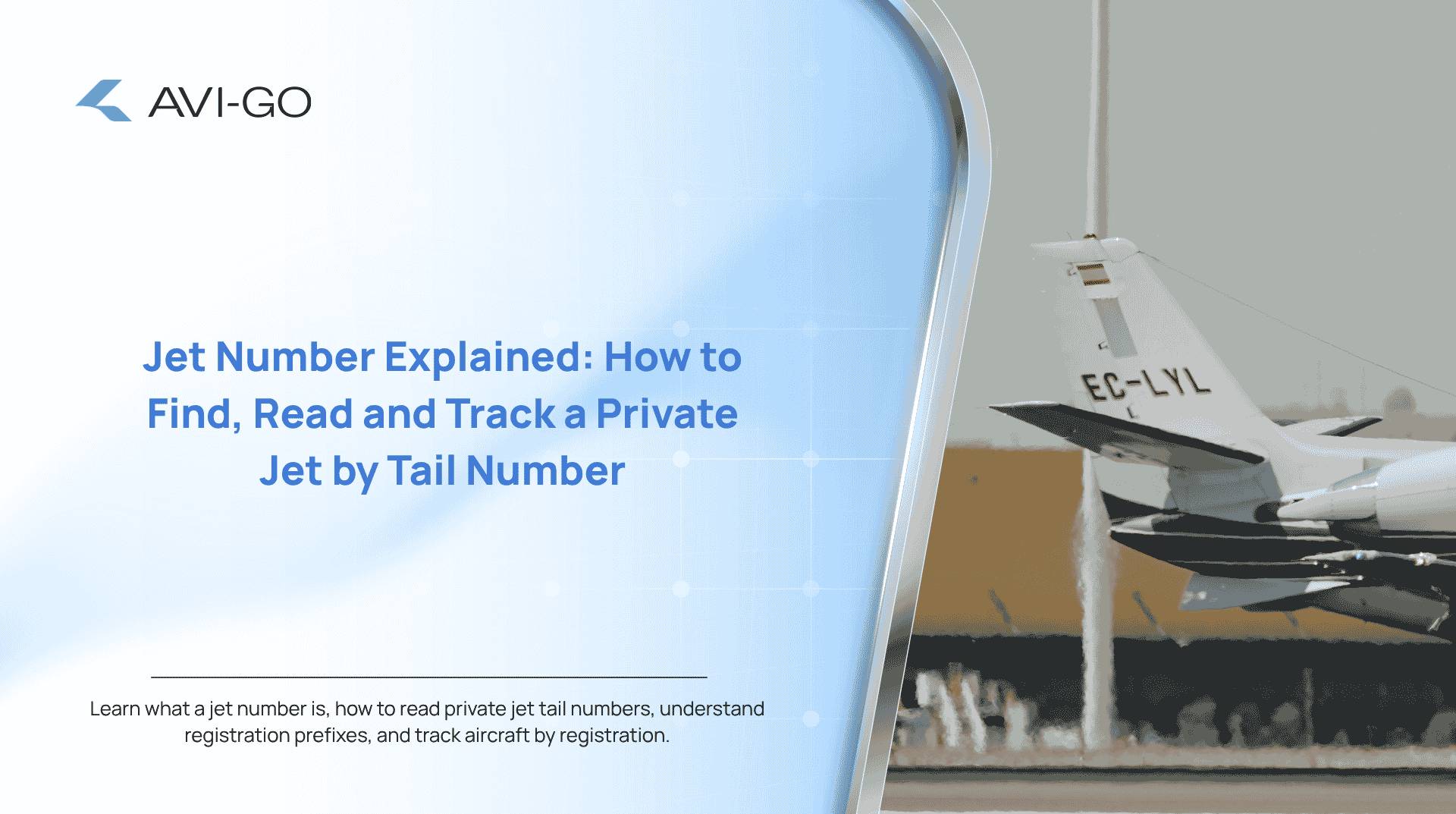
What is the number painted on the side or tail of a private jet?
It is usually the aircraft's registration number, more commonly called its tail number. Some people also refer to it informally as a jet number.
That short combination of letters and numbers can tell you more than you might expect. It can indicate where an aircraft is registered, distinguish one jet from another, and provide a starting point for following its flight activity.
But a tail number is not the same thing as a flight number, serial number or callsign and knowing the difference is important when you are trying to identify or track a private aircraft.
Here is how jet numbers work, how to read them and how they are used in private jet tracking.
What Is a Jet Number?
“Jet number” is not the formal aviation term, but people commonly use it when referring to the identifying number displayed on a private jet.
The correct term is usually:
- aircraft registration number
- aircraft registration
- tail number
For US-registered aircraft, you may also hear the term N-number because US registrations begin with the letter N.
An aircraft registration functions somewhat like a vehicle registration plate: it provides a recognizable identifier for an individual aircraft.
International standards for aircraft nationality and registration marks are established through ICAO Annex 7. The first part of the registration identifies the aircraft's country or jurisdiction of registration, while the remaining characters distinguish the individual aircraft.
Why Is It Called a Tail Number?
“Tail number” is an informal aviation term that developed because aircraft registrations are often displayed toward the rear of the aircraft.
On a private jet, the registration may appear on the:
- rear fuselage
- vertical tail
- area close to the engines
- side of the aircraft toward the aft section
The exact placement varies depending on the aircraft and the applicable registration requirements.
So when someone asks for a private jet's “tail number,” they are generally asking for its registration.
How to Read a Private Jet Tail Number
The easiest way to understand an aircraft registration is to separate it into two parts:
Nationality mark + individual registration
For example:
N123AB
N indicates that the aircraft is registered in the United States.
123AB identifies the individual aircraft within that registration system.
Another example:
G-ABCD
G indicates a United Kingdom registration.
The remaining characters identify that particular aircraft.
And:
A6-ABC
A6 is the nationality mark used by the United Arab Emirates.
This means the first characters of a jet number can quickly tell you where the aircraft is registered.
They do not necessarily tell you where the aircraft is based, who regularly uses it or where it normally operates.
Common Private Jet Registration Prefixes
Business jets routinely cross borders, so private aviation professionals often encounter registration marks from many different jurisdictions.
Some common examples include:

These prefixes are especially useful when looking at an unfamiliar jet because they provide an immediate clue to its registration jurisdiction.
However, registration should not be confused with operating location.
A jet carrying a Maltese, US or Isle of Man registration, for example, could spend much of its flying time elsewhere.
Jet Number vs Flight Number: What's the Difference?
A tail number identifies the aircraft.
A flight number identifies a flight operation.
That distinction becomes particularly important when tracking private aviation.
For example:
N123AB might identify one specific private jet.
An operational flight number or callsign used by that aircraft can vary from one journey to another.
A simple way to remember the difference is:
Tail number: Which aircraft is this?
Flight number: Which flight is being operated?
For scheduled airlines, passengers usually follow flight numbers because the same service may operate every day.
For private aviation, the aircraft registration is often a more useful starting point when you want to follow one particular jet.
Is a Tail Number the Same as an Aircraft Serial Number?
No.
A private jet can have both a registration number and a manufacturer serial number.
They serve different purposes.
The registration is issued through an aircraft registry and can change during the aircraft's life.
The serial number is assigned by the manufacturer and normally remains connected to that aircraft throughout its life.
For example, an aircraft could have:
Registration: N123AB
Manufacturer: Gulfstream
Model: G650ER
Serial number: 6XXX
If the aircraft is later exported to another country, its registration could change while its manufacturer serial number remains the same.
This is why aviation researchers often use serial numbers when they need to follow an aircraft across multiple registrations.
If your goal is specifically to search a registration and discover an aircraft's model, specifications or history, see our guide on how to search a tail number and find aircraft details.
Can a Private Jet's Tail Number Change?
Yes.
A registration is not necessarily permanent.
An aircraft may receive a different tail number when it:
- moves from one national register to another
- is imported or exported
- changes registration assignment
- receives a requested or personalized registration
- changes its ownership or registration structure
That means the same physical aircraft can appear under several registrations over its lifetime.
This is particularly relevant when researching older aircraft movements.
Searching only the current tail number can show you part of the picture, while the aircraft's serial number can help connect its different identities over time.
Can You Tell Where a Private Jet Is Based From Its Tail Number?
Not reliably.
A registration tells you where the aircraft is registered, not necessarily where it lives.
Consider a private jet with an American N-number.
It may be registered in the United States but routinely operate between Europe, the Middle East and Asia.
Likewise, an aircraft registered in Malta or the Isle of Man could be based elsewhere.
To understand where a private jet actually spends its time, you need to look at flight activity rather than registration alone.
Repeated departures, arrivals and airport visits can provide a much more useful picture of the aircraft's operating pattern.
How Does Private Jet Tracking by Tail Number Work?
When you search for a particular private aircraft, the registration acts as the identifier that connects the jet with available flight data.
Aircraft tracking platforms can combine information from sources such as aircraft position signals, airport data and flight movement records.
The typical process looks like this:
Tail number → aircraft identity → flight activity → origin and destination → operating pattern
Instead of following a scheduled service, you are following the physical aircraft.
That makes tail-number tracking particularly useful for private jets because their schedules can change frequently and may not resemble normal airline timetables.
What Can Flight Activity Tell You About a Private Jet?
A tail number alone gives you the aircraft's identity.
Its movement history can tell you much more about how it operates.
Depending on data availability, you may be able to examine:
- recent departures
- recent arrivals
- airports visited
- origin and destination pairs
- flight duration
- historical movements
- activity frequency
- frequently visited locations
One flight provides a snapshot.
A longer history begins to reveal a pattern.
For example, repeated movements between the same airports could indicate a frequently operated route, while changes in activity over several months could show different patterns of utilization.
This is where aircraft tracking moves beyond simply answering “Where is this jet?”
It can also help answer “How is this aircraft being used?”
Can You Track Every Private Jet by Its Tail Number?
No.
Even when you know the correct registration, tracking information may not always be complete.
Several factors can affect the data available.
The aircraft may be on the ground
If a jet is parked, there is naturally less current movement information to display.
Geographic coverage can vary
Aircraft position coverage is not identical everywhere in the world.
Some regions have denser tracking infrastructure than others.
Public flight information may be limited
Some aircraft operators use available privacy programs or data restrictions that can reduce the flight information distributed publicly.
The aircraft may have changed registration
Searching an old registration could lead to historical information rather than the aircraft's current activity.
Different data platforms have different coverage
The amount of historical or operational information available can differ between tracking services.
For this reason, a missing flight should not automatically be interpreted as evidence that an aircraft did not fly.
It may simply mean that the movement was not available through the dataset being viewed.
Can You Identify the Owner From a Jet Number?
Sometimes a registration search can reveal the entity listed on an aircraft registry.
But this information needs to be interpreted carefully.
The registered entity might be:
- a company
- aircraft leasing company
- trust
- holding company
- financing entity
- aircraft management structure
The name shown in a registry therefore does not necessarily identify the person who ultimately owns, controls or regularly travels on the jet.
Likewise, the registered owner and aircraft operator may be different organizations.
Aircraft registration data can be useful for research, but it should not be treated as definitive evidence of who is travelling aboard an aircraft.
Why Tail Numbers Are Particularly Useful in Business Aviation
Tail numbers are useful for much more than aircraft spotting.
At an individual-aircraft level, a registration can help connect:
Aircraft → Flights → Airports → Routes → Activity
Across a larger dataset, those same identifiers become building blocks for understanding the business aviation market.
Aircraft-level movement data can help reveal trends such as:
- fleet utilization
- regional flight activity
- airport demand
- frequently operated routes
- aircraft type activity
- operator activity
- changes in flying patterns over time
That makes the tail number one of the fundamental identifiers behind business aviation data.
You may begin with one aircraft.
But when the same methodology is applied across thousands of registrations, the result becomes a much broader picture of how the private aviation market is moving.
A Simple Example: From Jet Number to Flight Activity
Imagine you see the registration:
N456XX
The first letter immediately tells you it is a US-registered aircraft.
From there, a tail-number search can be used to establish which aircraft the registration belongs to.
Once the aircraft has been identified, available flight data can then answer another set of questions:
- Where has it flown recently?
- Which airports has it visited?
- How frequently has it been active?
- Does it appear to operate mostly within one region or internationally?
This illustrates an important difference between aircraft lookup and aircraft tracking.
A lookup tells you what the jet is.
Tracking helps show you what the jet is doing.
What Should You Do If You Have a Jet Number?
What you do next depends on the question you are trying to answer.
If you want to know what aircraft the number belongs to, search the registration in an aircraft database.
If you want to understand its model, specifications or registration history, use an aircraft lookup resource designed for aircraft details.
If you want to know where it has been flying, search the registration using a flight-tracking platform and examine its available movement history.
Keeping those objectives separate helps you choose the right dataset instead of treating every tail-number search as the same type of lookup.
Know the tail number? Track the jet with Avi-Go here: https://avi-go.com/live-flight-tracking
Business Aviation Forecast: What to Expect in H2 2026


Private Jet Value in 2026: 5 Factors That Affect Aircraft Resale Price
NetJets Activity in H1 2026: Top Routes and Most Utilized Aircraft
Ready to Supercharge
Your Business Aviation Tech Stack with AI and Data?
Sign up free and start using the tools available in your chosen plan.
Discover how our aviation technology helps you work more efficiently and grow with confidence.
Subscribe to the Avi-Go Newsletter
Business aviation data, insights, and trends — trusted by 10,000+ professionals worldwide.