
Booking Private Jet Requirements Explained


Booking a private jet is often seen as simpler and more flexible than flying commercially. In many ways, it is. You can choose your schedule, use private terminals, avoid long airport queues, and enjoy a more personalized travel experience.
However, private jet travel still comes with important requirements. These go beyond simply choosing an aircraft and arriving at the airport. Depending on the route, passengers may need to provide identification, passport details, visa documents, customs information, baggage details, and payment confirmation.
Behind the scenes, the operator may also need to secure landing permits, overflight permits, airport slots, parking, customs availability, and other operational approvals before the flight can be confirmed.
This guide explains the main booking private jet requirements in detail, including passenger documents, customs and immigration, baggage rules, taxes, fees, and special travel considerations.
What Are the Basic Requirements for Booking a Private Jet?
The basic requirements for booking a private jet usually include passenger information, route details, identification documents, payment, and any special travel needs.
In most cases, a private jet operator or charter broker will ask for:
- Full legal names of all passengers
- Dates of birth
- Nationalities
- Passport details for international flights
- Government-issued ID for some domestic flights
- Departure and arrival airports
- Preferred flight date and time
- Number of passengers
- One-way or round-trip preference
- Baggage details
- Payment or deposit
- Signed charter agreement or booking confirmation
For domestic flights, the process may be relatively simple. For international flights, the requirements are more detailed because customs, immigration, visas, airport permissions, and entry rules may apply.
Customs and Immigration Requirements
Customs and immigration are among the most important private jet booking requirements for international travel.
For international private jet flights, passengers may need to provide:
- Passport details
- Visa documents
- Customs declarations
- Arrival and departure information
- Passenger manifests
- Details of goods, valuables, or special items being carried
Some airports have dedicated customs-cleared private terminals or FBOs. In other cases, passengers may need to arrive at a specific terminal approved for international private flights.
Not every airport can handle international private jet arrivals. Some airports may not have customs facilities, or customs may only be available during certain hours. This can affect which airport can be used, especially for smaller regional airports.
For example, a destination airport may be convenient for the passenger but unavailable for international arrival if it does not offer customs clearance. In that case, the aircraft may need to land first at a customs-cleared airport before continuing to the final destination.
Payment and Contract Requirements
Before a private jet booking is confirmed, passengers usually need to complete the commercial requirements.
These often include:
- Signing a charter agreement or booking confirmation
- Paying a deposit or full payment
- Accepting cancellation terms
- Agreeing to operator conditions
- Confirming passenger and itinerary details
Private jet bookings are typically not fully secured until the contract and payment requirements are completed.
This is especially important during peak travel periods, major events, holidays, or when booking high-demand aircraft. Delays in payment or contract signing may affect aircraft availability, airport slots, or the final quoted price.
Baggage Requirements for Booking a Private Jet
Baggage is one of the most overlooked private jet booking requirements. Many passengers assume that private jets allow unlimited luggage, but baggage capacity depends heavily on the aircraft type.
Unlike commercial flights, private jet baggage is limited by both weight and space. On some aircraft, baggage compartment volume is more restrictive than total weight.
Typical baggage capacity by aircraft category may include:
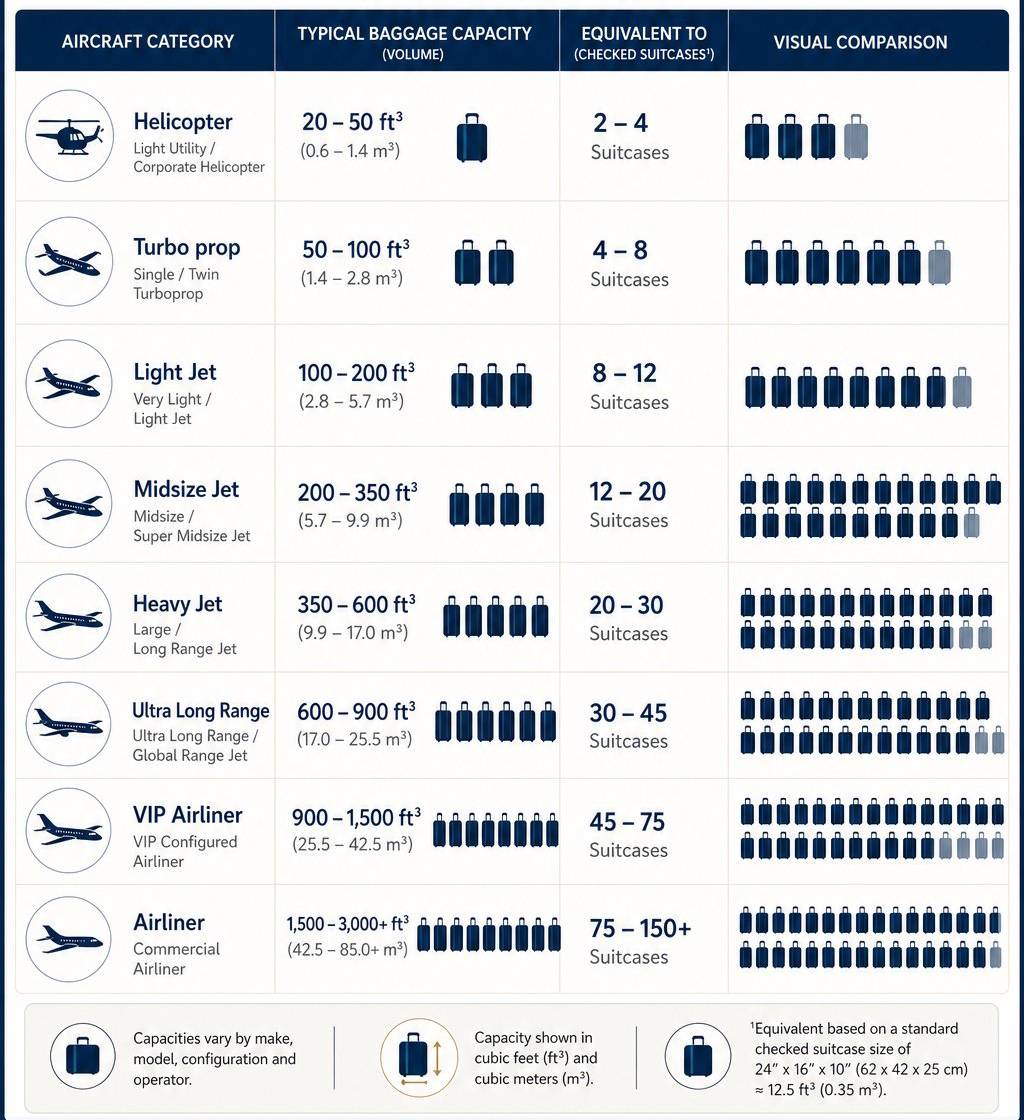
These are practical planning ranges, not fixed rules for every aircraft. Actual baggage capacity depends on the aircraft model, passenger load, route length, and weight-and-balance limits.
Why Soft Bags Are Often Preferred
Soft-sided luggage is usually preferred on private jets, especially on light and midsize aircraft. This is because soft bags are easier to fit into compact baggage compartments.
Large hard-shell suitcases may be difficult to load, especially if the baggage hold has an irregular shape. Oversized items such as golf clubs, skis, musical instruments, camera equipment, and multiple cabin bags may require a larger aircraft.
If passengers are traveling with significant luggage, it is best to provide:
- Number of bags
- Bag dimensions
- Estimated total weight
- Details of oversized or fragile items
If baggage is not declared correctly, the operator may need to restrict luggage, arrange a larger aircraft, offload items, or add a technical stop due to weight limits.
Special Items That May Require Advance Approval
Some items require special handling or approval before the flight. These can include:
- Pets
- Firearms and ammunition
- Medical oxygen
- Medical equipment
- Sports equipment
- Valuable or fragile items
- Dangerous goods
- Lithium batteries
- Oversized luggage
- Unaccompanied minors
Rules vary by country, airport, and operator. For example, traveling with firearms may require permits and must comply with both departure and arrival country regulations. Pets may require vaccination records, microchip details, or import documents.
Medical equipment may also need to be reviewed in advance to ensure it can be safely carried and used onboard.
Not Sure Which Aircraft Fits Your Trip?
Choosing the right private jet is not only about passenger count. Baggage, route distance, airport access, and operating costs can all affect which aircraft makes sense for your trip. With Avi-Go’s Charter Cost Estimator, you can compare estimated private jet charter costs based on your route and aircraft needs before speaking with an operator.
If your schedule is flexible, you can also check Avi-Go’s Empty Leg Radar to explore potential empty leg opportunities that may reduce your private jet travel cost.
Operational Requirements Behind the Scenes
Many booking private jet requirements are handled by the operator rather than the passenger, but they can still affect whether a trip is possible.
These operational requirements may include:
- Landing permits
- Overflight permits
- Airport slots
- Aircraft parking availability
- Crew duty time limits
- Customs availability
- Airport operating hours
- Weather and runway suitability
- Aircraft range and performance
For international flights, overflight and landing permits can be especially important. Some countries require permits before an aircraft can enter their airspace or land at an airport.
Airport slots can also affect scheduling. At busy airports, private jets may need an approved arrival or departure slot. If the requested time is unavailable, the operator may need to suggest a different departure time or alternate airport.
Crew duty limits can also affect long or multi-sector trips. If the crew reaches its duty limit, the operator may need to arrange crew rest, reposition another crew, or adjust the itinerary.
Taxes and Fees That May Apply When Booking a Private Jet
Private jet pricing usually includes the aircraft, crew, and basic operating costs, but taxes and fees may vary depending on the route, country, airport, and operator.
Common taxes and fees can include:
- Landing fees
- Parking fees
- Passenger handling fees
- Ramp or FBO handling fees
- De-icing fees
- Customs and immigration handling
- Navigation charges
- Overflight charges
- Permit fees
- Passenger taxes
- VAT, where applicable
- U.S. Federal Excise Tax, where applicable
- UK Air Passenger Duty, where applicable
- Catering charges
- Ground transportation
- Crew overnight costs
Some fees are included in the quote, while others may be listed separately or charged after the flight if they depend on actual usage.
U.S. Private Jet Charter Taxes
For U.S. domestic private charter flights, Federal Excise Tax may apply. A common tax for applicable U.S. private charter transportation is 7.5% Federal Excise Tax.
There may also be a passenger segment fee for applicable taxable operations.
However, tax treatment can vary depending on the structure of the flight. For example, Part 135 charter, jet cards, and ownership structures may be treated differently. Passengers should review the quote carefully or ask the provider to explain which taxes apply.
European VAT and Passenger Taxes
In Europe, taxes can vary significantly by country and routing.
Possible charges may include:
- VAT on certain domestic or regional flights
- Passenger taxes in specific countries
- Airport handling and passenger charges
- Navigation fees
- UK Air Passenger Duty for eligible UK departures
VAT treatment depends on the country, route, and charter structure. Rates can vary widely, and some international flights may be treated differently from domestic flights.
For UK departures, Air Passenger Duty may apply depending on the aircraft classification, weight, passenger capacity, and route.
Airport, Handling, and Parking Fees
Airport and handling fees are common in private aviation.
These may include:
- Landing fees
- Ramp handling
- Passenger terminal or FBO fees
- Security fees
- Parking fees
- Overnight aircraft parking
- De-icing, if required
At smaller airports, these costs may be relatively modest. At major international airports or premium private terminals, handling and parking fees can be much higher.
Parking is especially important for round trips. If the aircraft waits for the passenger, parking and crew costs may apply. If parking is unavailable or too expensive, the aircraft may reposition to another airport and return later.
Navigation and Overflight Charges
For international private jet flights, navigation and overflight charges may apply.
These are charges related to air traffic control, route usage, and flying through certain airspace. On short regional flights, these may be relatively low. On longer international routes, they can add a meaningful amount to the total cost.
Some international trips may also require permit fees, especially when flying through or into countries with stricter aviation approval processes.
Common Mistakes When Booking a Private Jet
One common mistake is assuming that private aviation has no rules. Private jets offer flexibility, but they still operate under aviation, customs, immigration, tax, and airport regulations.
Other common mistakes include:
- Not checking visa requirements
- Providing passenger details too late
- Underestimating baggage volume
- Choosing an aircraft that is too small for luggage
- Forgetting about pet documentation
- Assuming all airports have customs
- Ignoring airport slot restrictions
- Not reviewing taxes and extra fees
- Waiting too long to sign and pay for the booking
These mistakes can cause delays, extra costs, or changes to the itinerary.
Final Thoughts on Booking Private Jet Requirements
Booking a private jet requires more than passenger documents, baggage details, and payment confirmation. Behind every trip, brokers and operators also need to check aircraft availability, route feasibility, airport restrictions, permits, pricing, and real-time aircraft movement.
Avi-Go helps simplify that operational workflow for business aviation professionals. With Charter Quotations, brokers can request and manage trip quotes more efficiently. With Aircraft Search, teams can find suitable aircraft for specific missions based on route, passenger needs, and availability. Live Flight Tracking gives users real-time visibility into aircraft movements, while Avi-Go.AI helps answer business aviation questions and generate useful market insights.
Avi-Go also provides weekly and monthly market insights, helping brokers and aviation teams stay informed about demand patterns, aircraft activity, and market changes.
For private jet bookings, preparation is important. Avi-Go helps turn that preparation into a more connected workflow, from quotation requests and aircraft search to live tracking and business aviation intelligence.

Private Jet Charter Cost Estimator and Airline Price Predictor

Best Private Jet Charter Companies 2026

Private Jet Sustainability
Ready to Supercharge
Your Business Aviation Tech Stack with AI and Data?
Sign up free and start using the tools available in your chosen plan.
Discover how our aviation technology helps you work more efficiently and grow with confidence.
Subscribe to the Avi-Go Newsletter
Business aviation data, insights, and trends — trusted by 10,000+ professionals worldwide.