
Inside the Private Jet Market for Hajj Pilgrims


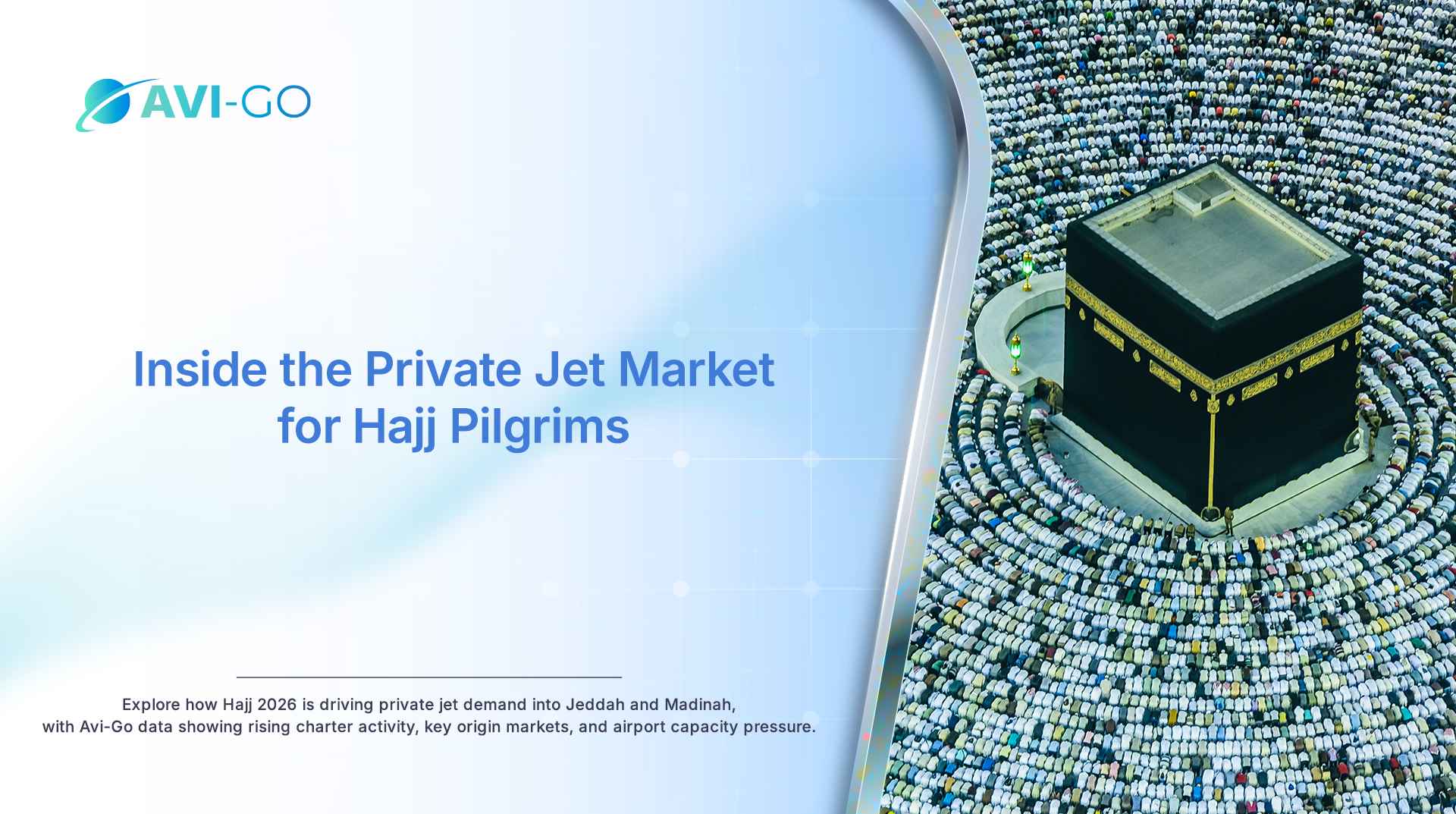
As 1.7 million pilgrims converge on Mecca, a quieter surge is taking place above the clouds. Private jets are arriving in Jeddah and Madinah in significant volumes ahead of Hajj 2026, revealing a market shaped by wealth, belief, and airport capacity constraints.
Hajj is one of the most time-sensitive travel events in the world. The pilgrimage is fixed in place, concentrated into a short religious window, and mandatory for every Muslim who is physically and financially able to perform it. For 2026, the Hajj season can be treated as beginning on 25 May, making the days immediately before that date the most important window for private aviation demand.
That timing matters. Private jet activity recorded earlier in the year provides useful context, but the real Hajj travel pressure builds in the final days before the pilgrimage begins. This is when aircraft positioning, family movements, VIP arrivals, and slot competition become most visible across Saudi Arabia’s key pilgrimage gateways.
What makes Hajj different from other private aviation surges is its driver. People are not flying private simply to be seen. They are flying private to perform an act of worship. The result is a market shaped less by vanity and more by devotion: a piety premium that operators are only beginning to fully understand.
“By May 2026, Jeddah and Madinah together recorded 1,170 inbound business jet movements, while overall pilgrim numbers grew just over 2%.”
The Piety Premium
Charter rates rise sharply around Hajj.
Across every aircraft category, prices move above their normal-season baseline, and the heavier the aircraft, the steeper the premium. Based on Avi-Go market data, a VIP airliner that would normally charter at an indexed rate of 100 can command between 140 and 170 during the Hajj travel window, a surge of up to 70%.
The gap versus commercial premium cabins widens even further. During Hajj, private charter on comparable routes can run roughly 8 to 20 times the cost of a commercial first-class ticket, compared with the already significant 6 to 15 times seen in the off-season.
What drives this?
Three forces stand out.
First, demand is highly compressed. Travellers want to arrive within the same narrow religious window before Hajj begins.
Second, repositioning costs rise. Saudi Arabia is not always a natural hub for private aircraft availability, meaning jets may need to fly empty into position or leave without passengers after the trip. Those empty-leg costs are often priced into the charter rate.
Third, preferred airport slots are limited. During the Hajj period, operators are not only competing for aircraft. They are competing for permits, parking, handling, and arrival windows at some of the busiest airports in the region.
Together, these forces create a distinctive Hajj pricing environment: a premium driven by timing, access, and religious obligation.
Where the Jets Come From
Avi-Go tracked 1,170 combined inbound business jet movements across Jeddah and Madinah between January and late May 2026. This wider January-to-May period should be read as broader market context, not as the full Hajj season itself.
The core Hajj season begins on 25 May 2026, with the most relevant private aviation surge concentrated in the days leading up to that date.
Within the broader January-to-May data, Jeddah dominates decisively. The airport recorded 1,004 inbound business jet movements, accounting for 85.8% of the combined total. Madinah handled 166 movements, or 14.2%.
Together, the two airports form the main private aviation gateway system for pilgrims travelling to Mecca and the holy sites.

The origin data shows a market led by Gulf demand but supported by a much wider international base.
At Jeddah, Saudi domestic traffic alone generated 520 flights, more than half of all inbound movements. The largest foreign source markets were Egypt with 90 flights, the UAE with 62, Turkey with 35, Switzerland with 28, and Qatar with 25.
Madinah followed a similar pattern. Egypt was the top foreign source market with 48 flights, followed by the UAE and Turkey.
At the city level, the concentration is even more striking. Riyadh alone dispatched 431 flights into Jeddah, representing around 43% of all inbound business jet movements to the airport. Cairo followed with 81 flights, while Dubai recorded 45.
For Madinah, Cairo was the top feeder city with 47 flights, followed by Riyadh with 32 and Jeddah with 16, reflecting movement between the two holy cities.
A More Global Private Hajj Market
The breadth of origin countries in 2026 is notable.
Jeddah received business jet flights from more than 60 countries, including Nigeria, Kenya, Indonesia, Malaysia, Kazakhstan, Senegal, Somalia, and Uzbekistan. Many of these are not traditional private aviation markets, but they are countries with Muslim populations and growing wealthy segments willing to charter for pilgrimage.
This signals that private Hajj travel is becoming a genuinely global phenomenon. It is no longer confined to Saudi Arabia, the Gulf, or a small group of established private aviation markets.
The Middle East remains the engine of demand. Riyadh’s 431 flights into Jeddah show the strength of Saudi domestic wealth and the importance of local high-net-worth travel. But the wider origin list points to a broader structural shift: as wealth expands across the Muslim world, more pilgrims are considering private aviation as part of their Hajj journey.
The Jeddah Bottleneck
Even if travellers have the wealth, the aircraft, and the will, they still have to contend with Jeddah.
King Abdulaziz International Airport is Saudi Arabia’s busiest hub and the primary gateway to Mecca. Its Hajj Terminal is built to handle large pilgrim volumes, but private aviation faces a different set of constraints.
The issue is not only passenger capacity. It is the availability of slots, aircraft parking, ground handling crews, permits, and preferred arrival times.
The broader January-to-May data shows more than 1,000 inbound business jet movements into Jeddah before the peak Hajj period. With the Hajj season beginning on 25 May 2026, this creates significant pressure in the final days leading into the pilgrimage.
Operators need to secure handling arrangements, permits, and slots well in advance. Missing a permit window or failing to confirm ground support can mean losing access to the preferred arrival period entirely.
A market receiving traffic from more than 60 countries is also a market where documentation, coordination, and approvals become more complex. The permit queue can grow quickly, especially when many operators are trying to move aircraft into the same airport within the same compressed time frame.
“Over 1,000 inbound movements into Jeddah before the peak Hajj period shows how much pressure builds around the pilgrimage travel window.”
The Bigger Picture
The most striking insight in the 2026 data is what the origin list reveals about the nature of the market.
Alongside expected Gulf states and European countries, Avi-Go tracked private jet movements from Nigeria, Kenya, Indonesia, Malaysia, Kazakhstan, Senegal, Somalia, and Uzbekistan. These countries are at different points on the wealth curve, but they share one important feature: Muslim populations with individuals who are willing and able to charter aircraft for Hajj.
Total Hajj pilgrims in 2026 reached 1,707,301, an increase of just over 2% compared with 2025. Private aviation demand, however, appears to be growing at a faster pace than overall pilgrim numbers.
That suggests a structural shift. As Gulf wealth concentrates and high-net-worth populations expand across the Muslim world, the propensity to charter rather than fly commercial is rising.
For operators, this convergence of faith and wealth creates one of the most defensible seasonal demand spikes in global aviation. Unlike Davos, Monaco, or major sporting events, Hajj cannot be rescheduled. It cannot move cities. It cannot be spread out to ease demand.
For Muslims who are financially and physically able to perform it, Hajj is not optional. It is one of the pillars of their faith.
That makes the Hajj charter market rare in business aviation: a demand curve anchored not only in preference, but in obligation.
Explore real-time business aviation market data with Avi-Go at https://avi-go.com/

Try Avi-Go’s 3 Free Aviation Tools — No Registration Needed!


Comparing Sustainable Aviation Fuel Suppliers for Private Jets
SAF Adoption Among Private Jet Operators Is Growing But Still Led by a Small Group of Major Players
Ready to Supercharge
Your Business Aviation Tech Stack with AI and Data?
Sign up free and start using the tools available in your chosen plan.
Discover how our aviation technology helps you work more efficiently and grow with confidence.
Subscribe to the Avi-Go Newsletter
Business aviation data, insights, and trends — trusted by 10,000+ professionals worldwide.