
Types of Private Jets: A Comprehensive Guide


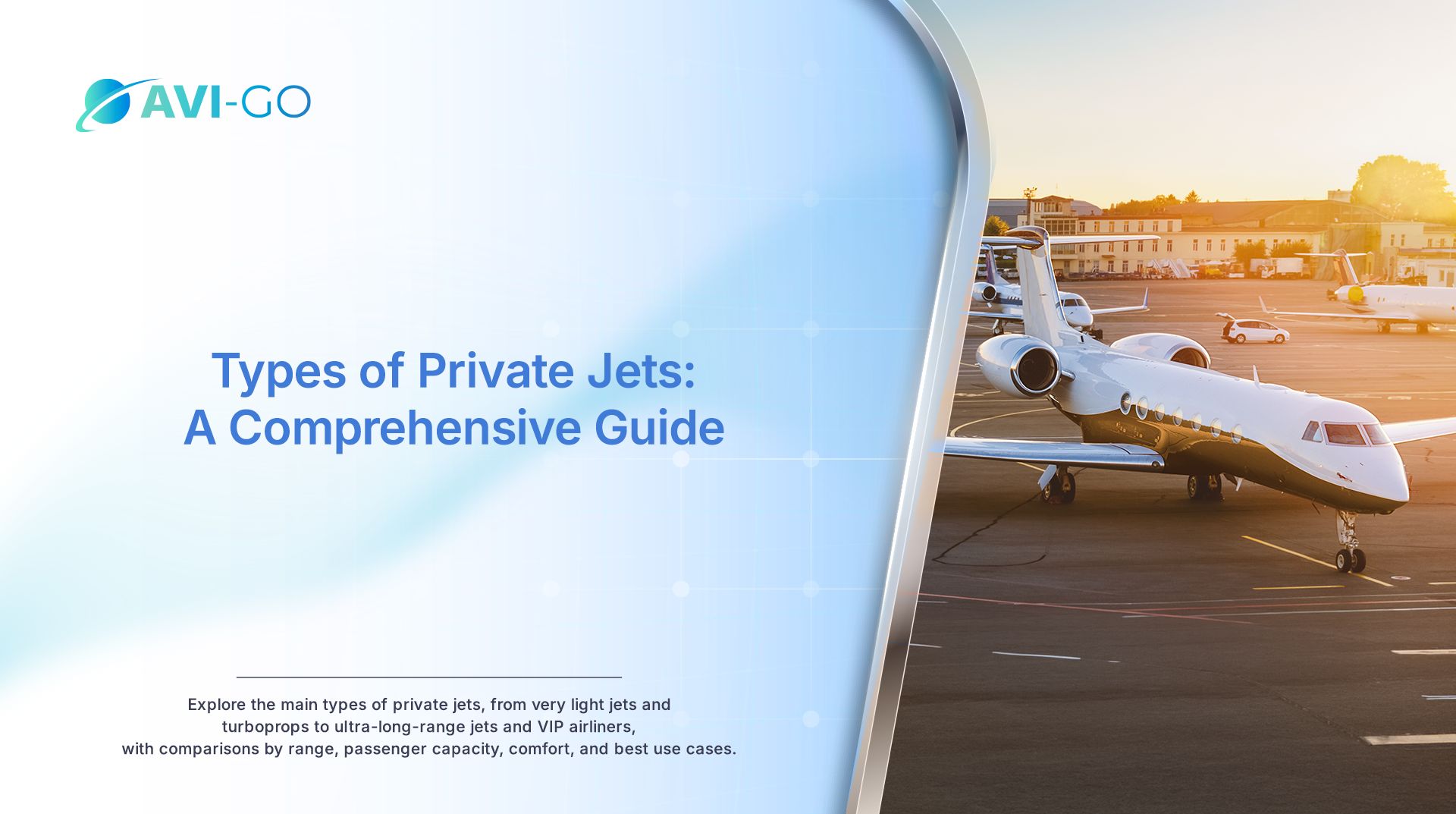
Private jets are commonly classified by cabin size, flight range, passenger capacity, speed, operating cost, and mission profile. In business aviation, the most widely used categories include very light jets, light jets, midsize jets, super-midsize jets, large-cabin jets, and ultra-long-range jets. Depending on the context, business turboprops and VIP airliners, also known as bizliners, may also be considered part of the broader private aviation market.
Understanding these categories is important because there is no single “best” private jet. The right aircraft depends on the mission: how many passengers are flying, how far they need to travel, which airports they want to access, and what level of comfort or onboard productivity they expect.
1. Very Light Jets
Very light jets, often called VLJs, are among the smallest jet aircraft used in private aviation. They are designed for short regional flights and are popular with owner-operators, small business teams, and travelers who need efficient access to smaller airports.
Typical characteristics
VLJs usually seat 4 to 7 passengers and offer a range of around 1,000 to 1,500 nautical miles. They are best suited for short hops, day trips, and regional business missions. Because of their smaller size, they often have lower acquisition and operating costs than larger jets and can operate from shorter runways.
Advantages
Very light jets are cost-efficient, easy to operate, and practical for small groups. They can provide access to airports that may be less convenient or unavailable to larger aircraft. For short missions with only a few passengers, they can be one of the most economical ways to enjoy the speed and convenience of private jet travel.
Limitations
The main trade-offs are cabin size, baggage capacity, and range. VLJs typically have compact cabins, limited amenities, and less headroom than larger aircraft. They are not ideal for long-distance travel or passengers who need a more spacious cabin.
Common use cases
VLJs are often used for day trips, short business flights, and regional travel for one to four passengers.
Examples
Common examples include the Cirrus Vision Jet, Embraer Phenom 100, and Cessna Citation Mustang.
2. Light Jets
Light jets are a step above very light jets and are among the most popular aircraft types in charter and corporate aviation. They offer a strong balance between cost, speed, comfort, and operational flexibility.
Typical characteristics
Light jets usually seat 6 to 8 passengers and have a range of roughly 1,500 to 2,500 nautical miles. Their cabins are more comfortable than VLJs, though still relatively compact compared with midsize and large-cabin aircraft.
Advantages
Light jets are well suited for regional and short-to-medium-range business travel. They are faster and more comfortable than turboprops on many routes, while still being more cost-effective than larger jet categories. Their operating economics also make them attractive to charter operators.
Limitations
Light jets are not designed for large groups or long intercontinental missions. Many do not offer full stand-up cabin height, and baggage space can be limited depending on the aircraft and passenger load.
Common use cases
Typical missions include domestic business trips, short international routes, and travel for small executive teams.
Examples
Popular light jets include the Cessna Citation CJ3+, Embraer Phenom 300, and Learjet 75.
3. Midsize Jets
Midsize jets provide more cabin space, longer range, and improved onboard comfort compared with light jets. They are often chosen by travelers who need better productivity and comfort on medium-range flights.
Typical characteristics
Midsize jets typically seat 7 to 9 passengers and offer a range of around 2,000 to 3,500 nautical miles. Many include an enclosed lavatory, more baggage capacity, and improved cabin amenities.
Advantages
The biggest benefit of a midsize jet is the combination of range and comfort. These aircraft are suitable for longer domestic flights, coast-to-coast missions, and regional international travel. Their cabins are better suited for working, relaxing, and conducting business while in flight.
Limitations
Midsize jets have higher operating costs than light jets and may require more runway length. While they offer strong performance, they are still not the best option for the longest global routes.
Common use cases
Midsize jets are commonly used for longer domestic business trips, regional international travel, and flights carrying five to eight passengers who want better comfort.
Examples
Examples include the Cessna Citation XLS+, Hawker 800XP, and Learjet 60XR.
4. Super-Midsize Jets
Super-midsize jets are one of the most versatile categories in business aviation. They offer strong range, speed, and cabin comfort without moving fully into the cost profile of large-cabin jets.
Typical characteristics
Super-midsize jets usually seat 8 to 10 passengers and have a range of approximately 3,500 to 4,500 nautical miles. Most feature stand-up cabins, generous baggage space, and strong runway and climb performance.
Advantages
This category is popular because it can handle many demanding missions while remaining more efficient than larger long-range aircraft. Super-midsize jets are well suited for transcontinental flights, multi-leg executive travel, and selected intercontinental routes.
Limitations
They are more expensive to operate than midsize jets and do not provide the same cabin volume or ultra-long-range capability as larger aircraft.
Common use cases
Typical missions include U.S. coast-to-coast flights, Europe-to-Middle East routes, multi-country executive travel, and premium charter missions where passengers want both comfort and efficiency.
Examples
Well-known super-midsize jets include the Bombardier Challenger 350/3500, Gulfstream G280, Cessna Citation Longitude, and Embraer Praetor 600.
5. Large-Cabin Jets
Large-cabin jets are designed for long-distance business aviation missions, larger passenger groups, and a high level of onboard comfort. They are often selected by corporations, VIP charter clients, and private owners who regularly fly longer routes.
Typical characteristics
Large-cabin jets generally seat 10 to 16 passengers and offer a range of around 4,000 to 6,500 nautical miles. Their cabins often include multiple seating zones, a galley, larger lavatories, and more advanced entertainment and connectivity systems.
Advantages
Large-cabin jets provide significantly more comfort on long flights. They allow passengers to work, dine, rest, and sleep more comfortably. They also offer better luggage capacity and a more premium travel experience, making them suitable for senior executives and VIP travelers.
Limitations
The main limitations are cost and infrastructure. These aircraft have higher acquisition, maintenance, fuel, crew, and handling costs. They may also require larger airports and more ground support than smaller jets.
Common use cases
Large-cabin jets are used for long transcontinental flights, international business travel, corporate executive transport, and high-end VIP charter.
Examples
Examples include the Bombardier Challenger 650, Dassault Falcon 900LX, Gulfstream G500, and Embraer Lineage 1000E.
6. Ultra-Long-Range Jets
Ultra-long-range jets represent the top end of the private jet market. They are designed to connect major global cities nonstop while offering exceptional comfort for long-duration flights.
Typical characteristics
These aircraft typically seat 12 to 19 passengers and can fly around 6,000 to more than 8,000 nautical miles. Their cabins are large, luxurious, and often divided into multiple living, working, dining, and rest zones.
Advantages
The biggest advantage of ultra-long-range jets is nonstop global capability. They can support intercontinental missions with fewer stops, saving time and improving passenger convenience. They also offer premium cabin technology, advanced connectivity, quieter interiors, and high-end finishes.
Limitations
Ultra-long-range jets come with very high ownership and charter costs. They are often unnecessary for shorter routine missions and usually require more airport infrastructure, crew planning, and operational support.
Common use cases
These aircraft are used for major intercontinental routes, global corporate mobility, heads-of-state transport, and ultra-premium private travel.
Examples
Examples include the Gulfstream G650ER, Gulfstream G700, Bombardier Global 7500, and Dassault Falcon 8X / 10X.
7. Business Turboprops
Although turboprops are not jets, they are often discussed alongside private jets because they serve many similar business aviation missions. For short regional routes, they can be highly practical and cost-effective.
Typical characteristics
Business turboprops usually seat 5 to 9 passengers and offer a range of around 1,000 to 2,000 nautical miles. They are slower than jets but can be extremely efficient on shorter flights.
Advantages
Turboprops are valued for their lower operating costs, excellent short-runway performance, and ability to access remote or smaller airports. They are especially useful in regions with limited airport infrastructure or where short-sector efficiency matters more than speed.
Limitations
The main limitation is speed. Turboprops are generally slower than jets and may be perceived as less prestigious in some markets. They may also be less appealing for passengers who prioritize speed, image, or a jet cabin experience.
Common use cases
Turboprops are commonly used for short regional business trips, island access, remote-area operations, and cost-conscious private travel.
Examples
Examples include the Pilatus PC-12, Beechcraft King Air 350, and Daher TBM 960.
8. VIP Airliners and Bizliners
VIP airliners, also known as bizliners, are commercial aircraft platforms converted for private, corporate, royal, or government use. They sit at the very top of the private aviation market in terms of space, customization, and cost.
Typical characteristics
Passenger capacity varies widely, often ranging from 15 to 50 or more passengers depending on configuration. These aircraft can have very long range and may include bedrooms, showers, conference rooms, lounges, dining areas, and private offices.
Advantages
Bizliners offer unmatched cabin space and customization. They are ideal for large delegations, heads of state, royal families, and ultra-high-net-worth individuals who require a flying office or residence.
Limitations
They are extremely expensive to acquire, operate, maintain, and crew. They also require major airport infrastructure and are not practical for most private owners or typical charter missions.
Examples
Common examples include the Boeing Business Jet, or BBJ, and the Airbus Corporate Jets, or ACJ, family.
Another Way to Classify Private Aircraft: By Mission
In addition to size and range, private aircraft can also be grouped by the mission they are designed to perform.
Short-haul mission aircraft
These aircraft are best for frequent regional travel, day-return trips, and small groups. Examples include the Phenom 100, CJ3+, and PC-12.
Charter-focused flexible aircraft
These aircraft offer broad appeal, strong economics, and the flexibility to serve many different route types. Examples include the Phenom 300, Challenger 350, and Gulfstream G280.
Long-haul executive aircraft
These aircraft are built for international business travel, onboard productivity, and premium passenger comfort. Examples include the Bombardier Global 7500, Gulfstream G650ER, and Dassault Falcon 8X.
Key Factors That Differentiate Private Jet Types
When comparing private jets, several factors matter more than the aircraft category alone.
Range
Range determines how far an aircraft can fly nonstop. This is one of the most important considerations for long-haul missions.
Cabin size
Cabin size includes height, width, seating layout, baggage volume, and the number of cabin zones. A larger cabin can make a major difference on longer flights.
Speed
Cruise speed affects total journey time, especially on longer routes or multi-leg business trips.
Runway performance
Short-runway performance is important for accessing smaller airports, remote destinations, or airports closer to the passenger’s final destination.
Operating cost
Operating cost includes fuel, maintenance, crew, insurance, navigation fees, landing fees, and ground handling. Larger aircraft generally cost more to operate, but the right choice depends on mission efficiency.
Passenger comfort
Comfort includes cabin noise, seat quality, lavatory type, galley facilities, Wi-Fi, entertainment systems, and sleeping capability.
Mission suitability
A private jet is only “best” when it matches the actual mission. Passenger count, route length, baggage needs, airport access, and budget all influence the right aircraft choice.
Simple Comparison Table

Which Type of Private Jet Is Best?
There is no universal best private jet. The best aircraft depends on the passenger’s mission, budget, comfort expectations, and operational requirements.
For short and cost-efficient trips, very light jets, light jets, and turboprops are often the most practical choices. For travelers who want a stronger balance of range, speed, and comfort, midsize and super-midsize jets are usually ideal. For premium long-haul travel, large-cabin and ultra-long-range jets provide the space, performance, and comfort needed for international missions.
Ultimately, the best private jet is the one that fits the route, passenger count, airport requirements, and onboard experience expected by the traveler.

Private Jet Charter Cost Estimator and Airline Price Predictor

Best Private Jet Charter Companies 2026

Private Jet Sustainability
Ready to Supercharge
Your Business Aviation Tech Stack with AI and Data?
Sign up free and start using the tools available in your chosen plan.
Discover how our aviation technology helps you work more efficiently and grow with confidence.
Subscribe to the Avi-Go Newsletter
Business aviation data, insights, and trends — trusted by 10,000+ professionals worldwide.