
What Is a Charter Carrier? How Charter Operations Work in Business Aviation


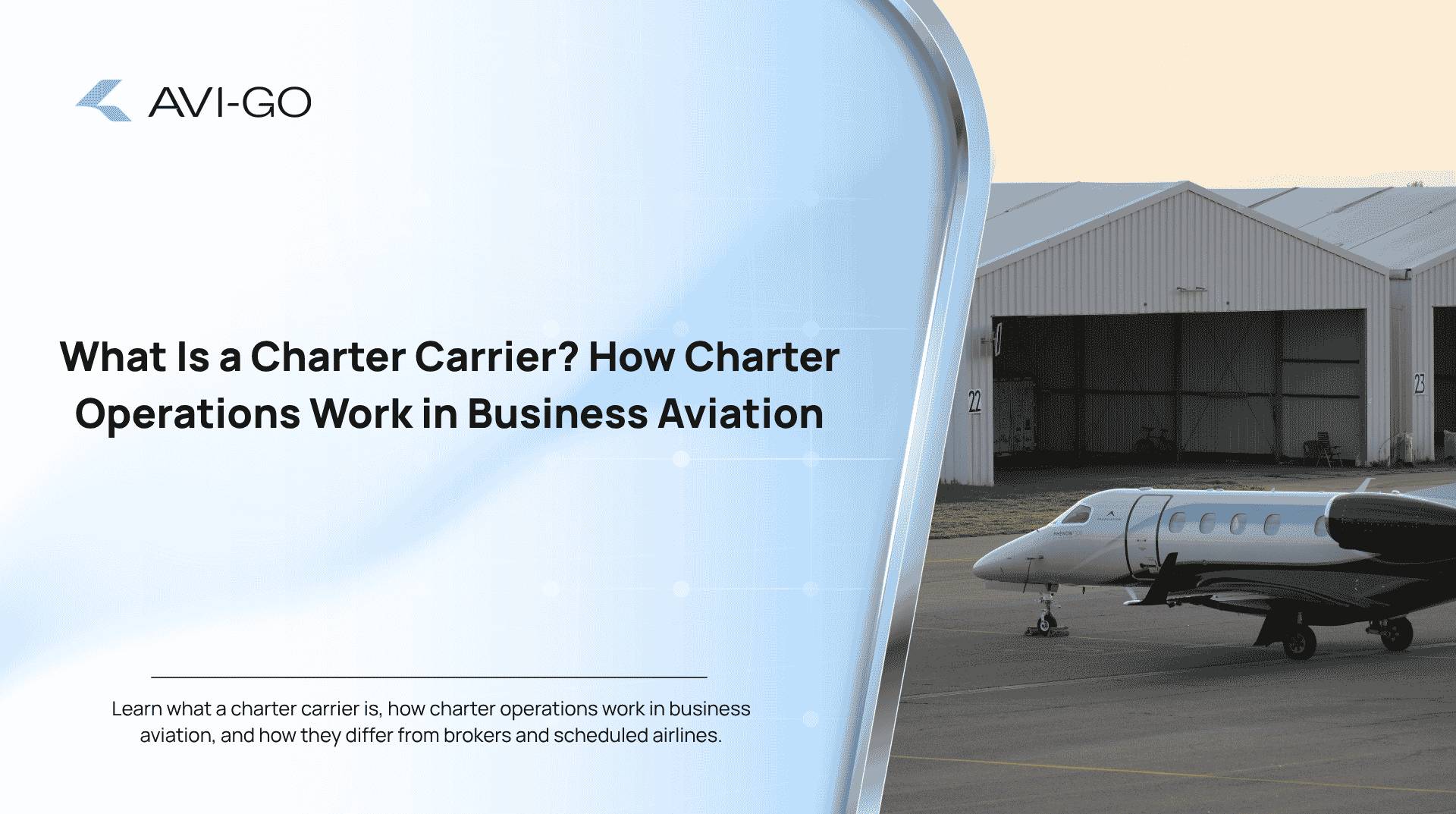
A charter carrier provides air transportation based on a customer’s requested journey rather than a continuously published airline schedule. In business aviation, charter carriers operate aircraft for individuals, companies, government organisations and other customers that require more control over their routes, schedules and aircraft selection.
Unlike a scheduled airline, which sells seats on predetermined routes, a charter carrier generally arranges flights according to a specific mission. The customer may request the entire aircraft, select the departure time and travel directly between airports that may not be connected by scheduled commercial services.
However, the term “charter carrier” is sometimes used loosely. A charter carrier is not necessarily the same as a charter broker, aircraft owner or digital booking platform. Understanding these differences is important when arranging a private flight and confirming which company will actually operate it.
What is a charter carrier?
A charter carrier is an authorised aviation company that operates passenger or cargo flights for compensation or hire outside a conventional fixed airline schedule.
Depending on the country and regulatory framework, a charter carrier may also be described as:
- An air charter operator
- A private jet operator
- An on-demand air carrier
- An air taxi operator
- A commercial air transport operator
- An Air Operator Certificate holder
In the United States, many private charter flights operate under Federal Aviation Regulations Part 135. The Federal Aviation Administration classifies air charter as commuter or on-demand operations conducted under Part 135 and applies specific requirements covering operator certification, aircraft, pilots, training and maintenance.
In Europe, companies conducting commercial air transport generally require an Air Operator Certificate. EASA describes an AOC as a certificate that permits an operator to perform specified commercial air transport operations.
The exact certificate, licence and operating requirements differ between jurisdictions. Customers should therefore evaluate a charter carrier according to the rules that apply where the aircraft is registered and operated.
Are charter carriers part of business aviation?
Charter operations are commonly discussed as part of the wider business aviation industry, although regulatory definitions can vary.
The International Business Aviation Council divides business aviation into several segments, including commercial business aviation. It defines this category as the commercial operation of aircraft used to carry passengers or goods in support of business, with the aircraft available for whole-aircraft charter and flown by professional pilots.
Business aviation also includes non-commercial activities, such as:
- Companies operating their own corporate aircraft
- Individuals flying owner-operated aircraft
- Fractional ownership programmes
- Government and specialist aviation missions
- Aircraft used by nonprofit and humanitarian organisations
NBAA broadly describes business aviation as the use of general aviation aircraft for business purposes. These aircraft can include jets, turboprops, piston aircraft and helicopters.
This means that private charter is an important part of the business aviation ecosystem, but business aviation is not limited to charter flights.
Charter carrier vs scheduled airline
Charter carriers and scheduled airlines both provide commercial air transportation, but their operating models are different.

A charter carrier may fly from a smaller regional airport, reposition an aircraft to collect passengers or operate a multi-stop itinerary built around the customer’s requirements.
This flexibility is one of the reasons business aviation can support destinations that have limited scheduled airline connectivity. ICAO has recognised that business aviation can improve access to transportation, particularly in rural or less-developed regions where conventional commercial services may be limited.
Charter carrier vs charter broker
One of the most important distinctions in private aviation is the difference between a charter carrier and a charter broker.
Charter carrier
The charter carrier directly operates the aircraft. It is normally responsible for areas such as:
- Assigning qualified pilots
- Maintaining operational control
- Confirming aircraft airworthiness
- Following the limitations of its operating certificate
- Managing crew training and checking
- Applying weather and fuel requirements
- Meeting maintenance and regulatory obligations
- Deciding whether a flight can safely operate
Charter broker
A charter broker acts as an intermediary. The broker searches for suitable aircraft, obtains quotations from operators and helps arrange transportation between the customer and the charter carrier.
The broker does not automatically become the operator of the aircraft simply because it manages the booking or communicates with the customer.
The US Department of Transportation describes air charter brokers as entities that connect prospective charter customers with direct air carriers. It has also emphasised that broker advertising should not mislead customers into believing that the broker is the carrier operating the flight.
When reviewing a charter proposal, passengers should understand:
- The name of the broker, when one is involved
- The name of the actual operating carrier
- The aircraft type being offered
- The aircraft registration when available
- Who holds operational control
- Which company is responsible for the flight
What does operational control mean?
Operational control is one of the most important concepts in charter aviation.
Under US regulations, operational control refers to authority over initiating, conducting or terminating a flight.
In practical terms, this means the charter carrier must retain authority to determine whether the flight can operate. The operator may need to delay, reroute, divert or cancel a flight when safety, weather, crew, airport or aircraft requirements cannot be satisfied.
Operational control can involve decisions related to:
- Pilot assignment
- Aircraft availability
- Maintenance status
- Weather conditions
- Fuel planning
- Airport suitability
- Runway limitations
- Crew duty time
- Weight and balance
- Flight permissions
- Departure, diversion and cancellation decisions
The customer can request a particular departure time or destination, but the final operational decision remains with the authorised operator and the relevant flight personnel.
This separation is essential. A passenger, broker or aircraft owner should not improperly assume the safety responsibilities that belong to the certificated carrier.
How does a charter carrier arrange a flight?
Although the exact process varies, a business aviation charter flight generally follows several stages.
1. The customer submits an itinerary
The initial request normally includes:
- Departure and destination
- Preferred date and time
- Number of passengers
- Baggage requirements
- Special passenger needs
- Pets or oversized items
- One-way or return travel
- Additional stops
Accurate information helps the carrier or broker identify aircraft that can perform the mission safely and efficiently.
2. Suitable aircraft are identified
Aircraft selection depends on more than cabin size or appearance. The carrier must consider factors such as:
- Flight distance
- Runway length
- Airport elevation
- Weather
- Payload
- Fuel requirements
- Passenger capacity
- Baggage volume
- Aircraft performance
- International operating authority
A turboprop may be suitable for a short regional journey, while a midsize or heavy jet may be required for longer routes, larger groups or more baggage.
3. Aircraft availability is confirmed
A listed aircraft may not always be immediately available. It could already be booked, undergoing maintenance or positioned in another location.
The carrier must also confirm the availability of qualified crew and determine whether the aircraft can be positioned to the departure airport.
4. The charter quotation is prepared
The quotation generally reflects the full operational requirements of the journey rather than only the time passengers spend onboard.
It may include:
- Occupied flight hours
- Aircraft positioning
- Fuel
- Crew costs
- Airport fees
- Ground handling
- Navigation charges
- Overnight expenses
- Passenger taxes
- International permits
- De-icing
- Catering
- Additional services
Customers should examine what is included, excluded or subject to change before accepting a proposal.
5. The operator is confirmed
Before the flight, the customer should know which charter carrier will operate the aircraft. This is especially important when a broker arranged the booking or when the original carrier has sourced another operator.
6. The flight is prepared and operated
The carrier completes its operational planning, which may include crew assignment, weather review, maintenance confirmation, fuel planning, passenger documentation, airport coordination and regulatory permissions.
The aircraft can depart only after the relevant operational and safety conditions have been met.
What types of aircraft do charter carriers operate?
Charter carriers may operate a wide range of business aircraft.
Turboprops
Turboprops are often used for shorter journeys and airports with limited runway infrastructure. They can offer a practical balance between operating efficiency, passenger capacity and airport access.
Very light and light jets
Light jets are generally used for short to medium-distance journeys with smaller passenger groups. They are popular for regional business travel and routes where larger aircraft may be unnecessary.
Midsize jets
Midsize aircraft provide greater cabin space, baggage capacity and range than light jets. They may also offer improved comfort for longer missions.
Super-midsize jets
Super-midsize jets combine longer-range capability with larger cabins. They are often used for transcontinental or medium-haul international journeys.
Heavy jets
Heavy jets typically provide larger cabins, longer range, increased baggage capacity and facilities suited to longer flights.
Ultra-long-range jets
Ultra-long-range aircraft are designed for long international missions and can connect distant business centres with fewer fuel stops.
The largest aircraft is not automatically the best choice. A suitable charter aircraft should match the passenger count, distance, airport conditions, baggage requirements and overall purpose of the journey.
Why do charter carrier prices vary?
Charter pricing can differ significantly even when two quotations appear to cover the same route.
The final price can be affected by:
- Aircraft type and size
- Aircraft location
- Required positioning flights
- Route distance
- Airport fees
- Fuel prices
- Crew availability
- Seasonal demand
- International permits
- Ground handling
- Overnight requirements
- De-icing
- Taxes
- Minimum daily flight time
- Aircraft scheduling
- One-way availability
For example, an aircraft already located at the departure airport may produce a different quotation from an aircraft that must fly empty from another city.
An empty-leg opportunity may reduce the quoted price, but it can also provide less schedule flexibility because the flight is linked to another confirmed aircraft movement.
Customers should compare more than the total figure. They should also consider aircraft suitability, operator identity, cancellation terms, included services and potential additional charges.
How to evaluate a charter carrier
Selecting a charter carrier should involve more than choosing the lowest quotation.
Before booking, customers should consider checking:
Operator certification
Confirm that the company is authorised to conduct the proposed commercial charter flight.
The FAA advises passengers in the United States to ask for the operator’s Air Carrier or Operating Certificate and confirm that the aircraft is authorised for charter use.
Aircraft authorisation
An aircraft being registered or privately owned does not automatically mean that it can legally be used for paid charter services. The aircraft must be operated under the appropriate commercial authority.
Operator identity
Confirm which company is actually conducting the flight, particularly when the booking was arranged through a broker or another carrier.
Operational control
Ask who is responsible for initiating, conducting and terminating the flight. A legitimate carrier should be able to clearly explain its operational role.
Insurance
Review whether appropriate insurance is in place for the aircraft, operator and proposed operation.
Safety practices
Consider the operator’s pilot training, maintenance procedures, regulatory history and relevant independent safety standards or audits.
Quote transparency
The quotation should clearly identify included costs, possible additional charges, payment terms and cancellation conditions.
Aircraft suitability
Confirm that the aircraft can accommodate the passengers, baggage, route and airport requirements.
Why authorised charter operations matter
A private aircraft, professional-looking website or experienced pilot does not by itself establish that an operation is legally authorised to carry paying passengers.
Illegal charter arrangements may attempt to disguise commercial transportation as aircraft leasing, cost sharing or private operation. These structures can create uncertainty about responsibility for maintenance, pilot qualifications and operational control.
The FAA warns that illegal charter operations create safety risks and advises passengers to verify both the operator and aircraft before booking.
It notes that authorised Part 135 operations are subject to more demanding requirements for pilot qualifications, maintenance procedures and safety oversight than ordinary private flying.
Possible warning signs can include:
- Refusal to identify the operating carrier
- Unclear responsibility for the flight
- Attempts to transfer operational control to the passenger
- Evasive answers about certification
- Pressure to describe the flight inaccurately
- Prices that appear inconsistent with legitimate operating costs
- Aircraft that cannot be confirmed under the carrier’s authority
Transparency is therefore an important part of charter selection.
How technology supports charter carriers
The charter industry has traditionally relied on phone calls, emails, spreadsheets and established professional networks. These methods remain important, but data and digital tools are changing how carriers identify and manage commercial opportunities.
Modern business aviation technology can help charter carriers:
- Review airport and route activity
- Analyse aircraft utilisation
- Monitor fleet movements
- identify potential charter demand
- Find positioning opportunities
- Commercialise available aircraft
- Reduce unnecessary empty flying
- Respond to requests more efficiently
- Compare aircraft for a specific mission
- Track changes in regional demand
- Support quotation workflows
- Improve fleet planning
Data can also help brokers and customers understand the market more clearly. Aircraft specifications, operator information, airport activity and historical flight patterns can contribute to better-informed charter decisions.
Technology does not replace operator certification or operational control. The charter carrier remains responsible for safely and legally operating the flight. Digital platforms instead support the commercial research, communication and decision-making surrounding the operation.
The role of charter carriers in modern business aviation
Charter carriers connect passengers and organisations with flexible aircraft capacity without requiring them to own or manage an aircraft directly.
They support a wide variety of missions, including:
- Corporate travel
- Multi-city business trips
- Remote-site access
- Government travel
- Sports team transportation
- Entertainment tours
- Medical and humanitarian missions
- Time-sensitive cargo
- Event travel
- Seasonal and specialist operations
Their value is not limited to privacy or luxury. A charter carrier can help travellers reach airports that receive limited scheduled service, coordinate multiple destinations and build a journey around operational requirements rather than an airline timetable.
As business aviation becomes increasingly data-driven, charter carriers will continue combining aircraft operations with market intelligence, digital distribution and more efficient commercial workflows.
Conclusion
A charter carrier is the authorised company responsible for operating a charter flight. It provides transportation according to customer demand while retaining responsibility for the aircraft, crew, safety and operational decisions.
Within business aviation, charter carriers give travellers and organisations access to flexible aircraft capacity, customised routes and a wide range of airports. However, customers should distinguish the operating carrier from brokers, aircraft owners and booking platforms.
Before confirming a private flight, it is important to verify the carrier, aircraft, operating authority, quotation terms and responsibility for operational control. A clearer understanding of these elements supports safer and more informed charter decisions.
Discover aircraft, operators, charter opportunities, and business aviation market intelligence with Avi-Go.
References
- Federal Aviation Administration, 14 CFR Part 135 Air Carrier and Operator Certification.
- Federal Aviation Administration, Safe Air Charter.
- Federal Aviation Administration, Thinking of Chartering an Aircraft?
- Federal Aviation Administration, Part 135 Operational Control Questions and Answers.
- European Union Aviation Safety Agency, Air Operator Certificate.
- European Union Aviation Safety Agency, Five Phases to an Air Operator Certificate.
- International Business Aviation Council, Definitions of Business Aviation.
- International Civil Aviation Organization, Facilitating the Development of International Business Aviation.
- National Business Aviation Association, What Is Business Aviation?
- National Transportation Safety Board, Safety and Industry Data Improvements for Part 135 Operations.
- US Department of Transportation, The Role of Air Charter Brokers in Arranging Air Transportation.

Business Aviation Events to Look Out for in 2027

Public Charter Flights Explained and How the Business Model Works
Hidden Fees on Discounted Empty Leg Charters
Ready to Supercharge
Your Business Aviation Tech Stack with AI and Data?
Sign up free and start using the tools available in your chosen plan.
Discover how our aviation technology helps you work more efficiently and grow with confidence.
Subscribe to the Avi-Go Newsletter
Business aviation data, insights, and trends — trusted by 10,000+ professionals worldwide.