
What Is a Jet Card Program?


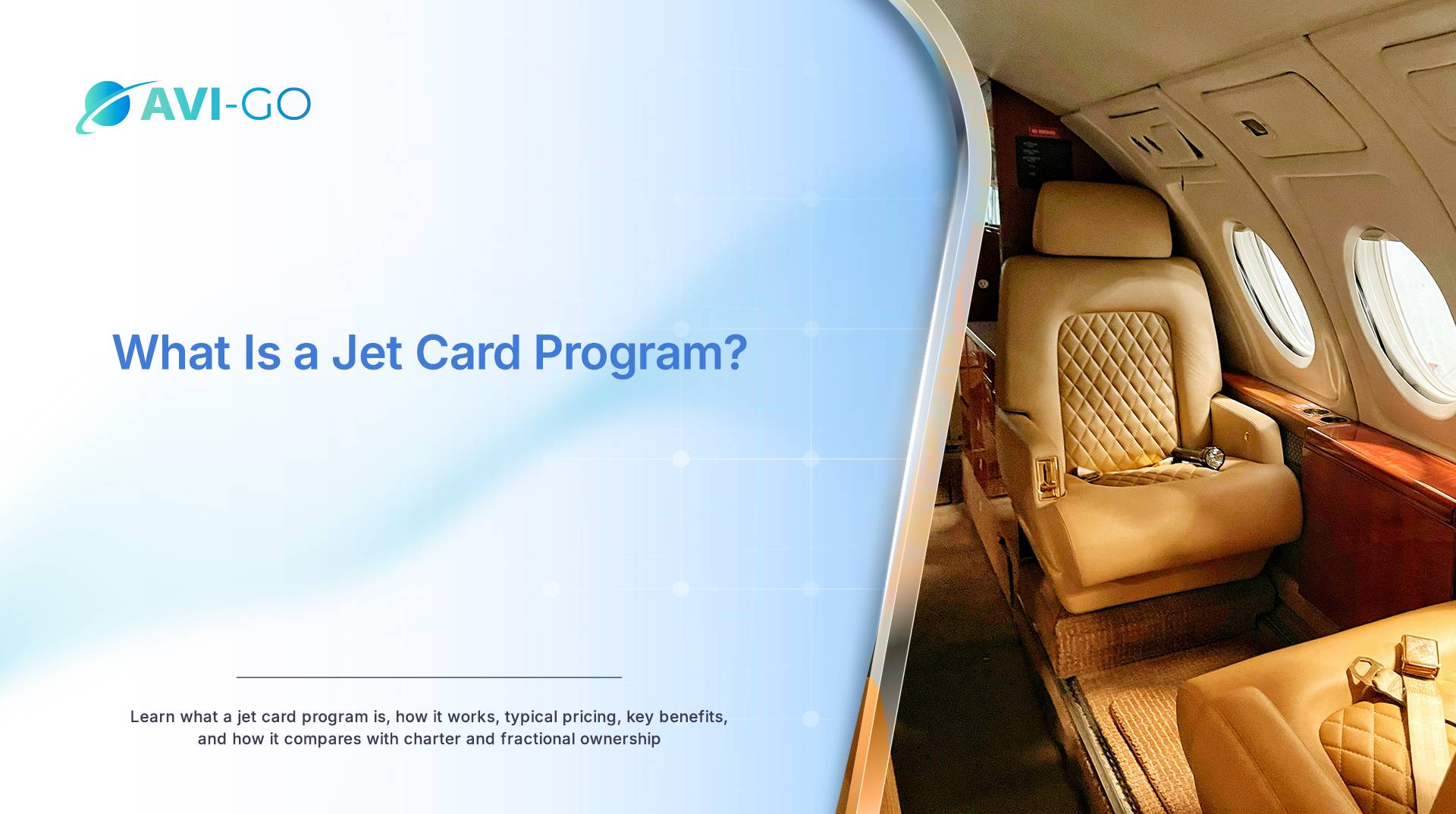
A jet card program is a prepaid private aviation solution that gives travelers access to private aircraft through a set number of flight hours or a deposited balance. It is designed for people who want more predictability than on-demand charter, but without the long-term financial commitment of fractional ownership.
In simple terms, a jet card sits in the middle of the private aviation market. It offers structured access, more consistent pricing, and service standards that appeal to frequent flyers who value convenience and reliability. According to Avi-Go market data covering January 2025 to February 2026, jet cards were broadly positioned as a product with higher upfront commitment than on-demand charter, but lower capital exposure than fractional ownership.
How a Jet Card Program Works
Most jet card programs are built around one of two models: prepaid flight hours or prepaid funds. In an hour-based card, the client prepays for a set number of hours, often 25 hours, tied to a certain aircraft category. In a dollar-based card, the client deposits funds, and each trip deducts from that balance according to the provider’s pricing rules. Some providers also use hybrid models that combine elements of both.
This structure is one of the main reasons travelers choose jet cards. Instead of requesting fresh quotes for every trip, members enter a program with clearer terms on rates, aircraft access, booking notice, and service coverage.
Avi-Go data shows that the most common market entry format in this period was either a 25-hour card or a prepaid deposit. Typical validity periods ranged from 12 to 24 months.
Pricing Structure of a Jet Card Program
Minimum Buy-In
One of the biggest advantages of a jet card is pricing predictability. Avi-Go market data shows that, from January 2025 to February 2026, most jet card programs had minimum buy-ins ranging from $25,000 to $200,000. That upfront amount usually secured access to a fixed number of hours or funded a balance for future flights.
Hourly Rate by Aircraft Category
Hourly pricing varied by aircraft category. Avi-Go data indicates the following typical ranges during the period: light jets at $7,000 to $8,500 per hour, midsize jets at $8,500 to $11,000 per hour, and large or heavy jets at $11,000 to $18,500 per hour.
Additional Fees to Consider
While many programs market fixed hourly pricing, travelers should still expect possible extra charges. Common fees in the 2025 to early 2026 market included peak-day surcharges, de-icing, international handling or permits, upgraded catering, overnight crew costs, fuel recovery fees, and taxi time depending on provider rules. That means the true value of a jet card is not only about the base hourly rate, but also about how transparent the program is around additional costs.
Booking Notice and Availability Rules
A jet card program is also defined by how access works in practice. Typical booking notice in the market ranged from 24 hours to several days, with longer notice often required for peak travel dates or international trips. Some short-notice access was possible, but usually subject to stricter conditions.
Availability terms are another major differentiator. Avi-Go data shows that guaranteed availability was commonly offered when notice requirements were met, but peak-day restrictions, blackout-style limits, and aircraft substitution rules often applied. In many cases, programs guaranteed an aircraft category rather than an exact tail number or model. Service was usually strongest in core domestic regions, while international access could be more conditional.
For this reason, buyers should look beyond the headline pricing and review operational details such as:
- whether rates are fixed for 12 months or longer
- how many peak days are defined
- whether blackout dates apply
- whether taxi time is included
- whether funds are refundable
- whether there is a membership fee separate from flight spend
Benefits of a Jet Card Program
The main benefit of a jet card program is simplicity. Instead of shopping the charter market trip by trip, members get a more structured private aviation experience. They know the program rules in advance, they typically receive more predictable pricing, and they often gain a smoother booking process.
Jet cards are especially attractive for travelers who fly regularly enough to justify prepayment, but not so much that ownership makes financial sense. Avi-Go market analysis suggests they work best for users who care more about access reliability and pricing predictability than finding the absolute lowest market quote each time. They are often a strong fit for travelers flying around 25 to 75 hours per year.
Jet Card vs On-Demand Charter
The clearest way to understand a jet card is to compare it with on-demand charter. On-demand charter allows travelers to book trip by trip with no prepaid commitment. That gives maximum flexibility, but pricing is more exposed to live market conditions and availability may tighten during holidays, major events, or last-minute windows.
A jet card, by contrast, requires upfront funds but usually offers more pricing predictability and more structured access terms. In Avi-Go’s market comparison, jet cards were positioned as medium upfront commitment, high pricing predictability, and medium to high availability assurance, while on-demand charter was characterized by no upfront commitment, low to medium pricing predictability, and variable availability.
For travelers with irregular flying patterns, on-demand charter may be the better choice. For those who want consistent standards and reduced sourcing effort, a jet card may offer better value.
Jet Card vs Fractional Ownership
Fractional ownership sits at the other end of the spectrum. It involves purchasing a share in an aircraft or managed access structure, usually combined with monthly management fees, occupied hourly charges, and a longer-term contractual commitment. It offers strong availability protections, but it also comes with the highest financial commitment and more complex economics.
Avi-Go’s comparison shows that fractional ownership typically has high upfront commitment, high pricing predictability, and high availability assurance, but also significant capital requirements and more contract complexity. Jet cards, in contrast, offer many of the access and service advantages of a structured program without requiring asset ownership.
That makes jet cards a practical middle-ground option for travelers who want dependable private aviation access without committing to ownership-style economics.
Who Should Consider a Jet Card Program?
A jet card program is usually best for travelers who fly frequently, value convenience, and want a repeatable private aviation experience. It can be especially suitable for:
- business travelers with recurring flight patterns
- families taking multiple private trips per year
- flyers who want cost predictability
- travelers who prefer contracted access instead of shopping the market every trip
Avi-Go data suggests jet cards are particularly useful for users who want to avoid the large capital outlay of fractional ownership while gaining more consistency than ad hoc charter.
Summary
A jet card program is best understood as a prepaid private aviation product that balances convenience, predictability, and flexibility. It gives travelers a more structured way to access aircraft, typically through prepaid hours or deposited funds, with defined rates and service rules. Based on Avi-Go market data from January 2025 to February 2026, the category remained defined by $25,000 to $200,000 minimum commitments, typical 25-hour or deposit-based structures, and hourly pricing that generally ranged from $7,000 to $18,500 depending on aircraft class.
In practical terms, the market positioning is clear: jet cards offer predictability and convenience, on-demand charter offers flexibility with no commitment, and fractional ownership offers the strongest access assurance with the highest financial commitment. For many frequent private flyers, a jet card program represents the most balanced option.
Looking for fast answers on jet cards and how they compare across the market? Register on Avi-Go here to try Avi-Go.AI and explore private aviation insights, compare programs more easily, and make smarter, faster decisions with confidence.

Private Jet Charter Cost Estimator and Airline Price Predictor


Best Private Jet Charter Companies 2026

Private Jet Sustainability
Ready to Supercharge
Your Business Aviation Tech Stack with AI and Data?
Sign up free and start using the tools available in your chosen plan.
Discover how our aviation technology helps you work more efficiently and grow with confidence.
Subscribe to the Avi-Go Newsletter
Business aviation data, insights, and trends — trusted by 10,000+ professionals worldwide.