
ADS-B Exchange Explained: How Real-Time Aircraft Tracking Works


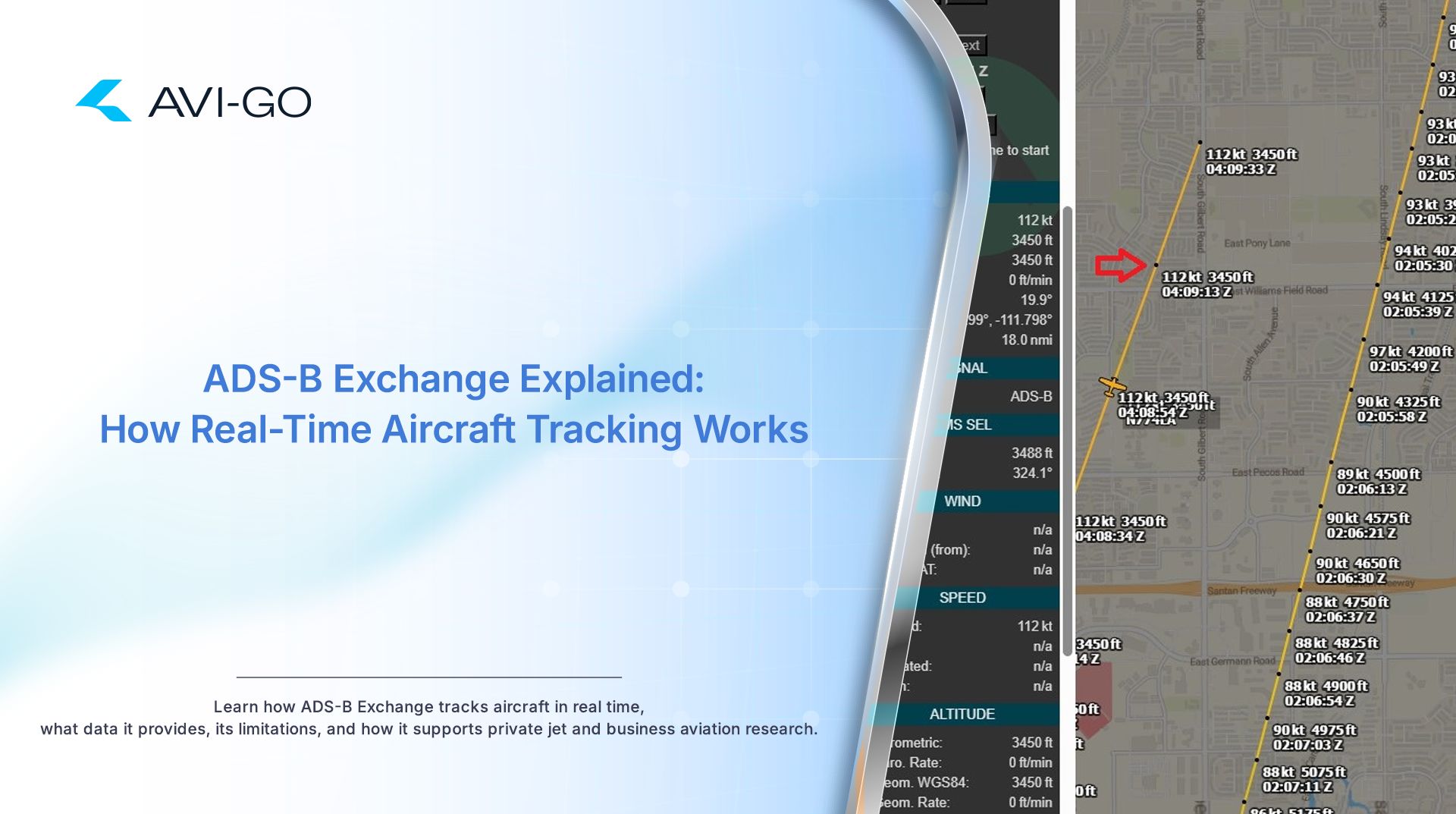
ADS-B Exchange is widely used by aviation enthusiasts, researchers, journalists, operators, and analysts who want to observe aircraft movements in near real time.
Unlike traditional airline flight-status platforms, ADS-B Exchange focuses on displaying aircraft positions collected directly from a global network of community-operated receivers. This makes it particularly useful for tracking private jets, business aircraft, cargo flights, government aircraft, and other operations that may not always appear clearly on conventional flight-tracking websites.
But what exactly is ADS-B Exchange, how does it collect flight data, and what should aviation professionals understand before using it?
What Is ADS-B Exchange?
ADS-B Exchange is an aircraft-tracking platform that aggregates live aviation data from a worldwide network of ground-based receivers.
These receivers collect signals broadcast by aircraft using Automatic Dependent Surveillance–Broadcast, commonly known as ADS-B. The information is then combined and displayed through an interactive aircraft-tracking map.
According to ADS-B Exchange, the platform was founded in 2016 and is supported by a community of individuals and organizations operating receivers around the world. Its stated objective is to provide broad and transparent visibility into civil, commercial, private, and military aircraft activity.
Users can generally explore information such as:
- Current or recently recorded aircraft position
- Altitude and ground speed
- Direction of travel
- Aircraft registration
- ICAO aircraft address
- Flight or call-sign information
- Aircraft type
- Recent movement patterns
The amount of available information can vary depending on the aircraft, signal type, receiver coverage, and data transmitted by the aircraft.
What Does ADS-B Mean?
ADS-B stands for Automatic Dependent Surveillance–Broadcast.
Each part of the name explains how the technology works:
- Automatic means the system transmits information without requiring continuous action from a pilot or air traffic controller.
- Dependent means the reported position depends on the aircraft’s navigation system, normally using satellite-based positioning.
- Surveillance refers to monitoring the aircraft’s location and movement.
- Broadcast means the information is transmitted openly to compatible receivers within range.
The FAA describes ADS-B as a surveillance technology combining an aircraft’s positioning source, onboard avionics, and ground infrastructure. ADS-B Out broadcasts information including GPS location, altitude, and ground speed to ground stations and nearby equipped aircraft.
ICAO similarly explains that ADS-B allows an aircraft to broadcast its GNSS-derived position, altitude, identity, and velocity without requiring interrogation from a radar station.
How Does ADS-B Exchange Track Aircraft?
ADS-B Exchange does not track aircraft using one central radar installation. It relies primarily on a distributed network of receivers.
The process typically works as follows:
- An aircraft determines its position using onboard navigation equipment.
- Its ADS-B Out equipment broadcasts position and flight information.
- A ground-based receiver within signal range captures the transmission.
- The receiver sends the information to ADS-B Exchange.
- ADS-B Exchange aggregates the signals and presents the aircraft on its map.
The platform also uses other surveillance methods when available, including Mode S data and multilateration.
What Is Multilateration?
Multilateration, or MLAT, can help calculate the position of an aircraft that transmits a Mode S signal but does not broadcast a complete GPS-derived position.
When several synchronized receivers detect the same aircraft transmission, the differences in signal arrival time can be used to estimate the aircraft’s location.
This can improve visibility for certain aircraft, although MLAT availability depends on having enough receivers positioned within the relevant area. ADS-B Exchange states that it combines ADS-B, Mode S, and MLAT information where available to develop a broader picture of aircraft activity.
What Information Can You Find on ADS-B Exchange?
The exact interface and available fields may change, but aircraft-tracking platforms built around ADS-B commonly present several categories of information.

ICAO materials identify aircraft address, aircraft identification, position, altitude, velocity, and time information as common elements contained in ADS-B reports.
However, not every aircraft will display every field. Some data may be missing, delayed, incorrectly entered, or unavailable.
Why Is ADS-B Exchange Popular for Private Jet Tracking?
Private and business aviation operates differently from scheduled commercial aviation.
An airline flight will usually have:
- A published flight number
- A fixed route
- A planned departure time
- A publicly available passenger schedule
A private jet may instead operate under a changing call sign, move between smaller airports, reposition without passengers, or fly on short notice.
For this reason, registration numbers, ICAO addresses, aircraft positions, and movement histories can be more useful than published schedules when following business aircraft.
ADS-B Exchange is commonly used because it emphasizes aircraft-level tracking rather than only scheduled flight information. Its community receiver model can also provide visibility across airports and regions covered by participating receivers.
Common Uses of ADS-B Exchange
Tracking a Specific Aircraft
Users can search for an aircraft using a registration, ICAO hex code, or call sign when that information is available.
This may help determine whether an aircraft is airborne, recently active, approaching an airport, or operating within a particular region.
Observing Airport Traffic
The map can be used to review aircraft arriving at, departing from, or operating near an airport.
This is useful for aviation enthusiasts, researchers, airport observers, and professionals assessing current traffic conditions.
Monitoring Business Aviation Activity
Charter companies, brokers, sales teams, and aviation analysts may use aircraft-tracking information to observe:
- Fleet movements
- Aircraft utilization
- Repositioning activity
- Frequently served airports
- Regional traffic concentration
- Possible operational patterns
Live aircraft positions alone, however, rarely provide enough information for a complete commercial or operational decision.
Research and Journalism
Aircraft movement data can provide supporting evidence when researching aviation events, emergency operations, public-interest stories, or unusual flight activity.
ADS-B Exchange lists journalism, emergency response, humanitarian research, aviation safety, and airspace awareness among the applications supported by its data.
ADS-B Exchange Limitations
ADS-B tracking can be valuable, but it should not be treated as a perfect or complete representation of all aircraft activity.
Receiver Coverage Varies
ADS-B signals generally require suitable receiver coverage and a clear line of sight.
Aircraft flying at higher altitudes can often be detected across a wider area, while low-flying aircraft may disappear behind terrain, buildings, or other obstructions.
Areas with fewer community receivers may therefore have less consistent coverage.
Not Every Aircraft Broadcasts the Same Information
An aircraft may transmit its position but not a recognizable flight identification. Another aircraft may transmit Mode S information without a complete ADS-B position.
Older, exempt, improperly configured, or differently equipped aircraft may provide limited information.
Registration and Call Sign Are Different
An aircraft registration identifies the aircraft, while a call sign may identify the flight or operating mission.
The call sign displayed during one flight may not be used during the aircraft’s next flight. Users should therefore avoid assuming that a call sign permanently belongs to one aircraft.
A Position Does Not Explain the Mission
Seeing a private jet flying between two airports does not reveal:
- Who is aboard
- Why the flight is operating
- Whether it is a charter, private, maintenance, training, or repositioning flight
- Whether the aircraft is commercially available
- Whether the displayed route reflects its final operational plan
ADS-B data should be interpreted as aircraft movement information rather than a complete explanation of the flight.
Data May Be Delayed or Incorrect
Aircraft-tracking information may occasionally contain gaps, incorrect call signs, inaccurate database matches, or delayed updates.
For safety-critical decisions, users should rely on authorized operational systems, air traffic services, dispatch information, and verified aviation sources rather than a public tracking map alone.
ADS-B Exchange vs. Radar Tracking
ADS-B and radar are both used for aircraft surveillance, but they work differently.

The FAA states that ADS-B can provide more precise aircraft surveillance than conventional radar and can improve coverage because ground stations are easier to place in remote areas.
ADS-B does not necessarily replace every form of radar or surveillance in every operating environment. Aviation authorities may combine several technologies to create a more complete traffic picture.
Is ADS-B Exchange the Same as Air Traffic Control Data?
No.
ADS-B Exchange is a public aircraft-tracking and aviation-data platform. It should not be confused with an official air traffic control display.
Air traffic controllers may receive information from certified ADS-B infrastructure, primary radar, secondary radar, flight plans, multilateration systems, and other approved surveillance sources.
Public tracking platforms receive and process data for informational, analytical, and commercial uses, but they are not a replacement for official ATC systems.
How Aviation Professionals Can Go Beyond Live Tracking
A live map answers an important question:
Where is the aircraft now?
Business aviation professionals often need to answer additional questions:
- Which operator manages the aircraft?
- What routes has it operated recently?
- Which airports does it visit most frequently?
- How many hours has it flown?
- Is it part of a larger fleet?
- What aircraft model and configuration is it?
- What market or utilization patterns can be identified?
Avi-Go’s aircraft-tracking and aviation-data tools are designed to add this business aviation context.
The Avi-Go Aircraft Tracker allows users to search an aircraft by registration and view its location on a live map. A free account can also provide access to aircraft profiles, operator details, historical movements, and related tracking information.
For a faster historical check, the Avi-Go Tail Number Quick Check can show recent flight segments, flight hours, frequently used routes, airports, and operator information connected to a registration.
Aviation Lookup expands the process further by connecting aircraft, operator, airport, fleet, and market information for charter planning and business aviation research.
ADS-B Exchange and Business Aviation Intelligence
ADS-B Exchange is useful for viewing aircraft movement and understanding how receiver-based flight tracking works.
For aviation enthusiasts, it provides an accessible way to explore what is flying overhead. For researchers and journalists, it can support the reconstruction and analysis of aircraft activity. For aviation businesses, it can serve as an initial source of movement awareness.
However, aircraft position is only one part of business aviation intelligence.
Charter brokers, operators, FBOs, aircraft sales teams, and market analysts often need verified aircraft profiles, operator relationships, historical activity, utilization patterns, airport intelligence, and commercial context.
Combining real-time aircraft tracking with broader aviation data provides a more useful foundation for operational and business decisions.
Track Aircraft with Avi-Go
Search a tail number, locate an aircraft on a live map, and explore the operator and movement information behind the flight.
For deeper business aviation research, use Aviation Lookup to explore aircraft, operators, airports, fleets, and related market intelligence in one platform.
References
- ADS-B Exchange, “About ADS-B Exchange.”
- ADS-B Exchange, official platform and data-network overview.
- Federal Aviation Administration, “Automatic Dependent Surveillance–Broadcast.”
- Federal Aviation Administration, “ADS-B Frequently Asked Questions.”
- International Civil Aviation Organization, ADS-B fundamentals and surveillance materials.
- Civil Aviation Authority of Singapore and ICAO, “Introduction to Automatic Dependent Surveillance–Broadcast.”

Why Tail Number Checks Matter Before Booking a Private Jet


Avi-Go Report Store for Updated Business Aviation Data and Market Analytics

5 Ways to Track a Private Jet on Your Phone in 2026
Ready to Supercharge
Your Business Aviation Tech Stack with AI and Data?
Sign up free and start using the tools available in your chosen plan.
Discover how our aviation technology helps you work more efficiently and grow with confidence.
Subscribe to the Avi-Go Newsletter
Business aviation data, insights, and trends — trusted by 10,000+ professionals worldwide.