
Exploring Innovation and Sustainability at EBACE 2025: Key Takeaways for the Air Charter Marketplace


Global Business Aviation Market Trends
As of mid-2025, the global business aviation market continues to expand, but at a measured and strategic pace, following a strong recovery period in previous years. According to Global Market Insights, the business jet market was valued at around USD 30 billion in 2024, with long-term projections suggesting it will surpass USD 45 billion by 2032. However, the 2025 year-to-date (YTD) trajectory reflects moderate growth, with most regions seeing a low-single-digit percentage increase in flight activity compared to the same period in 2024. This cooling trend marks a shift from the rebound-driven momentum of 2022–2023 to a more stable and sustainable demand curve.
OEMs like Gulfstream and Bombardier continue to report healthy backlogs, but order intake has shifted from volume toward value, with buyers prioritizing long-range, high-performance jets equipped with advanced avionics and sustainability features. A strong uptick in demand is visible in Asia-Pacific and the Middle East, where rising executive mobility and infrastructure investments are compensating for plateauing demand in North America. Additionally, 2025 is seeing a notable shift in operator priorities—from aggressive expansion to fleet right-sizing, cost control, and digital transformation. Charter platforms, predictive maintenance tools, and real-time booking interfaces have become central to business models worldwide.
Compared to 2024, where post-COVID recovery was the primary story, 2025 is about strategic maturity — balancing efficiency, customer expectations, and sustainability mandates. The market outlook remains positive, but tempered by fuel cost volatility, SAF availability concerns, and global economic uncertainty. In this new phase, agility and tech adoption are the key differentiators for global players.

European Business Aviation Trends
In 2025, the European business aviation market is entering a period of stabilization following the steady upward trajectory seen in 2024. Business aviation now represents approximately 8% of all European air traffic, and its strategic value is undeniable—connecting over 1,400 airports across the continent , including 900 destinations served exclusively by business aviation. This wide network underscores the sector’s critical role in regional accessibility, particularly in areas underserved by commercial airlines.
While flight activity across the ECAC area showed clear growth throughout 2024, the first half of 2025 has seen that momentum ease into a more modest, sustainable rate of increase. The market is no longer riding the wave of post-pandemic rebound but is instead navigating a more complex landscape shaped by regulatory scrutiny, environmental policy shifts, and tariff inconsistencies across national borders. These headwinds—especially around carbon taxation, noise regulations, and airport access fees—are pushing operators to reassess their operating models and cost structures.
Another trend gaining renewed attention is fractional ownership, which is benefiting from the current market stabilization. As private flyers seek long-term access without full ownership burdens, fractional programs offer a balance between flexibility and commitment. At the same time, demand for on-demand and highly flexible charter solutions continues to rise, reflecting a broader consumer shift toward convenience and personalized service.
Operators are also observing a generational change in their clientele. The new wave of private aviation users—many of whom are younger, tech-native professionals—are driving a shift in service expectations. Communication preferences are evolving quickly, with clients increasingly favoring mobile-first, app-based platforms that allow for rapid interaction, transparency, and real-time control. As one executive from Luxaviation noted at EBACE, today’s customer values speed, convenience, and customization more than ever before.
Industry Challenges: Regulation, Infrastructure, and Digital Risk
As the business aviation sector enters a more stabilized growth phase in 2025, a series of structural and regulatory challenges are coming into sharper focus—especially in Europe, where policy fragmentation and rising compliance pressure are weighing on operator efficiency.
One of the most pressing concerns is compliance with the RefuelEU Aviation Regulation, which requires fuel suppliers at EU airports to blend increasing volumes of Sustainable Aviation Fuel (SAF) into their supply. While the regulation is a positive step toward decarbonizing aviation, implementation is proving inconsistent. SAF availability remains limited and geographically uneven, especially at smaller regional airports—posing logistical challenges for business aviation operators who rely on these airports for point-to-point connectivity. The additional costs associated with SAF procurement are also beginning to impact charter pricing and operational margins.
At the infrastructure level, congestion and capacity constraints remain unresolved. Secondary airports, often the backbone of business aviation in Europe, are experiencing slot restrictions, noise-related curfews, and limited ground handling resources — further tightening operational flexibility. Meanwhile, access to major hubs is increasingly costly and bureaucratically complex, as airport authorities prioritize commercial traffic and apply differentiated fees.
In terms of tariffs, the EU’s trade position with the United States remains a source of market instability. Under current U.S. trade policy, the EU is subject to a 25% tariff on steel, aluminum, and vehicles, with a broad 10% tariff applied to most other imports—including aircraft and aviation components. However, with a temporary suspension of some tariffs set to expire in July 2025, there's growing uncertainty over whether rates will increase further—potentially doubling to 20% for certain aviation goods. Such an escalation would drive up costs for European operators reliant on U.S.-built aircraft, parts, and maintenance services, intensifying pressure on already tight operating margins.
Finally, as digital transformation accelerates across the aviation ecosystem, cybersecurity threats are emerging as a critical operational risk. From charter booking platforms and aircraft avionics to client communications and data storage, the industry is becoming increasingly exposed. For many air charter brokers and operators—especially smaller firms without dedicated IT security teams—ransomware attacks, data breaches, and system outages are no longer hypothetical risks but real-world liabilities.
Together, these factors highlight that the challenges of 2025 are not simply about slowed growth—they reflect a deeper need for resilience, adaptation, and strategic foresight across every layer of the business aviation value chain.
Opportunities: Innovation, Sustainability, and a New Generation of Clients
Even as the pace of growth slows in 2025, the business aviation sector is entering a phase rich with transformation opportunities—particularly for air charter brokers and operators and platforms that are agile enough to adapt. At the core of this shift is a renewed push toward sustainability, digitization, and service personalization, as the industry redefines its value in a changing global landscape.
One of the most promising areas is the continued development and scaling of Sustainable Aviation Fuel (SAF). Despite supply constraints and high costs today, SAF is widely seen as the cornerstone of the sector’s long-term decarbonization efforts. As governments roll out mandates and incentives under programs like RefuelEU, there is a clear market opening for operators and fuel suppliers who invest early in SAF integration—whether through direct sourcing partnerships or blockchain-based emissions tracking to offer clients transparent sustainability reporting.
At the same time, technology is driving a fundamental shift in how charter services are sold, managed, and experienced. The rise of AI-powered SaaS platforms like Avi-Go has transformed charter booking from a traditionally manual, fragmented process into a seamless, data-driven customer journey. Operators are now able to offer real-time aircraft availability, dynamic pricing, route optimization, and integrated broker communications, all from a single digital environment. This not only boosts efficiency but also meets rising expectations for speed and convenience.
Equally important is the evolving profile of the business aviation clients. A growing share of users are younger professionals and entrepreneurs who value flexibility, sustainability, and user-friendly tech. These clients are less interested in ownership and more drawn to fractional models, on-demand charter, and mobile-first engagement. Their expectations are shaped by digital-native experiences, and they demand everything from app-based booking to transparent pricing and customizable inflight experiences.
For forward-thinking players, this convergence of sustainability, technology, and lifestyle shifts offers a significant competitive edge. By aligning product offerings with these trends, brokers, operators and service providers can unlock not just short-term revenue opportunities, but long-term customer loyalty and brand differentiation in an increasingly crowded market.
Avi-Go: Stepping Forward as a Next-Gen Platform for Air Charter Professionals
Building on its earlier momentum, Avi-Go returned to EBACE 2025 with a clear message: the future of air charter operations is intelligent, flexible, and fully digital. Positioned as a fast-evolving SaaS solution in the business aviation space, Avi-Go continues to serve air charter brokers and operators with tools that simplify complex workflows, offer smarter insights, and improve day-to-day efficiency. As operational demands and client expectations rise, Avi-Go is steadily becoming a go-to platform for those ready to modernize how they work.
AI-Enhanced Aircraft Search with Predictive Pricing Intelligence
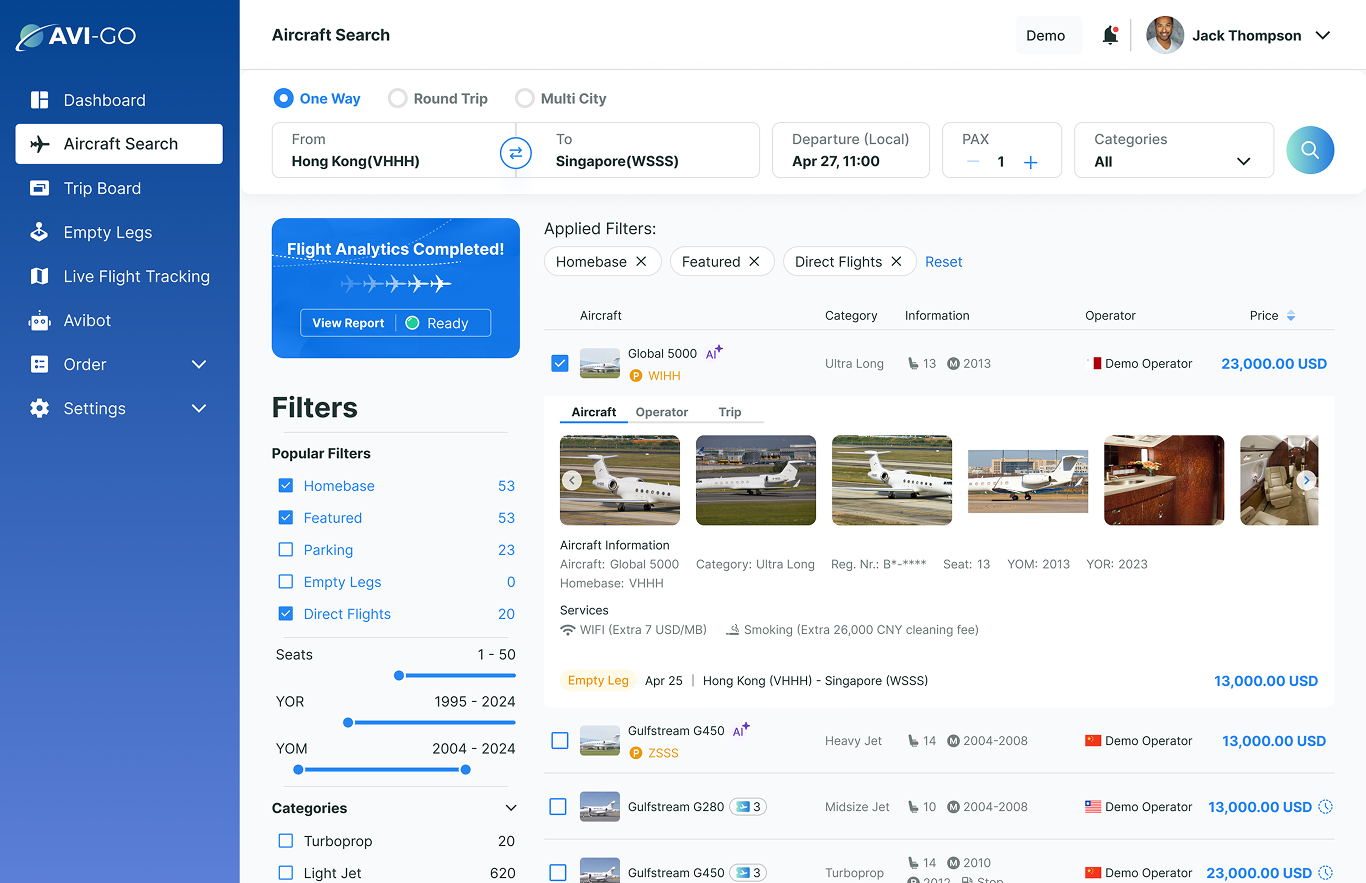
One of Avi-Go’s core strengths lies in its AI-enhanced aircraft search, which quickly delivers filtered aircraft options based on mission parameters—complete with suggested pricing to help brokers quote with confidence. This feature flows directly into a powerful quotation and inquiry management console, where users can move from lead to quote with ease. From open inquiry tracking to fully branded, customizable quote templates, Avi-Go offers a cohesive digital environment that reduces friction and saves valuable time.
What truly elevates this tool is the integration of predictive pricing insights. Avi-Go generates suggested pricing based on current market conditions, historical trends, and aircraft type—helping brokers make informed, data-backed pricing decisions with speed and confidence. This removes guesswork and supports more transparent communication with clients.
Workflow Automation: From Inquiry to Quotation with Zero Friction
Beyond search, Avi-Go provides a dedicated inquiry and quotation management console that brings operational clarity to the full sales cycle. Users can manage open inquiries, track quote status, and generate professional, fully branded quotes from a single dashboard.
The system is built for flexibility and customization—allowing brokers to adapt templates, and respond to clients faster, all while maintaining a polished and consistent experience. For charter teams juggling multiple requests or scaling up operations, Avi-Go’s workflow tools dramatically reduce the manual effort required to move from initial inquiry to final quote.
Navigating What’s Next in Business Aviation
EBACE 2025 has made one thing clear: the business aviation sector is evolving—facing both mounting challenges and unprecedented opportunities. From sustainability regulations and infrastructure pressure to rising client expectations and technological disruption, the landscape is shifting rapidly. Yet in this complexity lies a clear path forward: adaptability, data-driven decision-making, and digital transformation.
Avi-Go stands at the forefront of this movement. By offering a smart, scalable platform tailored to the real-world needs of charter professionals, Avi-Go is helping brokers and operators navigate change with confidence. Whether it’s through AI-powered aircraft search, predictive pricing, streamlined workflows, or real-time data insights via AviBot, the platform empowers users to work smarter, respond faster, and deliver better service in a more competitive market.
As we wrap up another impactful EBACE, Avi-Go remains committed to supporting the industry—not just with tools, but with technology that evolves alongside it. For aviation professionals ready to embrace the future, Avi-Go is already one step ahead.

Luxury Sells: A Broker’s Guide to Private Jet Amenities That Win Clients

Air Charter Marketplace: The Role of Technology in Modernizing the Private Jet Business

Private Jet Charter Cost Estimator and Airline Price Predictor
Ready to Supercharge
Your Business Aviation Tech Stack with AI and Data?
Sign up free and start using the tools available in your chosen plan.
Discover how our aviation technology helps you work more efficiently and grow with confidence.
Subscribe to the Avi-Go Newsletter
Business aviation data, insights, and trends — trusted by 10,000+ professionals worldwide.