
Is Business Aviation Becoming More Sustainable in 2026?


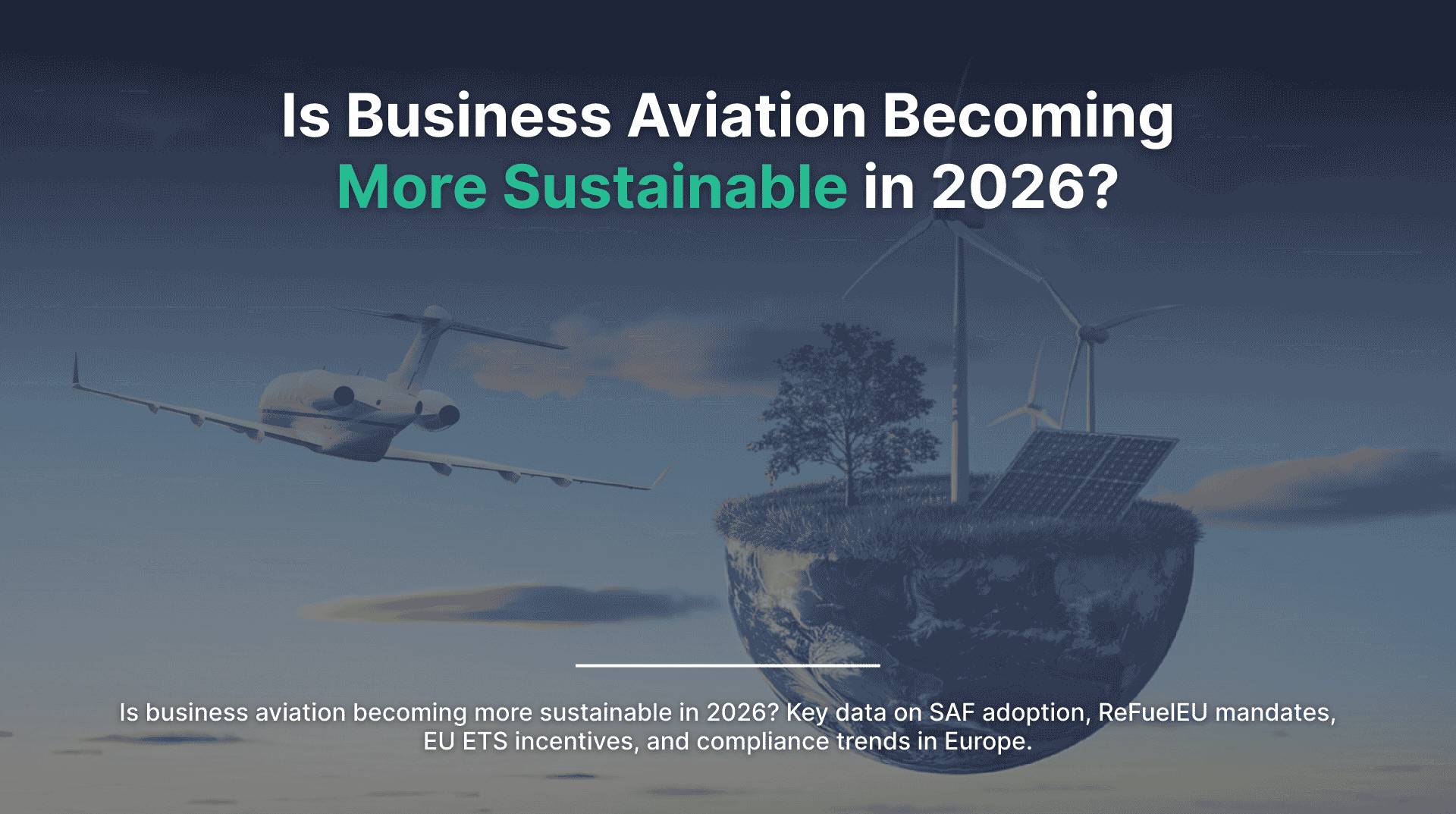
Private jets are often criticized in climate discussions. Globally, aviation contributes around 2 to 3% of energy-related CO2 emissions. Private aviation accounts for roughly 1.8 to 2% of total aviation emissions, equal to about 0.04 to 0.05% of global CO2 emissions.
A 2023 study published in Communications Earth & Environment estimated that private aviation emitted about 15 to 16 million tonnes of CO2 in 2019. While this is a small share of global emissions, emissions per passenger are significantly higher than commercial flights. This is why business aviation faces growing regulatory and reputational pressure, especially in Europe.
So, what has changed in 2024 to 2026?
Sustainable Aviation Fuel Is Becoming Measurable
The biggest shift is the scaling of sustainable aviation fuel, or SAF.
According to the European Union Aviation Safety Agency ReFuelEU Aviation Annual Technical Report published in October 2025:
- SAF accounted for 0.6% of total aviation fuel supplied at EU airports in 2024
- 193 kilotonnes of SAF were supplied
- Around 714 kilotonnes of CO2 emissions were avoided
This is important because it creates a clear compliance baseline. SAF is no longer just a voluntary sustainability action. It is now tracked and reported under a regulatory framework.
For business aviation operators flying in Europe, this means greater scrutiny over SAF usage and emissions reporting.
ReFuelEU Makes SAF a Requirement
Under ReFuelEU Aviation, sustainable aviation fuel blending becomes mandatory, starting with a 2% target in 2025.
This changes the conversation. SAF is no longer only about ESG positioning. It becomes a procurement and compliance issue.
Operators are increasingly expected to provide:
- Clear documentation of SAF claims
- Consistent emissions reporting
- Structured processes rather than occasional fuel uplift
Sustainability is moving into standard operations.
Book and Claim Is Expanding Access
One challenge in business aviation is that SAF is not available at every airport.
To address this, Airbus expanded a SAF book and claim initiative in March 2025 with partners including SMBC Aviation Capital, AerCap, and Luxaviation. Book and claim allows operators to purchase SAF certificates and claim emissions reductions even if the physical fuel is used elsewhere.
For business aviation, this helps solve:
- Limited SAF availability
- Small uplift volumes
- Operational inefficiencies
As long as verification standards are strong, certificate-based SAF claims are becoming more accepted in the market.
EU ETS Is Supporting SAF Economics
Cost remains one of the biggest barriers to SAF adoption.
In September 2025, the European Commission allocated around 100 million euros worth of EU ETS allowances to support SAF purchases for 2024 usage. Over 2024 to 2030, 20 million allowances are set aside, estimated at about 1.5 billion euros in value.
Even if many business aviation operators are not direct beneficiaries, this signals strong policy support. Regulators are actively trying to close the price gap between conventional jet fuel and sustainable aviation fuel.
Compliance Is Becoming More Structured
Sustainability is also becoming a compliance issue.
In May 2024, the International Business Aviation Council released guidance on ETS and CORSIA compliance for business aircraft operators. The guide helps operators understand:
- When flights fall under EU ETS or CORSIA
- How to calculate and report emissions
- How to work with compliance providers
This shows that emissions management is becoming part of routine operational and financial processes, not just a marketing initiative.
Is Business Aviation Becoming More Sustainable in 2026?
Yes, but in a structured and regulated way.
Business aviation still represents a small share of global carbon emissions, yet it faces high visibility and growing expectations. What is changing in 2026 is not just awareness, but implementation.
Sustainable aviation fuel adoption is now measurable. ReFuelEU makes blending mandatory. EU ETS provides financial incentives. Book and claim mechanisms improve access. Compliance guidance is clearer and more practical.
Sustainability in business aviation is shifting from voluntary ESG efforts to policy-driven, data-backed operational strategy. The industry is not fully transformed, but it is moving from intention to structured execution.
In 2026, becoming more sustainable is less about promises and more about measurable action.
As sustainability becomes measurable and compliance-driven, access to accurate aviation data is essential. Explore business aviation insights with Avi-Go only at https://avi-go.com/report-store

Private Jet Charter Cost Estimator and Airline Price Predictor


Best Private Jet Charter Companies 2026

Private Jet Sustainability
Ready to Supercharge
Your Business Aviation Tech Stack with AI and Data?
Sign up free and start using the tools available in your chosen plan.
Discover how our aviation technology helps you work more efficiently and grow with confidence.
Subscribe to the Avi-Go Newsletter
Business aviation data, insights, and trends — trusted by 10,000+ professionals worldwide.