Suite Doors in Business Class Cabins Require Extra Safety Certification, Often Lagging Aircraft Delivery
Why It MattersDoor certification runs on its own track from seat and aircraft approval, so premium cabin launches often precede the full product; the gap shapes how airlines sell and sequence new suites.
What happened
Sliding privacy doors fitted to business class suites require additional safety certification beyond standard seat approvals, because regulators treat the door as a potential barrier between a passenger and an emergency exit. Under Federal Aviation Administration (FAA) requirements, an aircraft must be able to evacuate fully within 90 seconds in darkness, with half of the exits blocked and simulated passenger panic. Manufacturers must show that a door's design, latching mechanism and breakaway features will not meaningfully delay egress.
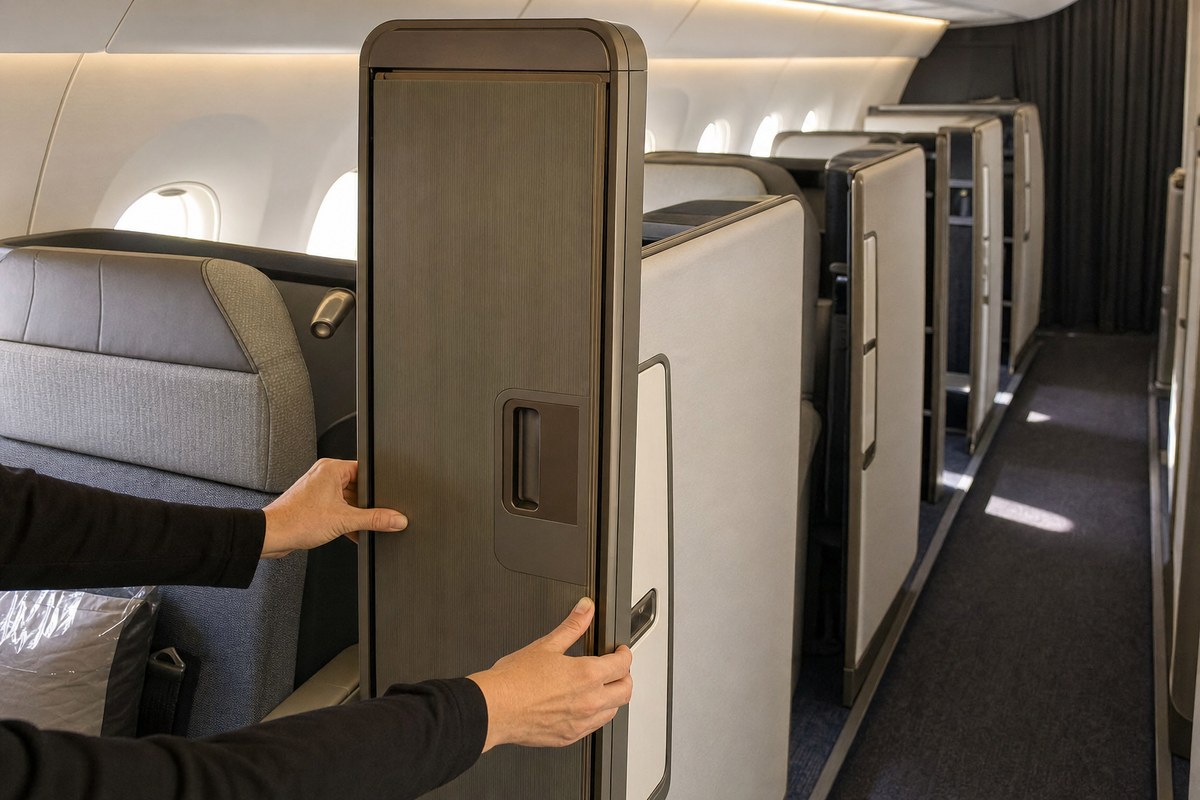
Seat models with doors also undergo dynamic 16g sled tests simulating a survivable crash landing. The door structure, locking pins and tracks must remain intact so that airframe flexing does not jam the door shut. Regulators also require proof that air can flow between the enclosed suite and the main cabin during a rapid decompression, so oxygen delivery and pressure equalization are not compromised.
Operationally, FAA exemption documents and cabin safety guidelines require suite doors to be locked open during taxi, takeoff and landing, so flight attendants have an unobstructed view of passengers and clear exit paths. Passengers may close doors only at stable cruise altitude, and crew can manually override and open any door from the aisle in an emergency.
Where certification has slowed deliveries
The process can prolong seat development. When Qatar Airways worked with Adient on the Ascent seat for its 787-9 fleet, achieving compliance for the sliding door contributed to a two-year program delay, with FAA certification completed in January 2021.
Certification can also lag aircraft delivery. United Airlines' new 787-9 Polaris suites, using the Adient Ascent seat architecture, entered service on April 22, 2026 with privacy doors locked open. The FAA did not grant final certification for the door mechanisms until about three months later, in August 2026, after which United unlocked doors one aircraft at a time.
American Airlines experienced a similar lag with its 787-9 and A321XLR suites, and KLM Royal Dutch Airlines has at times blocked off specific premium seats pending regulatory clearance. Airlines manage passenger expectations through booking disclaimers and proactive notifications, while manufacturers are streamlining early certification filings to shorten the gap between entry into service and full door activation.
Industry impact & what to watch
A suite door is certified as an evacuation question, not a comfort feature, which is why it follows a different path from the seat shell around it. A seat can clear structural and crash testing and still wait on a separate finding about the door, so an aircraft can enter service with the headline premium product only partly usable. The United sequence, with doors locked open for roughly three months and unlocked one aircraft at a time, shows how that plays out in a fleet rollout.
For airlines, the commercial consequence is that the product sold at launch and the product available in the cabin can differ for a period. Booking disclaimers and proactive passenger notifications are the stated tools for managing that difference, and the Qatar Airways program shows that the delay can stretch to years when door compliance is the sticking point.
The manufacturers' move toward earlier certification filings is the lever that would narrow the gap. The measurable signal is how many days pass between an aircraft's entry into service and its first fully operable doors on the next suite launches.