AirVenture 2026 Draws Thousands of Aircraft to Oshkosh as First MOSAIC-Compliant Light Sport Designs Debut
Why It MattersWith certification standards now open, light sport manufacturers can bring larger, more capable, IFR-equipped aircraft to market, widening the entry-level segment beyond the old 1,320-pound limit.
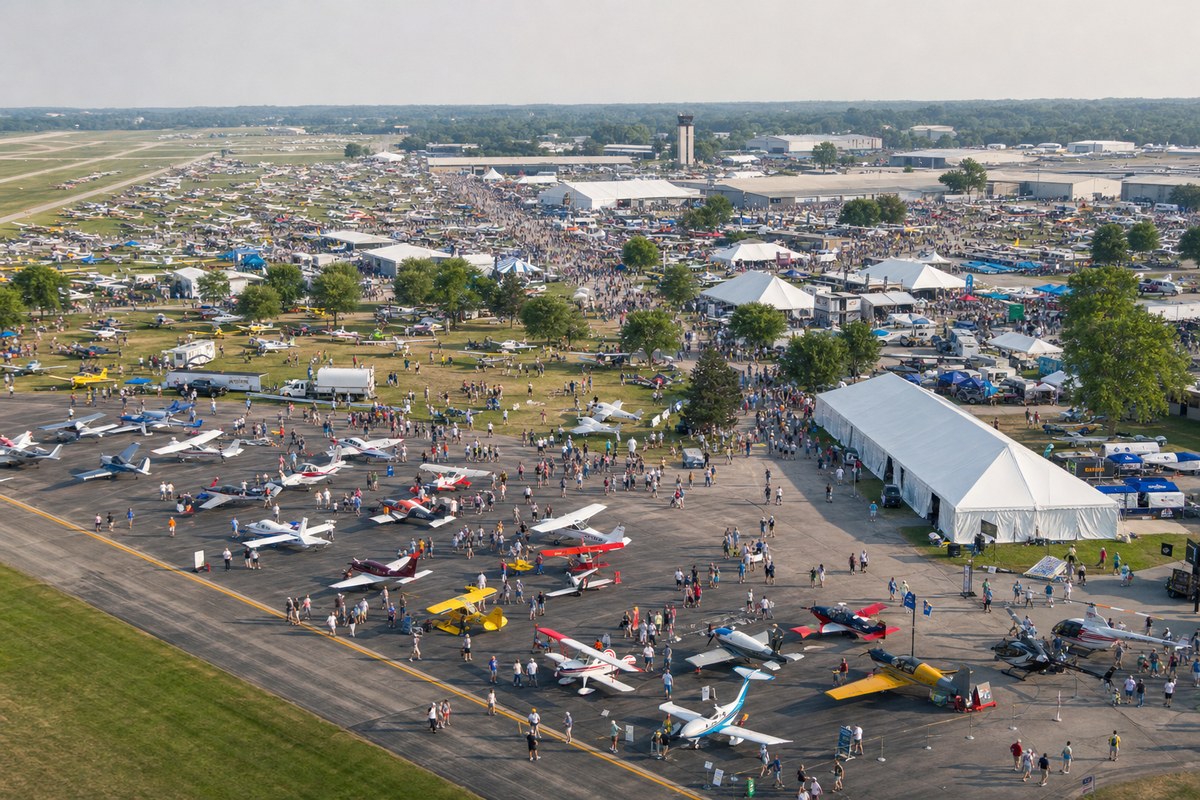
Thousands of aircraft and hundreds of thousands of aviation enthusiasts gathered in Oshkosh, Wisconsin, in July for the weeklong EAA AirVenture. Heavy smoke from Canadian wildfires created IFR conditions and poor air quality in the days before the show, but the haze cleared in time for a full week of flying, forums, exhibits and announcements.
On July 24, the FAA accepted a new set of industry standards allowing manufacturers to begin certifying larger and more capable light sport aircraft under the agency's Modernization of Special Airworthiness Certification (MOSAIC). The rule, finalized during AirVenture last year, removed the 1,320-pound light sport aircraft weight limit created in 2004 and replaced it with performance-based criteria, chiefly a clean-configuration stall speed of up to 59 knots. It lets sport pilots fly aircraft with up to four seats. The Van's RV-12iS became the first factory-built light sport design granted an FAA MOSAIC 14 CFR Part 22 airworthiness certificate and certified for operations in IMC; the pilot must still hold at least a private pilot certificate and an instrument rating. The IFR-equipped RV-12iS has a base price of $246,200. Sling Aircraft North America showed the Sling 2M, a compliant version of the Sling NGT trainer with a gross weight of 1,540 pounds, a useful load of about 600 pounds, an airframe parachute system and the new Garmin Axis flight system, with deliveries expected to begin this year. Arkansas owner Tony Burrow displayed a twin-engine Jabiru J432 powered by two 85 hp J2200 engines and fitted with a ballistic parachute, reflecting a MOSAIC provision that lets properly trained and certified pilots fly sport aircraft with multiple powerplants.
On Boeing Plaza, a Lockheed C-5M Super Galaxy, the largest cargo aircraft used by the U.S. military, was displayed with its nose door open alongside a Boeing C-17 Globemaster III. The Commemorative Air Force's B-17G Sentimental Journey was open for tours and flights, and the C-54 Skymaster Spirit of Freedom, which flew in the Berlin Airlift and is now a mobile museum, was also on display. The American Heritage Museum's PBY-5A Catalina, acquired in 2019 after several years in the Netherlands and restored at American Aero Services in New Smyrna Beach, Florida, drew steady crowds.
Other aircraft included the Zenith CH 750 Super Cruzer, a high-wing all-metal design with a 180 hp Lycoming O-360 and two-plus-one seating, and the Kitfox Patriot Fox, a special-edition Series 7 marking the 250th anniversary of the United States that first flew and was certified on July 4. Bob and Diane Dempster showed a replica of the amphibious Douglas World Cruiser Seattle, built over more than 20 years. An AOPA Piper Archer II was decorated live by artist Noah Heckel, and the Stockton Field Aviation Museum's restored 1945 Douglas A-26C Invader Hell's Belle flew in the afternoon airshow.