Laser Study Finds Alternative Jet Fuel Surrogate Produces Smaller Soot Particles and Lower Soot Loads Than Jet A-1
Why It MattersLaboratory evidence that low-aromatic synthetic kerosene sharply cuts soot formation strengthens the technical case for alcohol-to-jet fuels as a lower-particulate option for aviation, though only at atmospheric burner conditions.
Researchers Brendan Gachot, Cornelia Irimiea, Renaud Jalain, Nicolas Fdida and Xavier Mercier report in Applied Physics B that an alternative aviation fuel surrogate produces markedly smaller primary soot particles, substantially lower soot loads and a different soot structure than conventional Jet A-1 kerosene in turbulent spray flames. The team used three laser-induced incandescence configurations under atmospheric burner conditions to examine particle growth, filament intermittency and spectral emission.
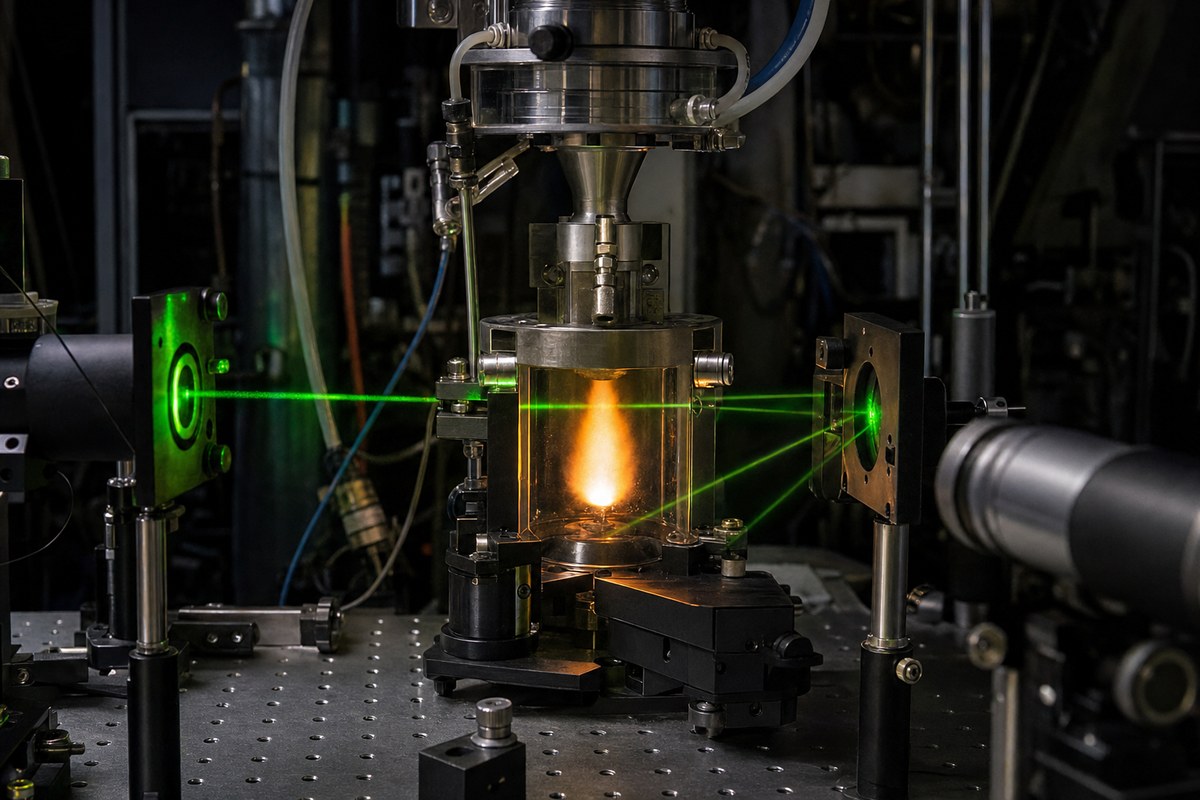
The surrogate, Isopar-M, is a laboratory analog for alcohol-to-jet synthetic kerosene. It consists mainly of branched alkanes with 13 to 15 carbon atoms (84 percent by weight) and contains less than one percent aromatics. Jet A-1 had a density of 800 kg/m3, a dynamic viscosity of 1.3 mPa·s at 293 K and a lower heating value of 43.2 MJ/kg; Isopar-M measured 780 kg/m3, 2.1 mPa·s and 44.6 MJ/kg. Two turbulent atmospheric jet diffusion flames were stabilized on a laboratory burner, both at the same fuel flow of 100 g/h, nebulized with 18 g/h of nitrogen and stabilized by 1,500 g/h of co-flowing air, giving flames about 270 mm tall.
Time-resolved incandescence decay time, which tracks primary particle size, ranged from 50 to 550 ns in Jet A-1, peaking between 140 and 150 mm height. In Isopar-M it stayed between 50 and 150 ns with an essentially flat axial profile, indicating very limited particle growth. Jet A-1 showed longer decay times, pointing to larger, more graphitized aggregates, and an average incandescence intensity about three times that of Isopar-M. Analysis of 35,000 individual filaments showed the 95th percentile of filament surface area in Jet A-1 was 2.6 times that in Isopar-M.