SAF Supplied 0.6% of Global Jet Fuel in 2025 as Mandates Spread, but Scaling Beyond Used Oils and Fats Remains a Challenge
Why It MattersWith 95% of capacity tied to used cooking oil and fats, feedstock supply rather than investment or mandates looks set to cap how far SAF can scale.
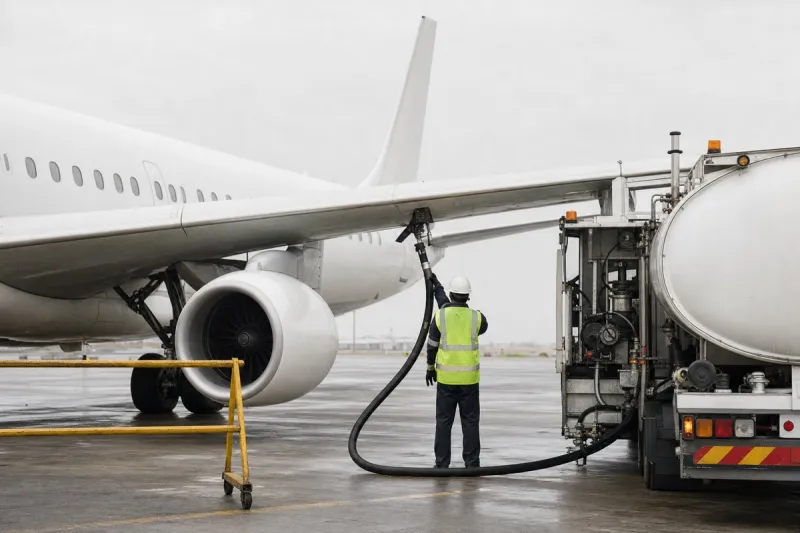
Disruptions to oil shipments and refining in the Middle East have pushed up jet fuel prices and renewed interest in sustainable aviation fuel (SAF), a non-petroleum alternative made from renewable waste and feedstocks. An analysis by Rhodium Group and Bruegel found that SAF supplied 0.6% of global aviation fuel demand in 2025, up from 0.1% in 2021. The International Air Transport Association (IATA) projects 2026 production of 2.4 million tons, roughly 0.8% of global jet fuel production. SAF prices are two to five times those of conventional jet fuel in 2026, so government mandates and volume commitments drive demand.
Europe has the most ambitious mandates. The EU's ReFuelEU Aviation regulation, also adopted by Switzerland and Norway, requires the SAF share of fuel delivered to airports to rise from 2% in 2025 to 6% in 2030 and 70% in 2050, with an electro-SAF sub-target of 5% in 2030. The EU exceeded its 2025 target, with SAF at 2.8% of jet fuel supply. The UK has a similar mandate with rising minimum shares, high penalties and price guarantees for domestic production. South Korea mandates 1% from 2027, rising to 7-10% in 2035, and Brazil requires a 1% emissions cut on domestic flights through SAF in 2027.
Global SAF investment totals $23 billion across 258 projects tracked by the Clean Investment Monitor. Actual annual investment grew from $150 million in 2018 to a peak of nearly $5 billion in 2024, before slowing in 2025. Announcements have stayed relatively steady in the first half of 2026, with new projects representing over 2 million tons of annual capacity announced in Brazil, the US, the UK, Belgium, Denmark and France. Existing capacity is substantially underutilized: 1.9 million tons were produced in 2025 against an estimated capacity of 7.3 million tons.
Operational capacity is concentrated in the US, China and Europe, each accounting for about a quarter (1.6-1.9 million tons). About 2.5 million tons more is under construction as of the second quarter of 2026, including about 850,000 tons in China, 370,000 tons in Brazil, 250,000 tons in Europe and 115,000 tons across five US projects. Counting under-construction and announced projects, China would hold 17% of SAF capacity, the US 32% and Europe 22%, far less concentrated than solar, batteries and wind, where China's share ranges from 72% to 88%.
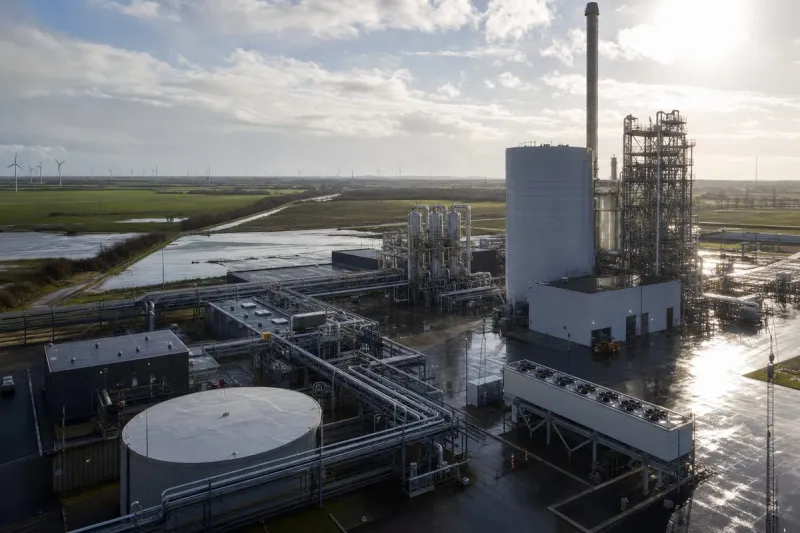
Production is technologically concentrated: almost all (95%) of operational and under-construction capacity uses the hydroprocessed esters and fatty acids (HEFA) route, which converts used cooking oil and animal fats into jet fuel. Supply of these feedstocks is limited: meeting global 2030 SAF targets would require at least twice as much used cooking oil as can be collected in the US, Europe and China combined, and planned HEFA and co-processing capacity of 3.9 million tons in Europe by 2035 is roughly twice what estimated regional feedstock could supply.