Transportation Secretary Sean Duffy Pilots $148,000 Jetson ONE Over NASA's Kennedy Space Center
Why It MattersThe flight shows how personal eVTOL makers use high-profile demonstrations to build legitimacy, while the Part 103 ultralight pathway, not any regulatory change, still defines who can fly these aircraft and where.
What happened
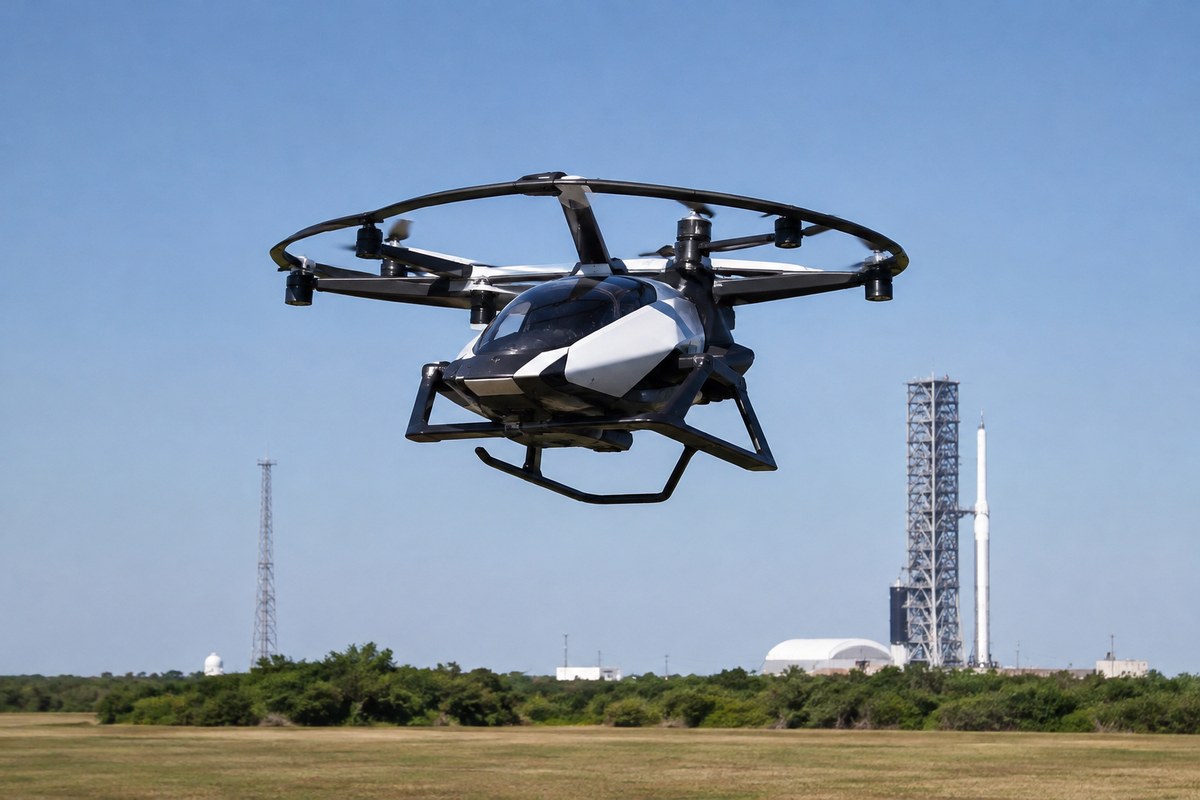
U.S. Transportation Secretary Sean Duffy flew a Jetson ONE solo over NASA's Kennedy Space Center in Florida. Jetson says he became the first sitting U.S. transportation secretary to pilot a personal electric vertical takeoff and landing (eVTOL) aircraft. Duffy lifted off vertically in the single-seat aircraft and performed flybys using its joystick controls; Jetson says the computerized flight system automatically helps stabilize the aircraft. After landing, he said: "Personal flight isn't the future anymore, it's here." His flight did not change any FAA regulations or expand where the Jetson can be flown.
During the November MAX POWER airshow, Jetson flew five aircraft in a synchronized formation from Kennedy Space Center's Shuttle Landing Facility. The event also featured NASA research aircraft and the U.S. Air Force Thunderbirds. One of the five was Astro, the flying police vehicle of the Florida Polytechnic University Police Department, which carries police lights and the registration N911FP. Its participation does not establish that the department has approval for routine police operations; the university has been pursuing separate FAA authorization.
According to Jetson's published specifications, the Jetson ONE has eight electric motors, an open cockpit and a folding aluminum frame. It reaches 63 mph, stays airborne about 20 minutes per charge, and carries one person up to 210 pounds. Listed safety features include a ballistic parachute and radar-assisted automatic landing, and the company says it can remain airborne if one motor fails. The aircraft costs $148,000 before taxes and fees. Jetson says its 2026 and 2027 production slots are sold out, with new orders targeting 2028 delivery.
The Part 103 framework
Jetson designed the aircraft for FAA Part 103 ultralight rules, under which qualifying aircraft can be flown recreationally without a pilot's license or airworthiness certificate. Operators generally must fly in daylight and not over congested cities or outdoor gatherings, and some controlled airspace requires prior authorization.
Jetson lists the ONE at 253 pounds with batteries, just under the 254-pound empty-weight limit for powered ultralights.
Industry impact & what to watch
Personal eVTOL sits in a different regulatory lane from the air-taxi programs that dominate the sector's headlines. Aircraft built to fit Part 103 skip type certification entirely, so their commercial case rests on weight limits, daylight and airspace restrictions, and the willingness of buyers to pay $148,000 for roughly 20 minutes of flight. A senior federal official flying one is a visibility event for that niche, not a change to the rules that bound it.
The sold-out 2026 and 2027 slots, with new orders pointing to 2028 delivery, indicate demand is outrunning production capacity at this price point, at least by the company's own account. The police-vehicle appearance shows where the pressure for expansion is likely to come from: public-safety use, which would need approvals beyond Part 103 that the university department is still pursuing separately.
The next concrete milestone is the Founders Edition aircraft delivered to Rocket Lab founder Sir Peter Beck, which Jetson expects to fly by Christmas, pending regulatory approvals.