BizJet Journal Explains How Maintenance Delays and Parts Shortages Reduce Usable Business Jet Capacity
Why It MattersUsable business jet supply is set by how fast a shop can find, source and release work, so registered fleet counts and announced facilities overstate what can actually fly.
What happened
A BizJet Journal analysis by Joash Koech, published November 9, 2026, argues that business jet maintenance capacity is more than hangar space. It describes capacity as the combined ability to inspect, diagnose, source eligible parts, complete repairs and release aircraft. The article separates registered, active, advertised-for-sale and trip-available aircraft into different populations, so a jet can remain on the register while being unavailable for flying.
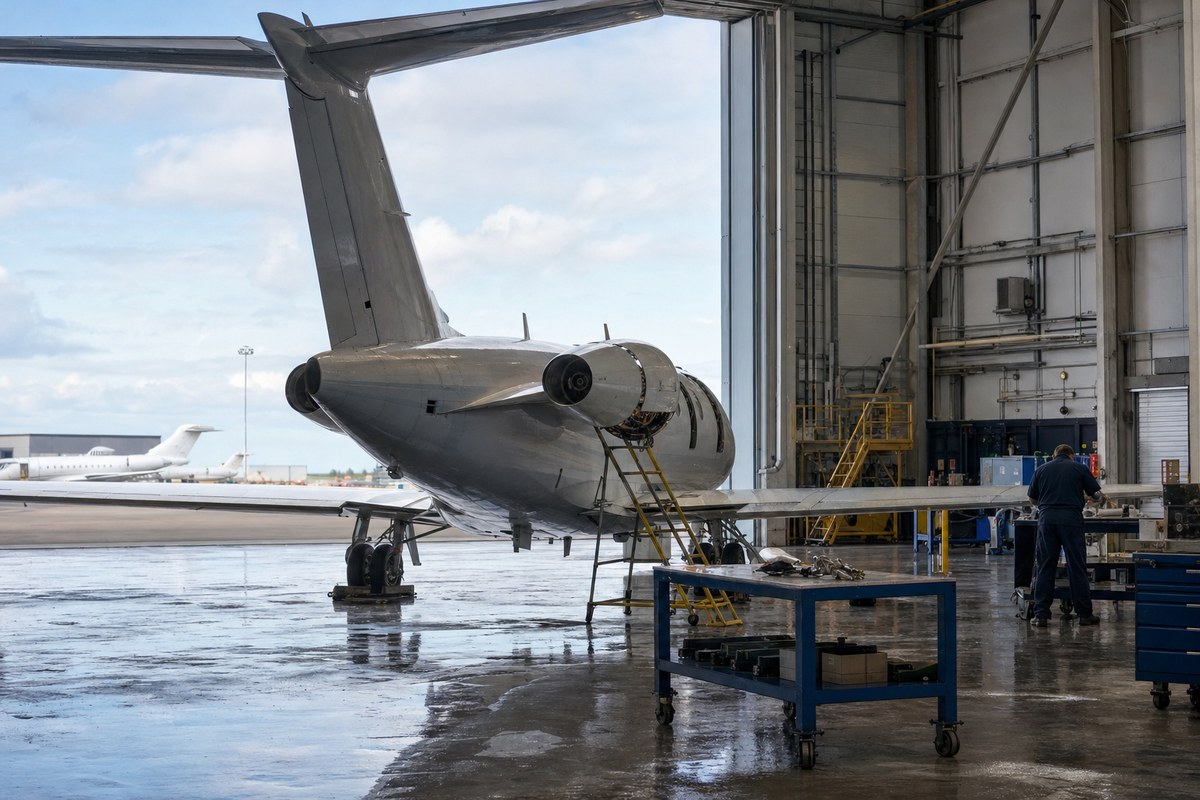
As a first measure the article proposes aircraft-days. Fleet size multiplied by calendar days gives theoretical capacity, and subtracting maintenance downtime gives technical availability. It adds that technical availability is not automatically charter capacity, because crews, positioning, reservations and cabin or runway suitability also constrain use. The release date depends on the slowest required task: in an illustrative 20-day visit, a finding on day eight that needs a part due on day eighteen would move completion to day 21, and if the part arrived on day thirty, completion would move to day 33.
On parts, the article cites FAA guidance that quality, identification and installation eligibility must be established together for US type-certificated products. It compares new, repaired, exchange and loaner components, noting that exchange pricing can depend on returning a qualifying core and that loaners can add later removal and installation work.
In an illustrative 20-jet fleet with 45 days of downtime per aircraft per year, 6,400 aircraft-days are available. An extra 15 days per aircraft removes 300 aircraft-days, a 4.69% reduction, and an extra 30 days removes 600, or 9.38%. Assuming three paid hours per recovered aircraft-day and $3,000 contribution per hour, the conditional contribution forgone would be $2.7 million and $5.4 million respectively. The article stresses these figures require unfilled, economically useful demand and are not necessarily lost earnings.
The article also distinguishes announced projects from delivered capacity. Bombardier announced on June 9, 2026 a planned Singapore facility of approximately 250,000 square feet, expected to begin operations in the second half of 2028, with maintenance and component repair and overhaul capabilities. In an October 19, 2026 announcement, Gulfstream reported more than $3 billion invested in dedicated spare-parts inventory and expanded distribution and component repair capabilities. The article cautions that neither establishes that every needed part is available or that every aircraft's turnaround is faster.
Industry impact & what to watch
The framing shifts attention from how many jets exist to how many can be released to fly. Fleet counts and listings describe aircraft on a register or on the market; what a charter customer or owner can actually use is the slice left after inspection, diagnosis, parts sourcing and sign-off are finished. Because release waits on the slowest task, a single late part can hold an entire aircraft regardless of how much hangar space or labour is free around it.
That makes parts logistics and shop throughput, rather than headline facility size, the variable that governs usable supply. Exchange and loaner arrangements can shorten downtime but carry their own conditions, such as qualifying core returns and extra removal and installation work. The aircraft-days arithmetic also shows how modest additions to downtime compound across a fleet, though the article is explicit that converting recovered days into revenue depends on real, unmet demand.
Announced investment is a different thing from delivered turnaround. A planned facility with operations expected in the second half of 2028, or a large spare-parts inventory commitment, signals intent. The measure that would test it is whether released aircraft-days actually rise for operators using those networks.