IndiGo's A321XLR Flies About 4,200 nm on Mumbai–Amsterdam Route, Detouring Around Pakistan and Iran
Why It MattersAirspace closures can erase most of the range margin on long narrowbody routes, so fuel burn, seat inventory and aircraft rotation drive their economics rather than the published sector length.
What happened
On October 25, IndiGo began operating its Mumbai (BOM)–Amsterdam Schiphol (AMS) service with the Airbus A321XLR, replacing the leased Boeing 787-9 previously used on the route. At about 3,707 nautical miles (6,865 km), it is the world's longest scheduled A321XLR route, with a scheduled flight time of around 10 hours.
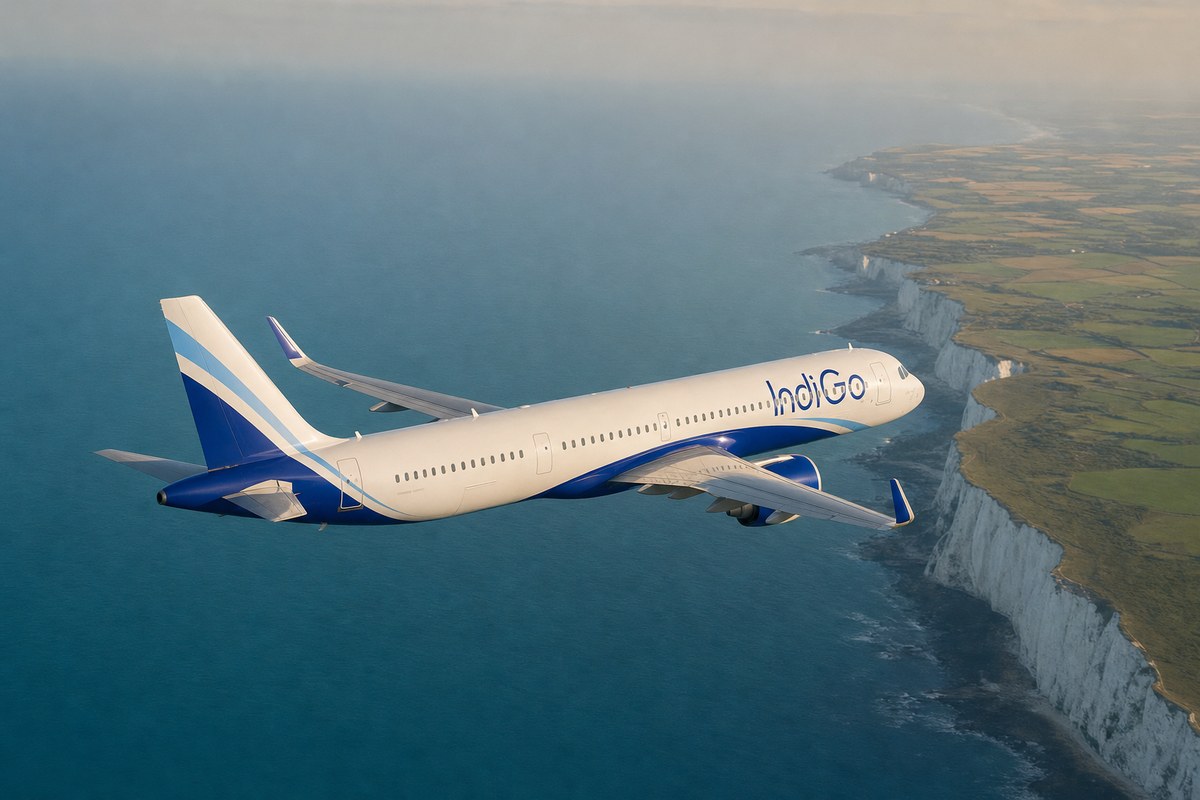
The distance actually flown is longer. On November 1, IndiGo flight 22, operated by A321XLR VT-NLC, left Amsterdam at 2:31 PM local time and landed in Mumbai at 4:10 AM the next morning after about nine hours and nine minutes in the air. It flew southeast across Central Europe toward Turkey and Iraq, then through the Gulf region and Oman, avoiding Iranian and Pakistani airspace. Aerospace Global News puts the distance flown, with those detours, at roughly 4,200 nautical miles (7,778 km), about 13% more than the direct route and closer to the A321XLR's advertised maximum range of 4,700 nautical miles.
Pakistan has closed its airspace to Indian-registered, owned, operated or leased aircraft since April 2025, according to the International Civil Aviation Organization (ICAO), and has extended the restrictions several times. The European Union Aviation Safety Agency (EASA) advises operators to avoid Iranian airspace at all altitudes. The longer routing raises fuel needs and operating costs. According to avicionline, IndiGo is selling fewer than 140 seats on the Mumbai–Amsterdam leg, although its A321XLRs are configured with 195 seats (12 business and 183 economy), meaning more than 25% of capacity goes unsold.
Flight Tracker data for October 25 to November 4 shows flight 6E21 (Mumbai–Amsterdam) averaged nine hours and 36 minutes airborne over 11 flights, about 20 minutes shorter than the 787-9's nine hours and 56 minutes over its final nine flights. In the other direction, 6E22 (Amsterdam–Mumbai) averaged nine hours over 10 flights, versus eight hours and 31 minutes for the 787-9 over 10 flights, 29 minutes slower. The fastest A321XLR flight to Amsterdam took nine hours and 19 minutes (VT-NLD, October 28) and the longest nine hours and 52 minutes (VT-NLD, October 25).
Four A321XLRs have operated the route in the first 11 days: VT-NLC (four flights to Amsterdam), VT-NLD (three), and VT-NLA and VT-NLB (two each). On November 1, VT-NLC had about two hours and 33 minutes between landing in Amsterdam and departing again, allowing the daily service without dedicating several aircraft to it.
Industry impact & what to watch
The route shows how airspace closures reshape the economics of long-range narrowbodies. A published sector length of 3,707 nautical miles suggests comfortable room within a 4,700 nautical mile maximum range, but a flown distance near 4,200 nautical miles leaves a much thinner margin. On a sector like this, the usable payload is set less by the airframe than by fuel reserves and routing, which is consistent with fewer than 140 of 195 seats being offered.
The swap also shows the trade an airline makes when it moves a widebody route to a smaller aircraft. The A321XLR flew the westbound leg about 20 minutes faster and the eastbound leg about 29 minutes slower than the 787-9 on average, so speed is not the differentiator. What the narrowbody offers is lower trip cost and flexibility on a thinner market, bought at the price of fewer sellable seats and a tighter operating envelope.
The next signal is the status of the Pakistani restrictions. They have been extended several times since April 2025, and any further extension keeps the detour in place, while a lifting of the closure would shorten the flown distance toward the 3,707 nautical mile scheduled figure and widen the seat inventory IndiGo can safely offer on the route.