Unidentified Business Jet Flies Rome Ciampino to Tehran Under Apparently Fictitious Identity
Why It MattersTransponder identity is only as trustworthy as its registration records, so a quiet government-linked repositioning flight shows how ADS-B tracking and database checks alone leave sensitive missions open to interpretation.
What happened
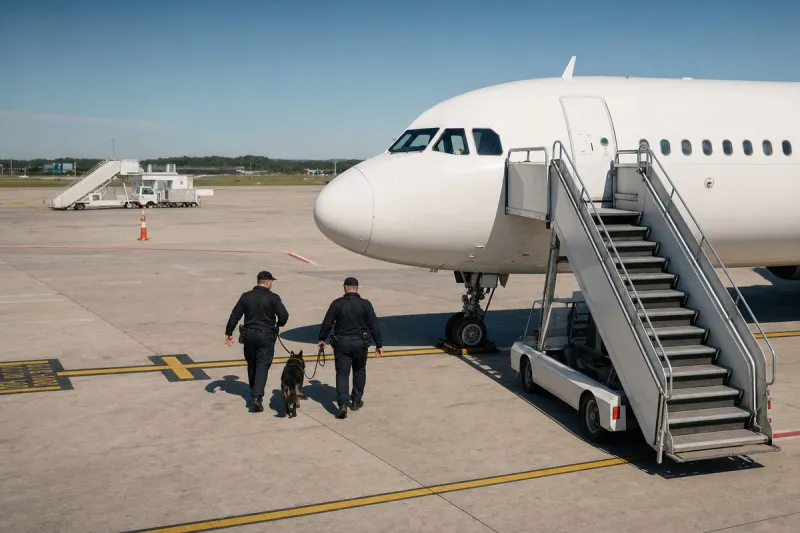
An unidentified business jet took off from Rome Ciampino airport shortly after 01:10 UTC on Nov. 3, 2026 and landed at Tehran Mehrabad Airport at about 04:30 UTC, a flight of roughly three hours and 20 minutes. The aircraft stayed on the ground for approximately eight hours before departing again.

The Italian military aviation tracking website ItaMilRadar first reported the flight, following it on Flightradar24 and ADS-B Exchange. The aircraft transmitted ICAO 24-bit address 300AB4 and callsign ICVMN. The hex code falls within the block allocated to Italy, and the callsign resembles an Italian civil registration, I-CVMN. Searches of public aircraft databases and registration records found no aircraft using either identifier before Nov. 3, 2026, and neither tracking platform showed a registration or aircraft type.
ItaMilRadar examined a possible link to Compagnia Aeronautica Italiana (CAI), a Rome Ciampino-based operator whose Dassault Falcon 900 and Gulfstream G600 jets have been associated with government and secret service missions. The publicly known CAI aircraft are I-DIEM (Falcon 900, Mode S 3004AA), I-GATC (G600, 30090D) and I-ANIG (G600, 30097A). None matches 300AB4, and the callsign does not match CAI's usual AIRCAI identification. The observed flight parameters are consistent with a business jet and with both types, but do not allow a definitive identification.
Earlier cases of changed identities
In January 2025, a CAI Falcon 900 flew the same Rome Ciampino–Tehran route under a temporary identity, I-TWOW, to bring home Italian journalist Cecilia Sala, who had been detained in Iran.
In 2020, a U.S. Air Force RC-135W changed its ICAO address from AE01CE to 750548, a code in Malaysia's range.
Industry impact & what to watch
The flight suggests the jet may have operated with a deliberately altered electronic identity, although that cannot be independently confirmed. An unexpected hex code does not by itself prove deception, since configuration errors or database inconsistencies can also cause discrepancies. Changing a transmitted identity also does not remove an aircraft from primary radar, so the aircraft stayed visible to air traffic control even if public trackers could not name it.
For the business-aviation market, the case shows the limit of open-source tracking. Public ADS-B feeds and registration databases are the main tools used to attribute a flight, and both depend on the aircraft transmitting a code that matches a record. When a code matches nothing, observers are left to infer an operator from the route, the airport and the aircraft's performance, which is circumstantial evidence rather than identification.
The next piece of evidence would be an Italian or Iranian statement, or a registration entry that ties 300AB4 or I-CVMN to a specific airframe. Until one of those appears, the operator and purpose of the flight stay unestablished.