Diamond DA-42NG Lands With Right Main Gear Up at Daytona Beach After Oversized Tire Jams Gear; NTSB Cites Maintenance Error
Why It MattersThe case shows how a single skipped post-installation check on a routine consumable swap can disable a certified landing gear system, putting weight on maintenance verification discipline rather than parts supply.
What happened
A Diamond DA-42NG landed with its right main landing gear retracted at the airport in Daytona Beach, Florida, according to a National Transportation Safety Board accident report published in November 2024. On approach, the pilot selected the landing gear down, but the right main gear failed to extend. After multiple attempts to extend it, the pilot decided to land with the right main gear up.
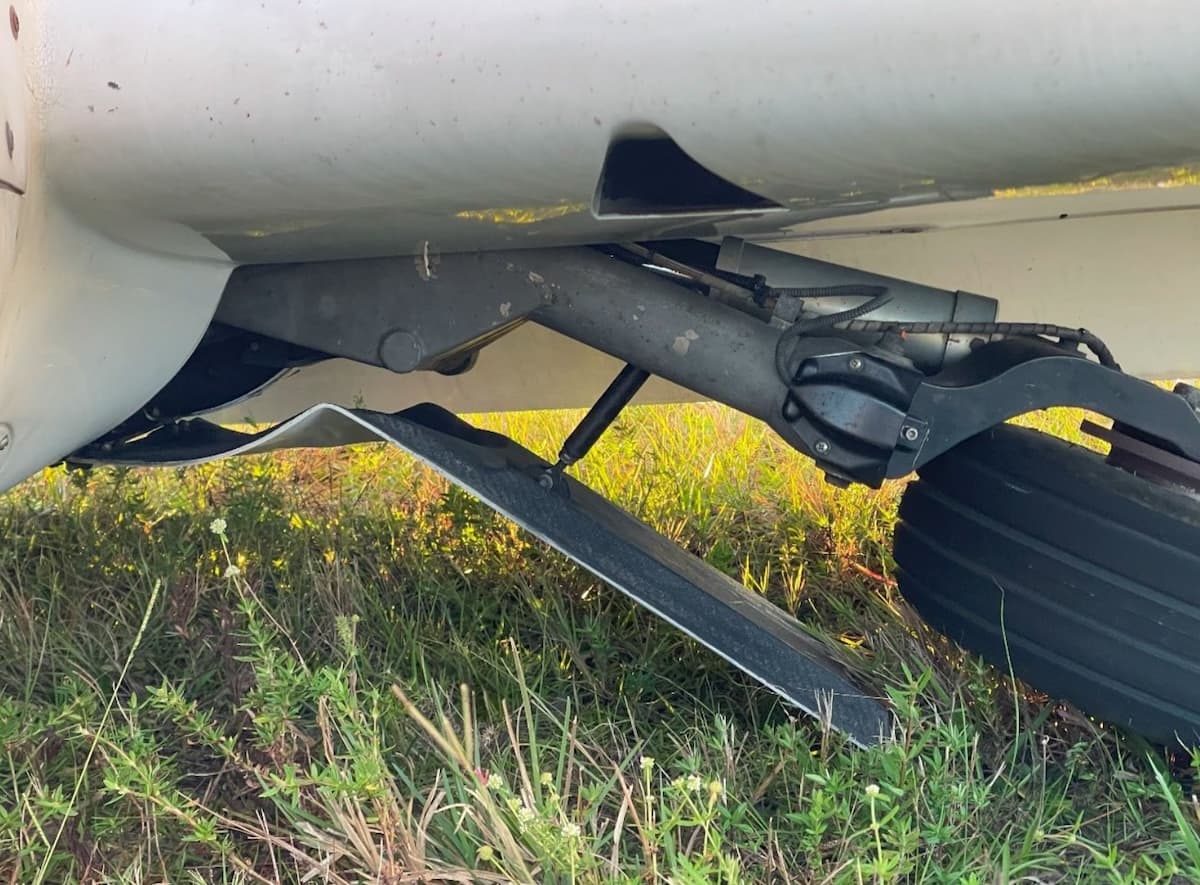
Video showed a smooth landing on the left main gear and nose gear, with the right wing settling onto the runway. The airplane exited the right side of the runway, and the right wing struck an object that the report excerpt does not complete.
Maintenance records showed the right main wheel and tire had been replaced before the accident flight. During the landing gear examination, when the gear was retracted, the tire contacted the outer diameter of the wheel well cutout and the hydraulic system forced it into the well. When selected down, the gear became stuck on the cutout and could not extend. Measurements showed the installed tire, and four others of the same make, model and size, were 0.5 inches larger in diameter than the recommended tire. With the manufacturer's recommended tire, the gear extended and retracted normally.
The DA-42 maintenance manual specifies a minimum tire-to-wheel-well clearance of 4 millimeters, and the larger tread radius of the tire used exceeded that threshold. The manual's wheel and tire replacement procedure requires the landing gear to be retracted and adjusted for this tolerance on every tire change. The technician who changed the tire reported that he did not perform the gear retraction and adjustment afterward.
The NTSB determined the probable cause to be the maintenance technician's failure to follow the manufacturer's recommended procedures during the wheel and tire change to ensure proper tire-to-wheel-well clearance, resulting in the right main wheel becoming stuck in the well and a subsequent partial gear extension landing. The report is published as an educational tool to help pilots learn from the misfortunes of others.
Industry impact & what to watch
A tire change is among the most routine tasks on a piston twin, and that routineness is the exposure. On aircraft with retractable gear, the tire is not an isolated consumable: its outer diameter has to fit a fixed envelope in the wheel well, and the only way to confirm that fit is to cycle the gear after installation. When that confirmation step is treated as optional, the aircraft can look serviceable on the ramp and still fail when the gear is first commanded down in flight.
The measurements point to a second layer. Five tires of the same make, model and size ran 0.5 inches over the recommended diameter, which means the dimensional check cannot be left to the part number alone. For training fleets, flight schools and owner-operators who buy tires in batches and rely on a shop's sign-off, receiving inspection and a documented gear-cycle check are separate controls, and each one covers a gap the other leaves open.
The report itself is framed by the NTSB as an educational document, and its causal finding sits entirely on the maintenance side. The gear-cycle step is already written into the manufacturer's procedure, so the open question is how often that line is signed off without being performed, and that is the figure shops, schools and insurers rarely see.