At Least Seven Europe-Bound Flights Hit by Bomb Threats in One Day; One Diverted, No Explosives Found
Why It MattersHoax threats against several flights in one day show how a low-credibility claim can still tie up aircraft, crews and small diversion airports until each search is complete.
What happened
At least seven flights heading to European destinations received bomb threats on Tuesday, a day after a Wizz Air flight from London Luton Airport (LTN) to Sofia (SOF) diverted to Budapest (BUD) on Monday. Most of Tuesday's flights continued to their destinations as normal, but one diverted, prompting a temporary closure at its new destination. Authorities secured the aircraft on the ground to check that the threats posed no concrete danger. The claims appear to have been unfounded, but the searches kept aircraft on the ground longer than planned and caused considerable disruption.
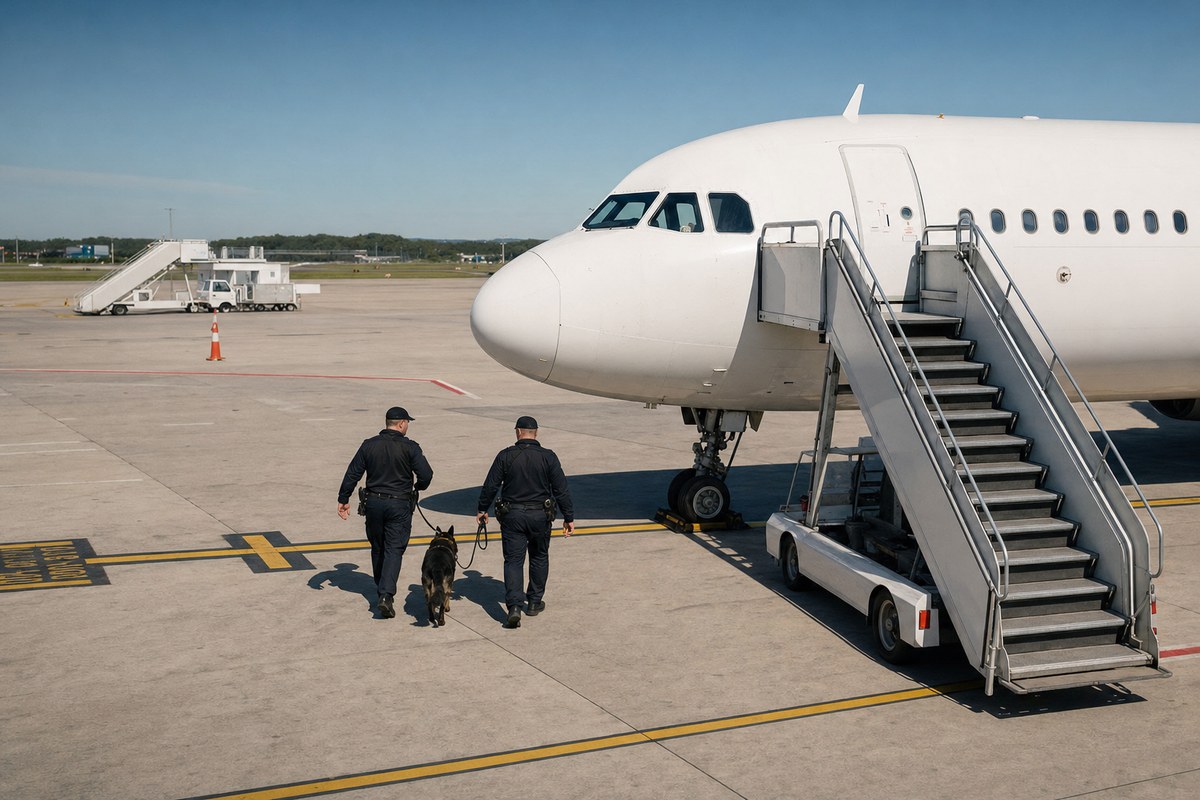
Two of the threatened flights were bound for Warsaw Chopin Airport (WAW). A LOT Polish Airlines flight from London Heathrow (LHR) with 181 people on board diverted to Warsaw Modlin Airport (WMI), which temporarily paused operations. Because Modlin is much smaller than Chopin, disruption was minimal, though Flightradar24 shows a Ryanair flight to Tenerife (TSF) left almost an hour late as a result. SAS flight SK751 also received a bomb threat while flying from Copenhagen (CPH) to Warsaw, where it landed safely. An SAS spokesperson said the airline was following established security procedures.
Three Ryanair flights were also targeted. FR4116 from Manchester (MAN) to Murcia (RMU), operated by Boeing 737 MAX 8-200 EI-IGO, landed 24 minutes early at 10:31 AM local time but was grounded for security checks. The return flight FR4117, normally departing at 11:30 AM, was expected to be around 3.5 hours late after Ryanair ferried replacement aircraft EI-IKY from Alicante (ALC). The flight carried 114 passengers and seven crew members. Two Ryanair flights to Rome Fiumicino (FCO), from Lisbon (LIS) and Dublin (DUB), were searched on arrival after anonymous tips.
In Bulgaria, initial reports linked a threat to El Al flight LY551 from Tel Aviv (TLV), which landed in Sofia 21 minutes early at 9:49 AM; the Boeing 737-900ER (4X-EHF) was airborne again at 11:31 AM, against a planned 11:20 AM departure for LY552. Local media later confirmed that flight was not threatened. Two Sofia-bound flights did receive bomb threats, bringing the day's total to seven, but they originated in Bergamo and Dublin. Examinations of those aircraft after landing also found no concrete evidence of explosives.
Industry impact & what to watch
A cluster of threats on one day, following a Wizz Air diversion the day before, shows how little it takes to pull aircraft out of the schedule. Each threat, credible or not, triggers a full search under established security procedures, and the cost lands on turnaround time, replacement aircraft and the next rotation rather than on any confirmed danger. The Manchester–Murcia case is the clearest example: a flight that landed early still produced a return leg expected to run around 3.5 hours late, with a replacement aircraft ferried in from Alicante.
Diversion choice shapes how far the damage spreads. Sending the LOT flight to the much smaller Modlin kept the effect on Warsaw's main airport minimal, even though Modlin paused operations and one Ryanair departure to Tenerife still left almost an hour late. For operators, the segment-level lesson is that the secondary airport absorbing a threatened aircraft matters as much as the threat itself.
The Sofia confusion also illustrates how early attribution can drift: a threat first linked to the El Al flight from Tel Aviv was later confirmed by local media not to have involved it. The next milestone is whether authorities publish findings on the origin of the anonymous tips.