Learjet 60 With Nine Aboard Crashes in Greenacres, Florida; Transportation Secretary Says All Killed
Why It MattersA fatal loss of a 1990s-design midsize jet shortly after a high-altitude cruise puts attention on how ageing business-jet fleets are maintained and tracked, though the cause remains undetermined.
What happened
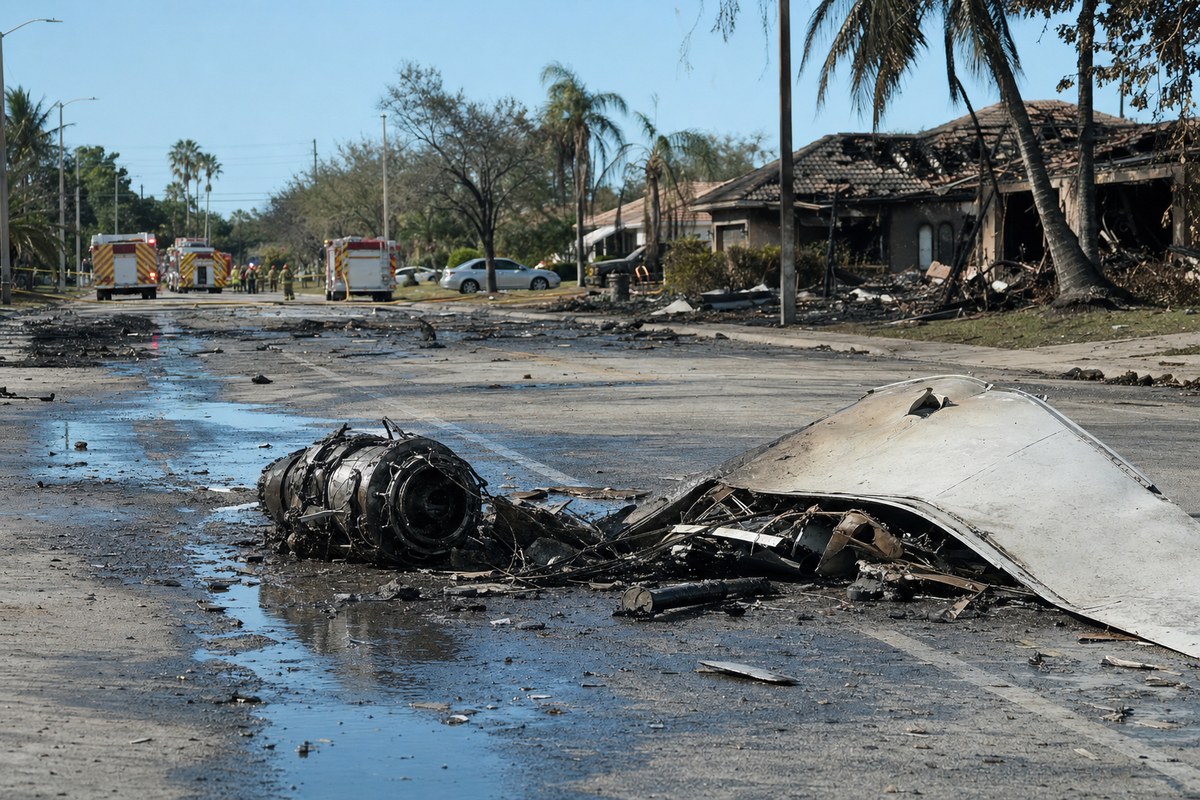
A Bombardier Learjet 60 carrying nine people crashed in a residential area of Greenacres, Palm Beach County, Florida, on November 1, 2026, after a steep nose-down descent. The aircraft came down near Military Trail and 10th Avenue North, roughly six miles from Mar-a-Lago, at about 12:50 local time and erupted into a fireball on impact. Videos shared online show the jet descending at a steep angle before striking the ground and exploding; the impact left a crater in the roadway and sent thick black smoke over the area.
The aircraft was registered N722BD (serial number 60-271) and was flying from Austin-Bergstrom International Airport (AUS) in Texas to North Eleuthera Airport (ELH) in the Bahamas. The Federal Aviation Administration (FAA) confirmed nine people were aboard. Preliminary FlightRadar24 tracking data indicates the jet departed Austin at about 15:37 UTC, climbed to a cruising altitude of around 41,000 feet and continued east toward Florida. It then entered a rapid descent over the West Palm Beach area, with an exceptionally high descent rate shortly before it disappeared from radar.
Palm Beach County authorities closed Military Trail between Cresthaven Boulevard and 10th Avenue North while emergency crews responded. Transportation Secretary Sean Duffy later confirmed on X that all nine people aboard had been killed; their identities had not been released. Whether anyone on the ground was injured was not established in initial reporting. The cause of the descent is unknown.
The National Transportation Safety Board (NTSB) will lead the investigation, assisted by the FAA.
The aircraft type
The Learjet 60 is a midsize business jet developed by Bombardier's Learjet division as an evolution of the Learjet 55. It first flew in October 1990, was certified in January 1993 and entered service later that year.
It is powered by two Pratt & Whitney Canada PW305A turbofan engines, each producing about 4,600 pounds of thrust, and has a maximum operating altitude of 51,000 feet.
Industry impact & what to watch
Accidents involving a business jet in the cruise-to-descent phase tend to move quickly from speculation to a narrow set of investigative questions. Here, the NTSB has said it will examine the aircraft's maintenance history, engine performance, flight-control systems, weather conditions and recorded flight data, and that range reflects how little is established about why the jet left cruise altitude at the rate the tracking data shows.
For the midsize segment, the type's age profile is the context that will draw attention: a design that entered service in 1993 sits in a part of the market where aircraft change hands often and are flown by a mix of private owners, charter operators and corporate departments. Whether that background has any bearing here is not something the investigation has indicated; the cause is undetermined and no finding on mechanical failure, loss of control or another emergency has been released.
The next substantive disclosures will come from the NTSB: a preliminary report, the identification of the people aboard, and any statement on the operator and the maintenance records of N722BD. Until those appear, inferences about fleet-wide implications are premature.