Garmin Autoland, Inspired by 1999 Payne Stewart Learjet Crash, Now Installed in More Than 2,500 Aircraft
Why It MattersAutoland's spread across piston and jet models, plus a first real-world decompression save, shows emergency automation moving from a niche option toward a baseline safety layer for aging pilot populations.
What happened
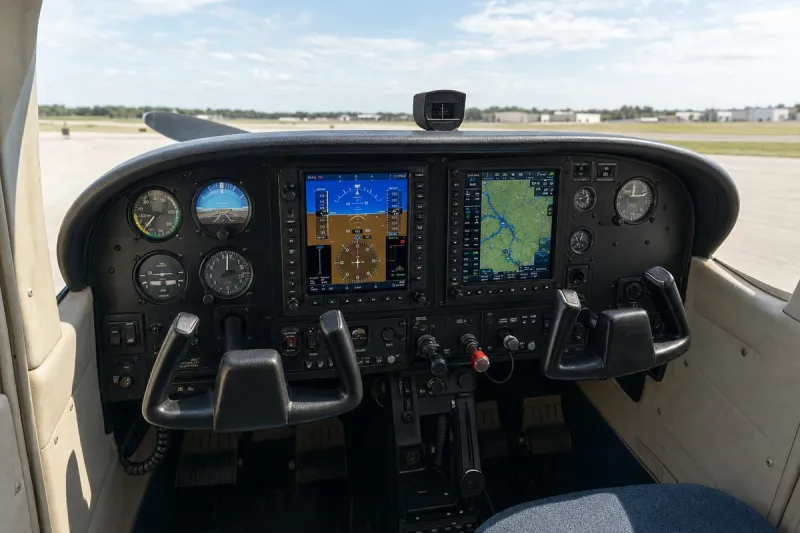
Garmin said earlier this month that its Autoland emergency system has been installed in more than 2,500 aircraft across more than 15 models, including piston-powered aircraft and twin-engine jets. The Federal Aviation Administration (FAA) certified the system in 2020. It is designed to land an aircraft automatically when a pilot is incapacitated.

The system's origin traces to the October 25, 1999 crash of a Sunjet Aviation Learjet Model 35 near Aberdeen, South Dakota, which killed all six people on board, including golfer Payne Stewart. The National Transportation Safety Board (NTSB) found that the flight crew became incapacitated after failing to receive supplemental oxygen following a loss of cabin pressurization, for undetermined reasons. The pilots had been unresponsive to air traffic controllers for roughly four hours before the aircraft went down.
Autoland can be activated by pilots or passengers with a single button, or it can start on its own. It can detect erratic flying, check for pilot responsiveness and take control if needed. An Emergency Descent Mode takes the aircraft to a safer altitude if the pilot is suspected of being unresponsive.
In the first real-world emergency use described, a Beechcraft King Air on a repositioning flight from Aspen lost cabin pressure while climbing to about 23,000 feet (7,010 meters). The two pilots donned oxygen masks and began emergency procedures, but with communications limited they activated Autoland. According to Aviation Today, the system selected Rocky Mountain Metropolitan Airport, communicated with air traffic control, flew the approach, landed, braked and shut down the engines without pilot input.
The NTSB's final report on a December 2024 Airbus AS350 B3 helicopter crash near Potrero, California, found no mechanical malfunction or external collision, but the 53-year-old pilot had severe coronary artery disease and heart damage. A study in Aviation, Space, and Environmental Medicine found a male pilot in his 60s had five times the incapacitation risk of one in his 40s. A 2023 Government Accountability Office report showed the 55–59 age group held about 24,800 active airline transport pilot certificates (14%).
Industry impact & what to watch
Autoland's path from a single 1999 accident to more than 15 certified models shows how a safety gap can take two decades to become a fitted-as-standard expectation. An installed base above 2,500 aircraft across both piston and twin-engine jet types means the capability is no longer confined to one price tier, which changes what buyers and insurers may come to treat as a normal level of equipment.
The King Air event matters less as a single save than as evidence the system performs the whole chain, from airport selection to engine shutdown, when the crew is limited by degraded communications. Incapacitation and decompression risk do not disappear with the technology, and the pilot-age data in the NTSB, medical-study and GAO figures indicates the exposure is tied to a workforce in which a sizeable share of certificate holders sits in older age brackets.
The next evidence point is whether further real-world activations are documented and how investigators describe them, since each one adds to the record of how the system behaves outside certification conditions.