Selling an Aircraft Needs Only Two FAA Forms, but a Seller-Drafted Bill of Sale Can Limit Liability
Why It MattersPrivate aircraft transfers shift most documentation risk onto sellers, since the minimal federal paperwork leaves post-sale liability for maintenance history and logbook gaps to be managed through contract language and disclosure.
What happened
From the FAA's standpoint, selling an airplane is quick and involves minimal paperwork, with no filing fees for the seller. Only two forms are required, and only one needs the seller's attention.
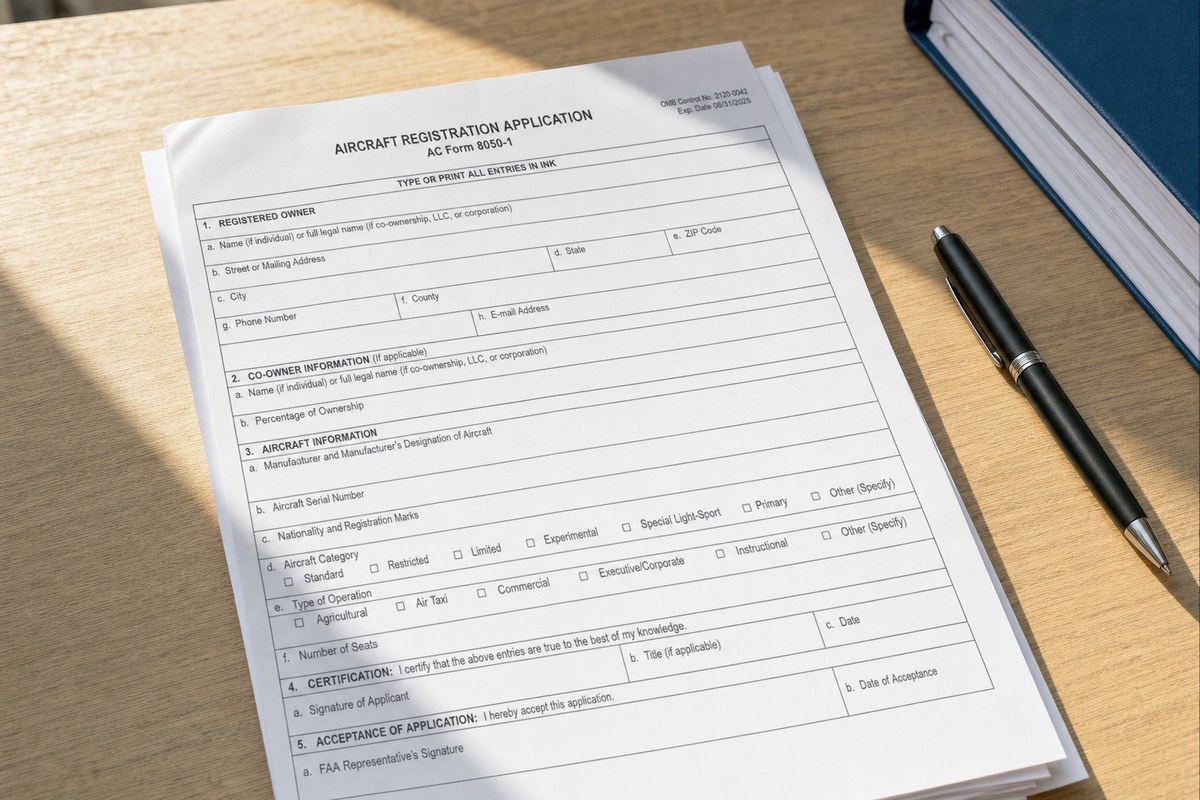
FAA Form 8050-1 is the registration application. The buyer is responsible for completing and submitting it. It requires identification of the buyer or buyers (an individual, a co-ownership, an LLC or a corporation), the appropriate signatures, and a $5 recording fee payable to the FAA, as set out in FAR 47.17 and 49.15.
FAA Form 8050-2 is the FAA Bill of Sale. It has three sections: the first identifies the aircraft by N-number, manufacturer, model and serial number; the second gives the buyer's name and address; the third requires the seller's name, signature and title.
The form's first line refers to "consideration" in dollars. Because the filed document becomes public, buyers often enter a nominal figure such as "$10 and OVC" (other valuable considerations) rather than the actual price. The author notes this does not relieve a buyer of tax obligations, and says a seller should not be alarmed to see such an entry.
The author argues that the standard form can leave sellers exposed to liability, particularly sellers of experimental aircraft who are also the builder. Three scenarios are described: a buyer who skips a pre-buy inspection and later faces a costly repair mandated by an Airworthiness Directive issued before the sale; a buyer who discovers undocumented instrument changes missing from the logbooks; and a buyer or insurer who seeks damages from a prior owner after an engine failure crash in which a post-accident investigation uncovers a questionable maintenance issue from years earlier.
The author recommends that sellers have an aviation lawyer draft a longer, more specific Bill of Sale that limits liability as far as possible, and suggests including the term "As is" in both advertisements and the Bill of Sale. The author also describes personal buying experience, including two sellers who had never registered the aircraft they were selling and an airplane with significant logbook gaps and undocumented damage history, and says he disclosed the known maintenance history when he later sold that airplane.
The author also suggests donating an aircraft to a non-profit with IRS 501(c)(3) tax-exempt status, which provides the donor a tax receipt.
Industry impact & what to watch
In the used-aircraft market, the regulator's role in a sale ends at recording the transfer. Everything that determines who bears the cost of a hidden defect, an old Airworthiness Directive or a gap in the logbooks sits in the private contract between the parties. That is why the Bill of Sale is where liability is actually allocated, and why a one-page standard form leaves most of that allocation open.
The three scenarios the author describes share a structure: the problem surfaces after ownership has changed, and the claim travels back up the chain of owners. For sellers of experimental aircraft who built the airplane themselves, the exposure is closer to that of a manufacturer than of a casual reseller. Clear logbooks, disclosed maintenance history and explicit "As is" language all work to narrow that exposure, while a buyer's pre-buy inspection works to narrow the buyer's own.
The point to watch is how much of this a seller's own counsel can settle in the contract itself. A tailored Bill of Sale limits what a buyer or insurer can later argue about the sale, but it does not change what the FAA records, and it sits alongside the tax questions the author raises on declared consideration.