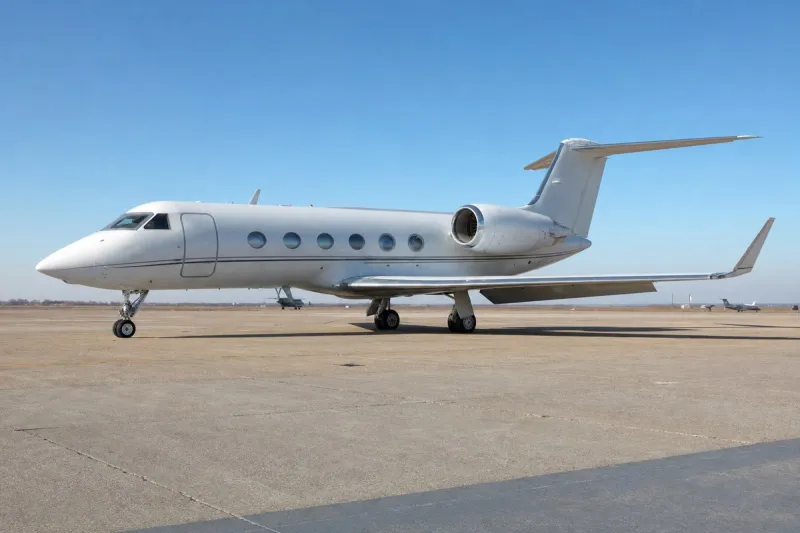
Global Business Jet Departures Fall 2.4% in Week 44 as Halloween Lull and Riyadh FII Postponement Weigh
Why It MattersA calendar-driven weekly dip, a cancelled flagship event and falling charter volumes show how sensitive weekly demand is to scheduled events, while fractional flying holds up better than branded charter.
What happened
Global business jet activity fell 2.4% year-on-year in Week 44 (26 October–1 November), with just over 74,000 departures operated worldwide, according to the WINGX Global Market Tracker. The four-week trend has turned slightly negative at -0.5%, while the year-to-date figure stands at +3.0% through 1 November. Week 44 was the weakest week since early September.

Halloween fell in Week 44 in both years. WINGX data show US business jet departures in Halloween week were lower than the average of the preceding three weeks in all 20 years from 2006 to 2025. This year's dip was 11.2%, the deepest since 2018 and about 2–3 points weaker than the recent norm; the 2021–2025 average was 8.2% and last year's was 9.3%.
North America slipped 1.6% to just over 53,300 departures. The United States, with 51,699 flights, was down 1.3%, while Canada fell 9.4%. Europe eased 2.4% to just over 9,550 flights, with year-to-date at +1.1%. Central America (-21.7%) and the Middle East (-22.5%) were the weakest regions. Africa (+7.9%), South America (+6.9%) and the Caribbean (+5.8%) grew, and Argentina (+85%) was the largest contributor to growth.
Mexico's departures fell 22.5%, driven by domestic flying, which dropped 33%, while international departures were down 2%. Routes into and out of Toluca lost 208 flights (-25%), almost half of Mexico's total decline. Acapulco–Toluca fell from 79 to 28 flights. Part of that drop reflects calendar timing around the Day of the Dead holiday.
Riyadh and the Gulf
Saudi Arabia's departures fell 74.7%. Last year's Week 44 coincided with the Future Investment Initiative (FII) in Riyadh, when movements at Riyadh's airports reached 548, about double the usual level. This year's edition, planned for 26–29 October, was postponed to 2027, and Riyadh movements were just 104. Gulf departures as a whole fell 44%.
Operators and the used market
Fractional operators were the only major operator type to grow, up 3.2%, while branded charter fell 8.3%, its fourth consecutive weekly decline.
JETNET data show 1,784 business jets listed for sale, 6.9% of the in-service fleet and up for a fourth consecutive week.
Industry impact & what to watch
Much of Week 44's weakness traces to two identifiable causes rather than a broad demand shift: a Halloween effect that has appeared every year for two decades, though deeper than usual this time, and a one-off event swing in Saudi Arabia. Event-driven flying can briefly double traffic at a single hub, so when a flagship conference is moved, the year-on-year comparison swings sharply for the host country and for the Gulf as a whole.
The operator split points to where demand is more resilient. Fractional programmes grew while branded charter declined for a fourth straight week, which suggests that owners and programme members are still flying while on-demand buyers are pulling back. Rising for-sale listings, now at 6.9% of the in-service fleet and up for a fourth week, are worth reading alongside that, because sustained increases in available inventory tend to shift pricing leverage toward buyers.
The next weekly readings will show whether the 2.4% decline fades once the Halloween and Day of the Dead calendar effects drop out of the comparison. The Riyadh comparison stays distorted until the postponed FII's 2027 date arrives.