Computer failures at NATS, FAA, and Alaska Airlines expose aviation's systemic dependence on ageing technology
Why It MattersRepeated air-traffic and airline computer failures show that redundancy built into legacy systems can fail as a single point when backups share the same faulty data or hardware.
What happened
A computer failure at National Air Traffic Services (NATS), which manages most aircraft moving through British airspace, knocked its flight-processing system offline for about three hours, wiping more than 1,750 flights from airline schedules. Aircraft ended up scattered across the wrong airports and crews exhausted their permitted working hours before normal operations could resume.
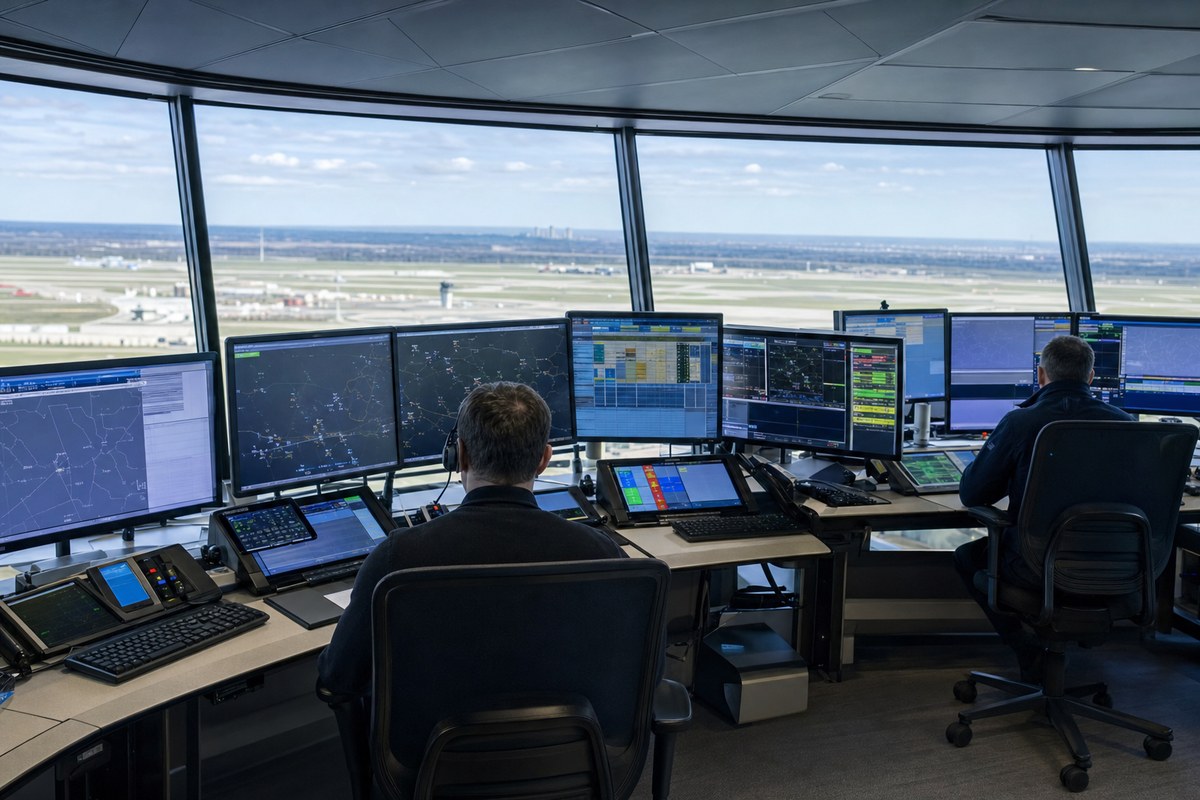
The failure echoed an earlier NATS breakdown in August 2023, when a flight plan from Los Angeles to Paris contained two waypoints sharing the same identification code — one in Mexico, one in Japan. Unable to resolve the ambiguity, the primary computer shut down; its backup received the same data and followed suit. Investigators classified the event as a "critical exception error." More than 700,000 passengers were affected at an estimated cost of up to £100 million, and recovery was further delayed because the specialist required for a manual restart was working remotely and had to travel to the control centre.
The United States experienced a comparable disruption in January 2023, when the Federal Aviation Administration halted all domestic departures for nearly two hours after the system distributing Notices to Air Missions — alerts covering runway closures, hazards and other pre-flight information — failed. Contract workers had accidentally deleted files while attempting to fix a synchronisation problem between the main database and its backup. By the time departures resumed, approximately 1,300 flights had been cancelled and around 11,000 delayed.
A faulty update from a cybersecurity company later crashed Windows computers worldwide, taking airline check-in and dispatch systems offline and disrupting baggage and passenger-processing services at airports. Delta Air Lines struggled for several days after its main US competitors had recovered, because the outage also struck software used to match crews with aircraft. In July 2025, Alaska Airlines halted its entire operation for roughly three hours after hardware failed at a data centre, causing more than 150 cancellations; the airline said the failed component had carried multiple redundancy layers, each of which failed at the same time.
South Africa's Air Traffic and Navigation Services (ATNS) spent two years recovering from unreliable navigation systems and a shortage of controllers, and had failed to maintain instrument approach procedures at Richards Bay, Upington and Bloemfontein's Bram Fischer International Airport. A committee appointed by transport minister Barbara Creecy identified gaps in safety governance and weaknesses in communications systems in March 2025. ATNS subsequently approved R1 billion for modernisation, but by October controller staffing stood at 70 percent of requirement.
Industry impact & what to watch
These episodes belong to the same pattern: air-traffic and airline computer systems built with backups still go down together, because the failure originates in shared data or shared hardware rather than in a single component. A waypoint code duplicated across a primary and backup system, or a redundant data-centre component whose layers all failed at once, defeats the purpose redundancy was meant to serve.
The segment runs on infrastructure that is decades old in places and on a small pool of specialists able to intervene manually when automated recovery fails — NATS needed a remote specialist to travel to the control centre before it could restart. That scarcity turns a technical fault into an extended, highly visible disruption measured in cancelled flights, delayed passengers and direct cost, as the £100 million estimate from the 2023 NATS event shows.
What comes into view next is whether regulators start requiring proof that backup systems are tested against the same fault, not just present as a second unit. ATNS's R1 billion modernisation programme and its controller staffing, still at 70 percent of requirement as of October, is one concrete marker to track; whether NATS or the FAA publish comparable modernisation commitments after their own outages is another.