Sharing an Air Ambulance Between Two Patients Can Cut Costs, but Medical Suitability and Ethics Must Come First
Why It MattersShared air ambulance missions are a conditional cost lever: clinical compatibility, cabin configuration and consent gate any pairing, so savings come only where operating costs and patient dignity both hold up.
What happened
An industry commentary published by aerospace-innovations.com argues that combining two patients on a single international air ambulance mission can lower per-patient costs, but only where medical, operational and ethical conditions allow it. Aircraft positioning, flight crew, fuel and airport handling stay largely the same whether one or two patients are carried, so a shared mission can spread those costs across both cases.
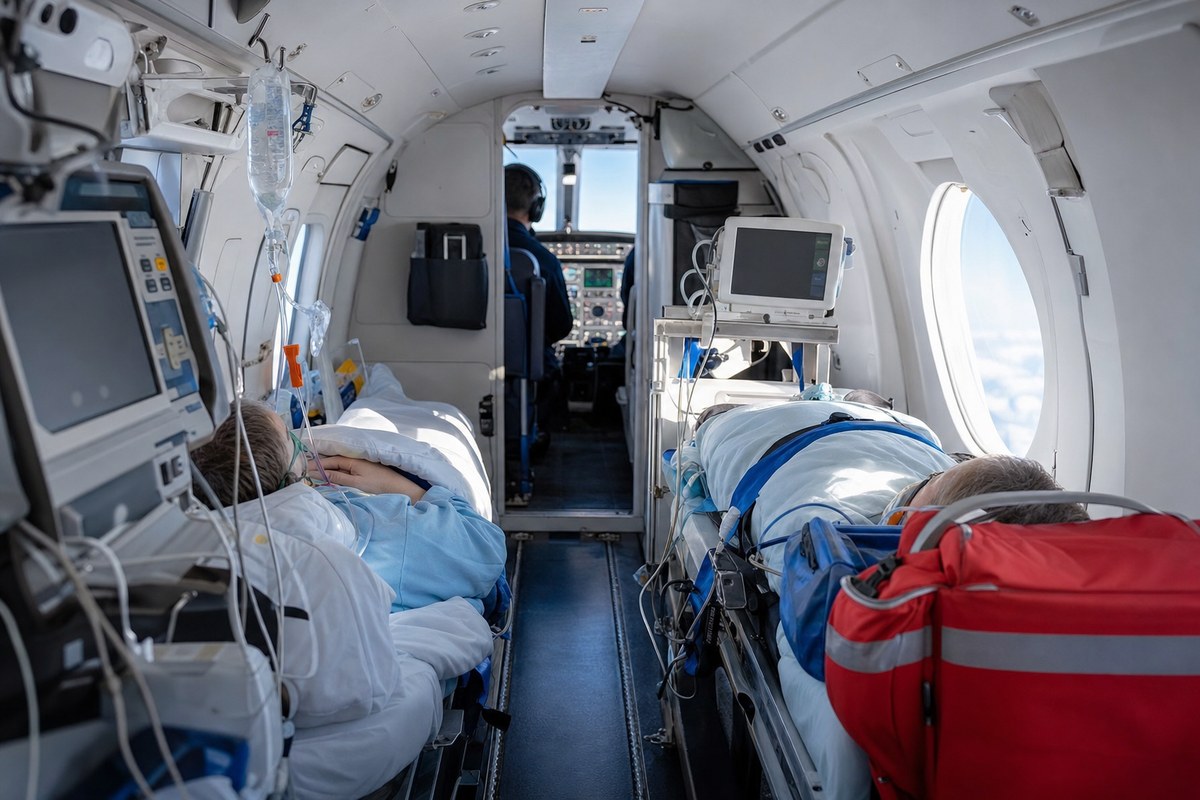
The commentary gives the example of two patients repatriating from the same country to nearby destinations. One flight would save positioning effort and flight time and may reduce costs for insurers. The savings are not automatic: additional medical personnel, equipment, airport stops and longer flight times can offset part of the benefit, so a shared mission should be assessed on its actual operating costs rather than assumed to halve the price.
Medical compatibility is described as the decisive factor. Patients on a compatible route may still need very different care: one may be recovering from orthopaedic surgery with limited mobility, while another needs continuous monitoring, supplemental oxygen and regular medication. Pairing is considered feasible only for patients with few complications and minimal intervention needs, and infectious disease can rule out shared transport even for stable patients. Sharing an aircraft does not mean sharing a medical crew; depending on clinical severity, extra medical staff may be needed.
Aircraft suitability goes beyond counting stretchers. Cabin size, stretcher and equipment configuration, access to each patient in an emergency, emergency exits, and weight and balance all matter. Extra equipment, staff and supplies affect range and fuel planning on long missions, and patients heading to different destinations may require separate ground transfers and coordination with receiving facilities.
On ethics, the commentary stresses privacy, confidentiality and consent. Patients able to decide should agree to share the cabin, while for those lacking capacity proper medical and legal steps are needed. It warns that families facing a large repatriation bill may feel pressured to accept a shared flight, and that operators must not let cost override medical suitability or dignity. If one patient has an emergency, an unplanned diversion can affect the other, so contingency planning is needed. The author concludes that multi-patient missions have a legitimate place when circumstances are appropriate.
Industry impact & what to watch
The commentary reflects how air ambulance economics work: a large share of a mission's cost sits in the aircraft and crew rather than in the individual patient, which is why pooling two cases on one sector looks attractive to insurers and assistance providers. But the cost saving is only as good as the clinical match. Once a second patient brings extra medical staff, equipment or stops, part of the benefit disappears, and the mission has to be priced on its real operating profile.
For the segment, this puts the burden of proof on the operator's medical and operations teams. Pairing decisions depend on patient acuity, infection status, cabin layout, emergency access to each stretcher, and weight and balance together, not on route overlap alone. Consent and confidentiality add a further gate, and the pressure a large repatriation bill can place on families means the way a shared option is offered matters as much as the price attached to it.
The point that would settle whether a given pairing is sound is the combination of clinical assessment, aircraft configuration check and documented patient consent, taken together before any quote is issued. A shared flight that passes all three is a legitimate cost-sharing product; one that skips any of them is not.