Kid Rock's Challenger 600 N71KR Flies Nashville to Tuscaloosa in 36 Minutes
Why It MattersThe leg shows an older large-cabin jet being used for a short regional hop well below its 3,300 nm range, the kind of high-frequency, short-sector usage that sustains regional airports.
A Bombardier Challenger 600 registered N71KR and linked to Kid Rock flew from Nashville (John C Tune) to Tuscaloosa National on October 24, 2026. The aircraft departed at 17:18 UTC and landed at 17:54 UTC, a flight time of 36 minutes. The great-circle distance between the two airports is 186 nm (214 miles). It averaged a ground speed of 308 kt and reached a top speed of 451 kt. Celebplanes estimates the flight burned about 169 gallons of jet fuel and released about 1,627 kg of CO2, roughly the same as driving a car 4,026 miles.
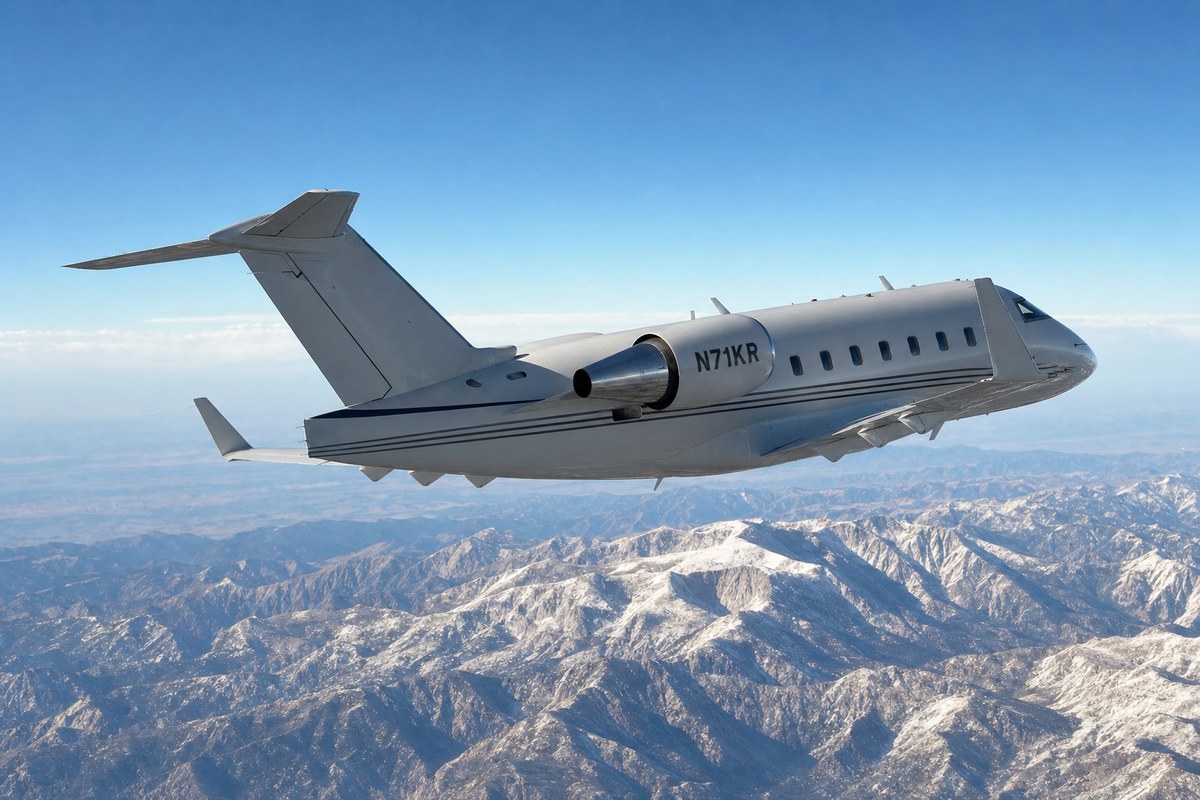
The Challenger 600 is a Large-class jet that can fly 3,300 nm without stopping, seats up to 14 passengers and cruises at Mach 0.82. In service since 1980, it was the first business jet with a supercritical wing. The flight used about 6 percent of the aircraft's total range. John C Tune's longest runway is 6,001 ft at 495 ft elevation; Tuscaloosa National's longest runway is 6,498 ft at 170 ft elevation. The distance from Kid Rock's home base at Oakland County International to Tuscaloosa is 601 nm.
This was N71KR's second tracked landing at Tuscaloosa in the tracked window; the previous one was on September 26, 2026, 28 days earlier. Two other tracked aircraft landed at Tuscaloosa in the 24 hours before this flight: a Cessna 680 Citation Sovereign linked to Kalen DeBoer and a Bombardier Global Express XRS linked to Jared Isaacman. The aircraft had been on the ground in Nashville for about eight days, and its previous tracked flight was a 2-hour, 1-minute leg from Teterboro to Nashville on October 16.
In the 30 days before this flight, the aircraft visited five airports, flew 6 flights totaling 8.8 hours in the air and covered about 3,268 nm, producing an estimated 23,617 kg of CO2. The longest leg in that period was Camarillo to Nashville on September 25, covering 1,576 nm. Its estimated fuel burn is 280 US gallons per hour. Among 40 tracked flights in the window from June 20 to October 16, the most common destination was Nashville, with 13 landings; its usual destinations include Nashville, Las Vegas, Marfa and Austin.