Sceye's Solar-Powered Stratospheric Airship Completes 18,641-Mile Round Trip to Japan in 30-Day Mission
Why It MattersThe test signals stratospheric platforms advancing as a potential lower-cost alternative to low-Earth orbit satellites for wide-area mobile connectivity and disaster response.
Aerospace company Sceye has completed a 30-day trans-Pacific test flight with its solar-powered stratospheric airship, covering 18,641 miles (30,000 kilometers) in a round trip from New Mexico to Japan and back. The Service Test 1 (ST1) mission launched on August 9, flying through Earth's stratosphere, operated for one week over Japan to test high-speed connectivity for emergency and disaster response scenarios, and returned to airspace near Sceye's headquarters in Moriarty, New Mexico, on September 5, where it completed additional testing before a planned termination and descent.
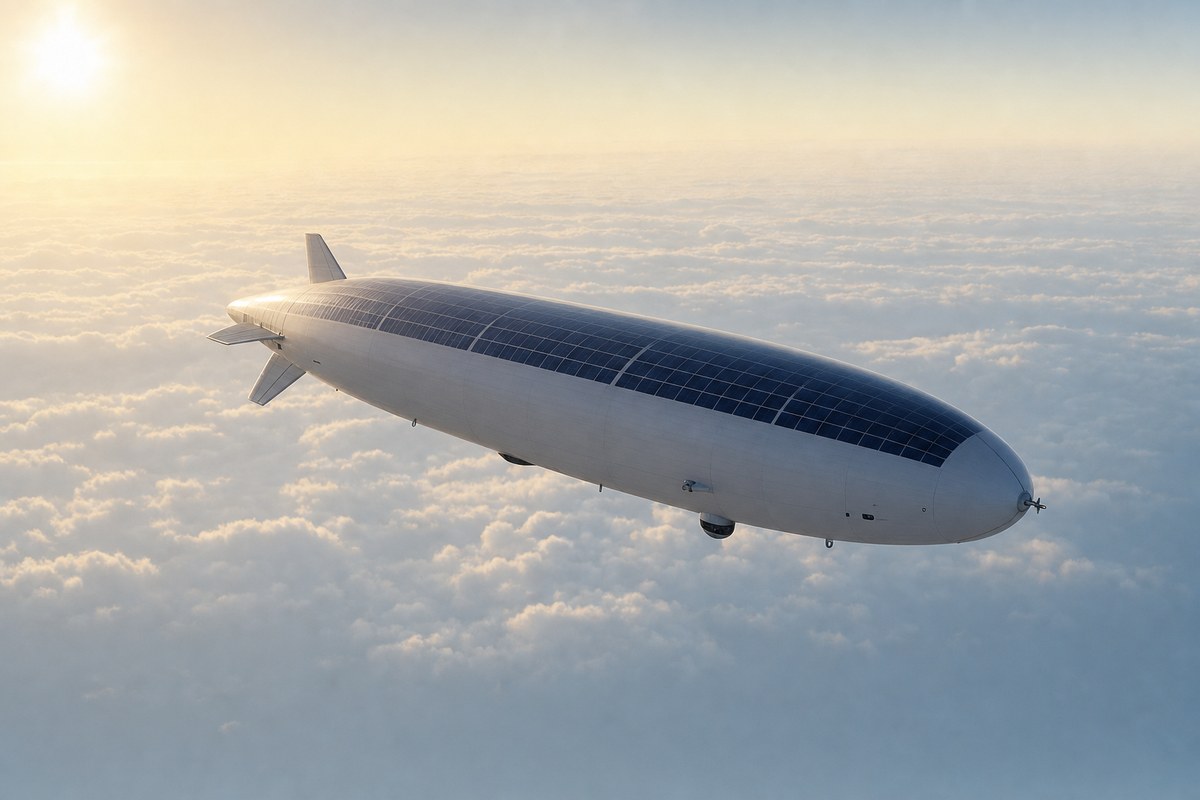
Sceye's vehicles, formally classified as High Altitude Platform Systems, use helium buoyancy to remain airborne without consuming fuel or electrical energy, with solar cells mounted on the hull powering the communications payload and helping the craft maintain position against stratospheric winds. The design allows the airships to remain suspended in the stratosphere for months or years at a time.
ST1 carried SceyeCell, an airborne cellular network antenna designed to deliver wide-area mobile broadband directly to standard devices from the stratosphere, and during the flight the airship demonstrated text messaging, voice calls, internet access, video streaming, emergency alert messaging, and communications with drones. Sceye said a single airship deployed at full scale could cover the equivalent area of approximately 500 terrestrial cell towers, and positions the technology as a lower-cost alternative to low-Earth orbit satellite connectivity, noting its vehicles operate similarly to a geostationary satellite but approximately 1,800 times closer to Earth.
Mikkel Vestergaard Frandsen, Founder and CEO of Sceye, said the mission proved the company's technology, vehicle systems, payload, and operational infrastructure are ready for connectivity services, and that the stratosphere is where the future of non-terrestrial infrastructure lies.