TUM and SJTU Researchers Propose 'Bounded Adaptation' Framework to Transfer Warehouse Logistics Control Methods to Low-Altitude Drone Operations
Why It MattersTreating low-altitude traffic as a material flow problem alongside air traffic management points to a possible future layer of cargo-mission dispatching for urban air corridors, though it remains conceptual and unvalidated.
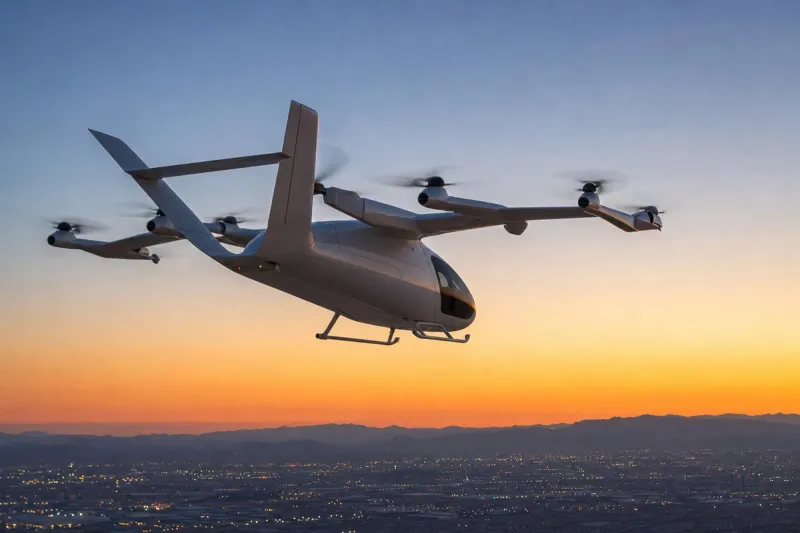
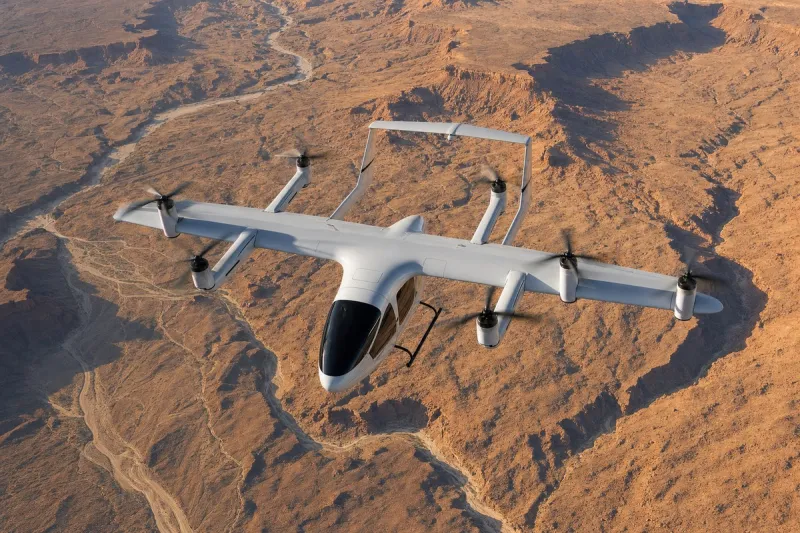
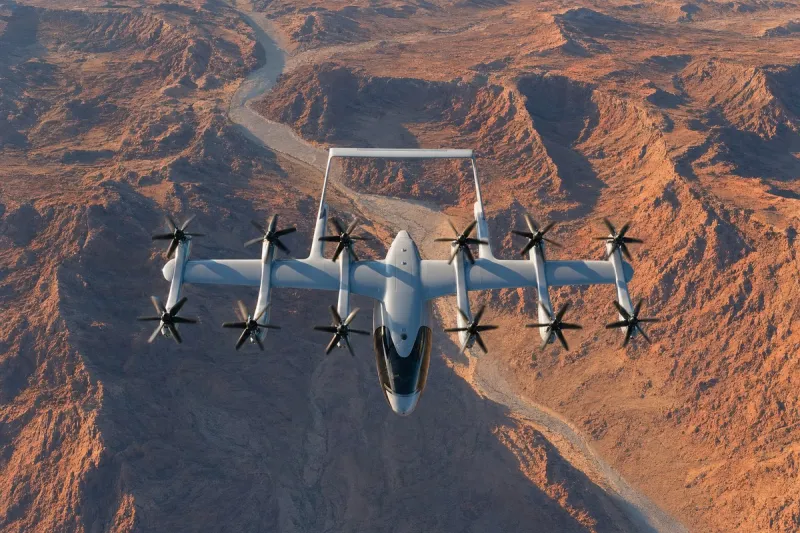
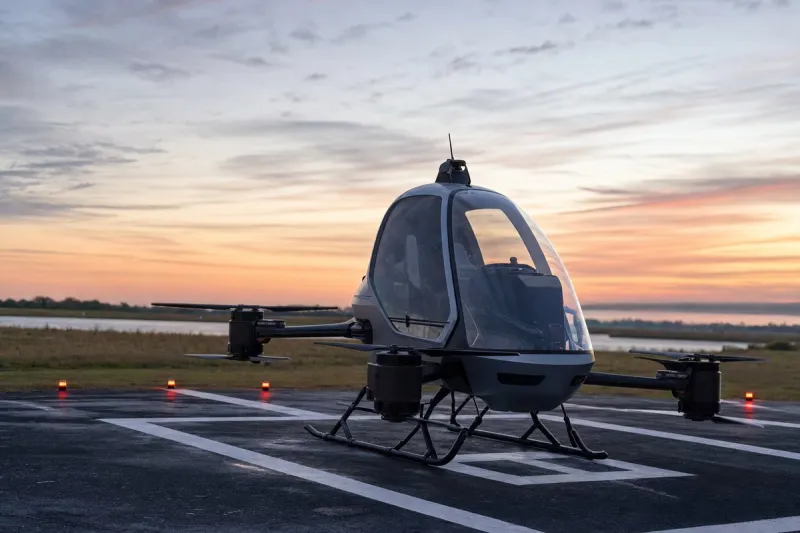
A perspective paper published in Aerospace Systems on 23 October 2026 by researchers at the Technical University of Munich (TUM) and Shanghai Jiao Tong University (SJTU) proposes transferring control methods from industrial intralogistics, the discipline behind automated warehouses, hospital transport networks and distribution centers, to the low-altitude economy of eVTOL aircraft, delivery drones and urban air services. The authors are Johannes Fottner, Felix Top, Tingyu Huang, Florian Holzapfel and Haichao Hong. They observe that an automated 3D-shuttle warehouse, with vertical layers, dynamically allocated slots and conflict resolution at network nodes, structurally resembles a layered urban air corridor network, and they propose Material Flow Control (MFC) as a complement to classical Air Traffic Management (ATM): ATM centers on the vehicle and its separation and safety, while MFC centers on the cargo mission and its throughput.
The core contribution, Bounded Adaptation, assesses each potential method transfer along five dimensions. If the deviation stays within an acceptable adaptation window, the method is directly portable; if it exceeds a threshold but a validated adaptation mechanism exists, the transfer is admissible after bounded modification; if no such mechanism exists, it is inadmissible. The authors state that these thresholds are conceptual and still need quantitative calibration through simulation and field data. Two aviation-specific constraints are treated as hard conditions: the Cannot-Stop Constraint, under which an airborne vehicle has no energy-neutral safe-stop state at an arbitrary point in the network, and contingency-aware routing, which requires every route to be planned for a defined set of degraded states with pre-planned contingency corridors and safe-landing options.
The paper proposes a Comprehensive Digital Twin with two coupled levels. The upper level is a Discrete-Event Simulation dispatching layer that assigns time slots by priority class, for example medical emergency above express cargo above routine delivery, at minute-scale granularity. The lower level is a continuous flight-dynamics simulation, drawn from SJTU work on eVTOL trajectory optimization, that checks physical feasibility at second-scale granularity. Whether full bidirectional coupling stays within real-time bounds under peak traffic is identified as an open question. Safety assessment is aligned with SORA 2.5, the Specific Operations Risk Assessment methodology that became the operative European framework in September 2025, using Rare Event Simulation and Subset Simulation with Markov Chain Monte Carlo sampling.
The NASA ATM-X Dallas/Fort Worth reference scenario, a seven-vertiport benchmark in which 694.63 minutes of total delay accumulated across 40 flights with 62.5 percent of aircraft affected absent active demand-capacity balancing, is proposed only as a candidate future validation baseline. The paper cites China's low-altitude economy projections of 1.5 trillion yuan by 2025 and 3.5 trillion yuan by 2035, and mandatory national standards GB 46761-2025 and GB 46750-2025, in force since May 2026, requiring digital identification with one-second position reporting over 5G-Advanced infrastructure. Shenzhen's Smart Integrated Lower Airspace System (SILAS) could supply calibration data for the digital twin, while DLR's VERTIFIED infrastructure at Cochstedt is named as an emerging European physical testing complement.
The authors state the limits of their work: no large-scale simulation or field validation has been performed, the MFC dispatching layer has not been benchmarked against ATM-only baselines, the adaptation thresholds rest on first principles and expert judgment, and access arrangements to SILAS data are not yet formalized. The ten transfer parallels are anchored in validated industrial projects of TUM's fml laboratory but have not been demonstrated in low-altitude settings.