Aero Team Develops AeroChief Case to Contain Lithium-Ion Battery Fires in Aircraft Cabins; TSO Application Planned for October 2026
Why It MattersCabin lithium-ion fires currently rely on unrequired airline containment bags and inconsistent solutions, so a one-person purpose-built case points to a more standardised, certifiable approach to onboard battery thermal-runaway response.
Aero Team, LLC, a company that primarily certifies aircraft, has developed a containment kit called AeroChief for lithium-ion battery fires in aircraft cabins. Brian DeCamp, who has more than 35 years in aerospace engineering and certification, said a local company approached Aero Team about a year and a half ago with an extinguisher for lithium-ion fires. He said FAA data indicated 1.5 to 2 such incidents occur on U.S. commercial flights every week, with limited reporting and visibility. Initial testing showed an extinguisher alone was not sufficient, because it does not address smoke.
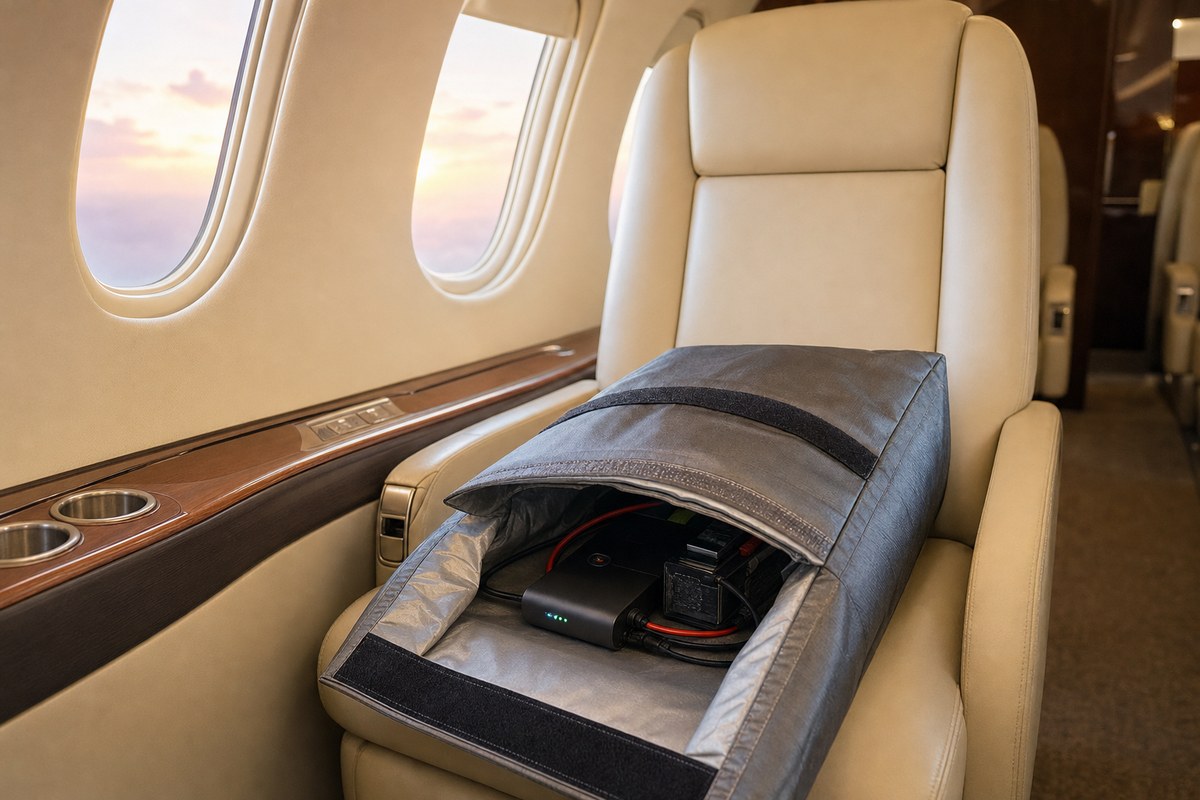
DeCamp said the FAA website advised pouring non-alcoholic liquid on such fires when he last checked. Some airlines carry containment bags, which are not required; he described them as probably a two-person job. He said the FAA tested several bag solutions with inconsistent results, with limited performance on smoke containment and ease of use.
The AeroChief kit is an orange hard case sized for up to a 15-inch laptop, lined with a ceramic blanket to address fire, heat and smoke from thermal runaway, and fitted with a TSA-approved pressure vent. Inside, a bag holds two cans of suppressant, 500-degree gloves and goggles. Once the bag is removed, the case is empty and ready for the device, and one person can handle the process. The case was designed to withstand temperatures up to 1,800 degrees and cabin pressure changes.
In-house testing showed the unpredictability of batteries: of three identical power banks ignited the same way, two went into thermal runaway as expected and the third exploded. Validation testing was moved to the National Institute for Aviation Research (NIAR) at Wichita State University; Aero Team engineers write test plans with NIAR, which issues final reports. The case fully contained heat and fire. Based on calculated mass, it contained 91% of the gases produced, which included hydrogen cyanide, hydrogen fluoride and carbon monoxide.
Aero Team shares test data with customers through distributors covering the U.S., Canada, Mexico, Europe and the Middle East, and says feedback has been positive. Interest has also come from outside aviation, including a Canadian mining company requesting a larger case for power tools and inquiries about classrooms and commercial buildings. DeCamp said that once a battery event starts there is typically less than one minute until full thermal runaway, so moving the battery into the containment case as quickly as possible is the best way to limit smoke and burn risk and fire damage.