Aether Fuels produces ASTM-spec synthetic jet fuel from landfill gas and captured CO2 at 2.5 barrels per day
Why It MattersUsing an existing ASTM D7566 pathway rather than seeking new certification lets synthetic fuel producers move from demonstration toward commercial-scale output faster, without regulatory delay.
What happened
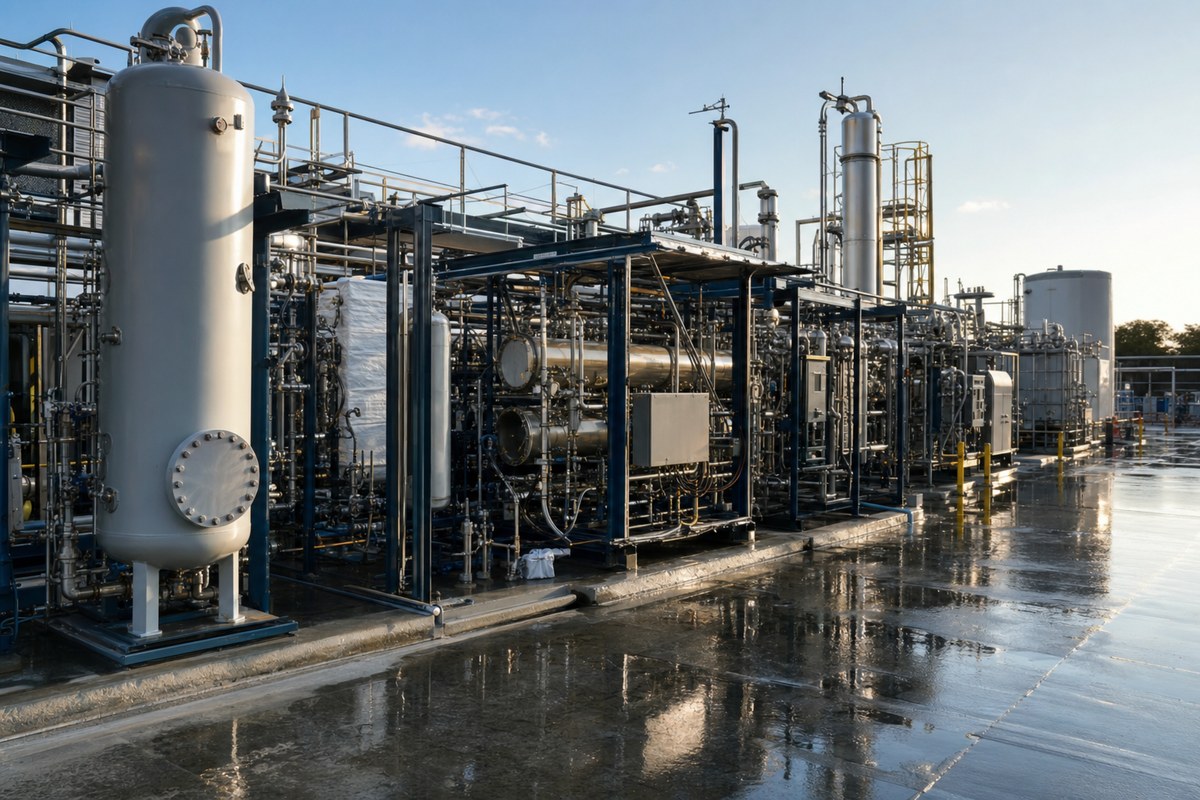
Aether Fuels, a climate technology company based in the US and Singapore, said it has produced synthetic aviation fuel from landfill-derived renewable natural gas (RNG) and captured industrial carbon dioxide using its Aurora technology platform. The fuel was made on a fully integrated demonstration line featuring a 2.5-barrel-per-day Aurora Tri-Converter and Aurora Upgrader, connected to an existing Fischer-Tropsch reactor operated by Research Triangle Park (RTI), covering the complete process of converting waste-derived gaseous feedstocks into upgraded synthetic liquid jet fuel.
Independent testing firm AmSpec confirmed that fuel samples from the demonstration met ASTM specifications for Fischer-Tropsch Synthesized Paraffinic Kerosene (FT-SPK), complying with ASTM D7566 requirements that allow qualifying synthetic fuel to be blended with conventional kerosene at concentrations of up to 50 percent without modifications to aircraft fuel tanks, pipelines, or airport fueling systems. Aether Fuels said that because the FT-SPK production route is already covered under ASTM D7566, its fuel does not require establishment of a new ASTM pathway. The demonstration used mass-balanced RNG from landfill gas generated in Kentucky alongside captured industrial CO2, and Aether Fuels said it is believed to be the first company in North America to produce ASTM-spec synthetic aviation fuel from mass-balanced RNG and captured industrial CO2 at this scale.
"This demonstration proves Aether's ability to scale up our integrated Aurora platform, take a feedstock through the complete end-to-end process, and produce on-spec synthetic aviation fuel," said Dhaval Shah, Aether Fuels CTO. The demonstration followed an earlier Tri-Converter test conducted with GTI Energy. CEO and co-founder Conor Madigan said the company had scaled its technology more than 50 times in standalone demonstration units before integrating them into the combined production line.
Project Beacon
Aether Fuels now plans to develop Project Beacon, a commercial facility in Singapore with an annual production capacity of 2,000 metric tons, producing approximately 50 barrels of fuel per day — roughly 20 times the capacity of the demonstration equipment. Larger commercial projects are expected to reduce lifecycle greenhouse gas emissions by more than 70 percent compared with conventional jet fuel.
Industry impact & what to watch
This demonstration belongs to a broader push among synthetic fuel developers to prove out waste-gas-to-jet-fuel conversion at small scale before committing capital to commercial plants. Fischer-Tropsch SPK is one of several sustainable aviation fuel pathways already approved under ASTM D7566, which matters because a producer working within an established pathway avoids the multi-year process of certifying a new fuel chemistry before it can be blended and sold.
How this segment actually scales is visible in the numbers here: a 2.5-barrel-per-day demonstration line feeding into a planned 50-barrel-per-day commercial facility is roughly a twentyfold jump, and Madigan's account of scaling standalone units more than 50 times before integration shows the stepwise path synthetic fuel technology typically takes from lab to plant.
What happens next depends on whether Project Beacon in Singapore secures the financing and feedstock supply needed to reach its 2,000-metric-ton annual target, and whether the greater-than-70-percent lifecycle emissions reduction claimed for larger commercial projects holds up once that facility is actually running.