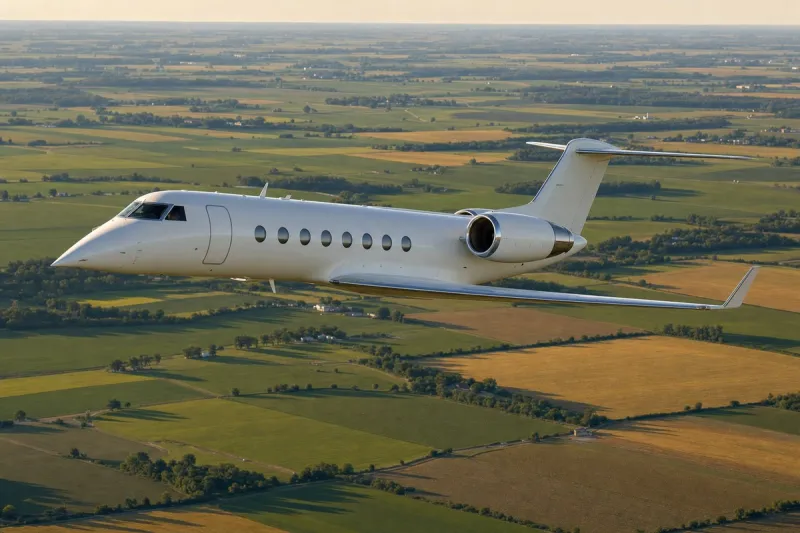
Bombardier Challenger 600 Family Carries Most FAA Airworthiness Directives Among Business Jets, With 104 in Effect
Why It MattersRegulatory maintenance burden tracks cabin class and certification age, so large-cabin jets with long-running type certificates carry far heavier directive loads than newer clean-sheet light and midsize designs.
What happened
An analysis of FAA airworthiness directives (ADs) published in the Federal Register between 1995 and October 27, 2026 found that the Bombardier Challenger 601-3A / 601-3R / 604 / 605 / 650 group has the most airframe ADs in effect among 94 business jet and turboprop types, at 104. Twenty of those require recurring actions, also the highest count of any type. The analysis drew on 12,880 final rules under 14 CFR part 39 covering all kinds of products.

The next types by airframe ADs in effect were the Canadair Challenger 601-1A (69); the Embraer EMB-135BJ series / Legacy 600, Dassault Falcon 2000 and Pilatus PC-12 (63 each); the Canadair Challenger 600 (62); the Bombardier BD-700-1A10 series / Global 6000 (59); the Dassault Falcon 900 (58); the Bombardier BD-700-1A11 series / Global 5000 (55); and the Bombardier Challenger 300 / 350 / 3500 (50).
Counts rise with aircraft class. The median number of airframe ADs in effect per type was 47 for large-cabin jets, against 9 for light jets. By class, the medians were 6 for very light jets, 10 for midsize jets, 38 for super-midsize jets, 19 for ultra-long-range jets and 15 for turboprops.
An AD counts for a type when its title or applicability names the type certificate holder (or a predecessor) and the FAA model designator. A match means the AD may apply; serial numbers, installed equipment and modifications determine whether it applies to an individual aircraft. Only airplane ADs not superseded or removed are counted, and engine, propeller and appliance ADs are excluded. Models sharing a type certificate share their ADs and appear as one row.
Industry impact & what to watch
The ranking shows that regulatory maintenance load is largely a function of how long a type certificate has been accumulating variants. A single large-cabin certificate can span thirty years and adopt directives from its home authority, while newer clean-sheet designs start near zero. That is why the Challenger family, spread across several generations, tops the list.
For the used-aircraft market, an AD count is a proxy for compliance workload, not a measure of safety. Recurring-action directives matter most for ownership cost, because they return on a schedule; the Challenger group's twenty such items are the figure to weigh against its total of 104. Whether a given directive touches a specific airframe still depends on serial number and installed equipment, so the type-level count is a starting point for a records review rather than a verdict on any one aircraft.