The Four-Digit Squawk Code: What It Tells Air Traffic Controllers and Why It Has Only 4,096 Combinations
Why It MattersThe transponder architecture shows how legacy hardware constraints still shape modern airspace surveillance, even as ADS-B begins to supersede radar-based squawk identification with continuous GPS-accurate position reporting.
What happened
Every commercial flight receives a four-digit transponder code before departure, displayed on air traffic control radar screens for the duration of the flight. Three codes — 7500, 7600, and 7700 — trigger automatic visual alerts on every controller display within range the instant they appear, with no radio call required from the crew. The codes use octal notation, each digit running 0 to 7, which produces exactly 4,096 combinations rather than the 10,000 a decimal system would allow, a limitation traced to the binary groupings of three bits used in the original hardware.
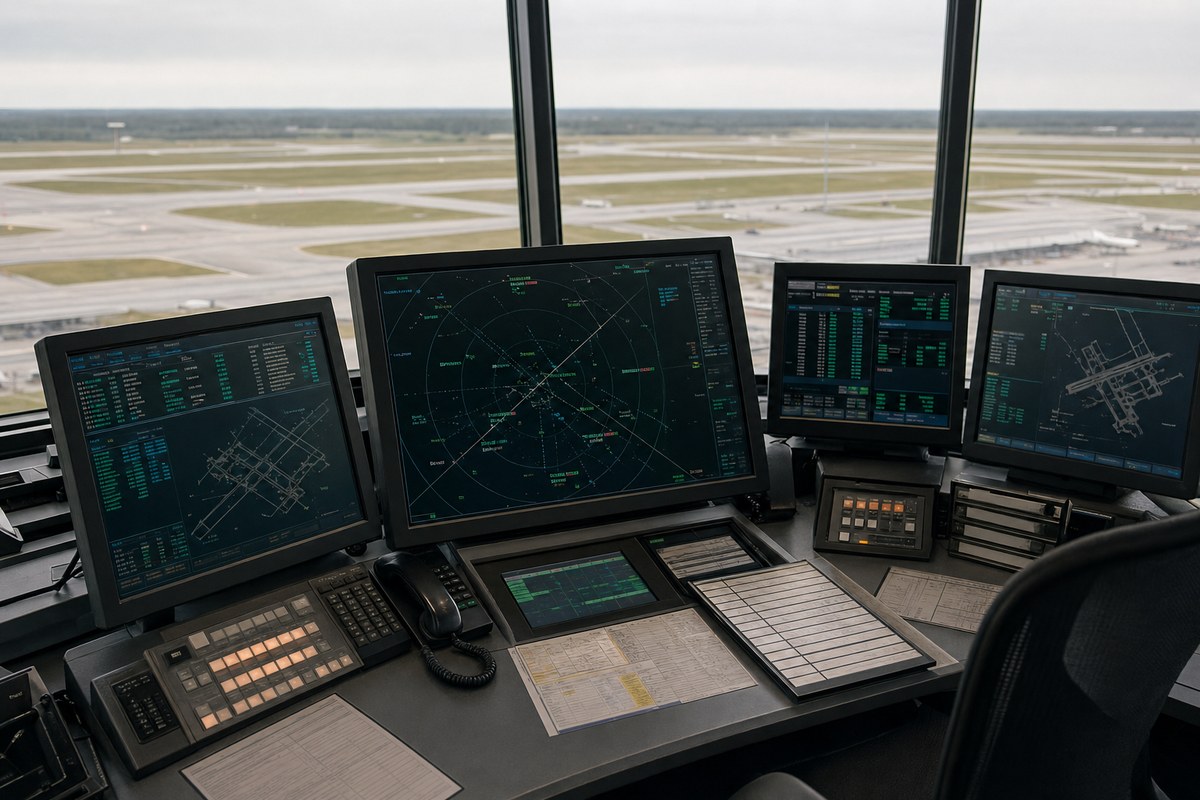
Certain codes are permanently reserved: 1200 for VFR flights, 2000 for flights entering controlled airspace without a prior ATC assignment, and the three emergency codes held outside the assignable pool. Controllers in busy terminal areas must manage code reuse to prevent two aircraft in the same radar environment from sharing an identifier. The system evolved through three modes — Mode A transmits the squawk code alone, Mode C adds pressure altitude in 100-foot (30-metre) increments, and Mode S transmits a permanently assigned 24-bit ICAO code unique to each aircraft along with flight number, ground speed, and the capacity to receive individual data uplinks.
Code 7700 signals a general emergency — engine failure, pressurisation loss, a medical crisis, or any situation requiring priority handling — flashing "EM" on the data block and triggering an audible alert at the controlling facility. Data covering 14 months through early 2024 recorded an average of 36 flights per week worldwide squawking 7700, roughly five per day, most resolved without incident as precautionary declarations. Code 7600 signals radio communication failure. On 11 September 2001, a Korean Air flight from Seoul to New York was diverted to Whitehorse, Canada after a pilot message containing "HJK" — a company code for hijacking — was interpreted as a genuine hijack alert; ATC asked the crew to squawk 7500 as a verification check, and the crew, unfamiliar with the implications of complying, set the code, which instantly triggered alerts on controller screens. The FAA's Aeronautical Information Manual instructs pilots to avoid unnecessarily cycling through 7500, 7600, and 7700 when changing codes, since older mechanical transponders can pass through an emergency code while rotating between two unrelated settings, such as from 7400 to 7600.
Origins and the shift to ADS-B
The octal architecture and the word "squawk" both trace to World War II Identification Friend or Foe (IFF) technology, when ground radar operators instructed pilots to "squawk" to activate the transponder or "strangle the parrot" to deactivate it. That terminology and the underlying mechanism — an aircraft replying to a radar interrogation pulse with a coded electronic response — carried into peacetime civil aviation unchanged.
A flight plan filed with the ATC computer system is automatically assigned a squawk code unique to that region at that moment, relayed to the crew as part of the ATC clearance and entered before engine start. The code remains assigned for the entire flight unless a new sector controller issues a revised code when the flight crosses regional ATC boundaries. Automatic Dependent Surveillance-Broadcast (ADS-B) is progressively replacing this radar-interrogation model: the aircraft's GPS receiver calculates its own position, and the transponder broadcasts that position along with altitude, velocity, flight number, and the 24-bit Mode S ICAO identifier once per second to any ground station or equipped aircraft within range.
Industry impact & what to watch
The 4,096-combination ceiling is a case study in how early hardware decisions outlive the technology that made them necessary: an octal scheme chosen for binary efficiency in World War II-era IFF equipment still governs how every commercial aircraft identifies itself today, constraining code allocation in busy terminal areas where controllers must actively manage reuse. The emergency-code system depends on human recognition and compliance, and the Korean Air case from 11 September 2001 demonstrates the failure mode built into it: a crew asked to squawk 7500 as a verification step, without understanding the silent alert it would trigger, produced a diversion to Whitehorse rather than a false alarm caught early.
The FAA's own guidance — warning pilots not to rotate mechanical transponder dials through 7500, 7600, or 7700 en route between unrelated codes — shows that the alerting mechanism remains sensitive enough to misfire on a transition rather than a deliberate entry, a design tension between sensitivity and false-positive risk that persists as long as mechanical selectors remain in service. The gradual shift to ADS-B, which replaces radar interrogation with continuously broadcast GPS position once per second, points toward a surveillance model less dependent on a pilot correctly dialing a four-digit octal code under stress. Whether ADS-B coverage eventually removes squawk-code ambiguity from emergency identification, or simply layers a second surveillance channel alongside the legacy transponder system, will depend on how completely ground infrastructure and aircraft equipage converge on it.