Cessna 172 Skyhawk Marks 70 Years as Most-Produced Aircraft, With About 45,000 Delivered
Why It MattersA trainer type that stays in production across seven decades shows how piloting pipelines, parts support and certified-airframe continuity, not new designs, anchor entry-level aviation supply.
What happened
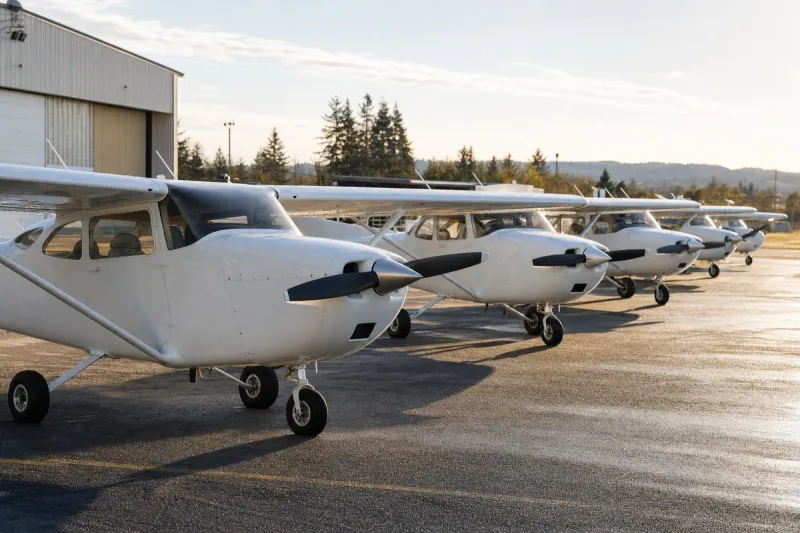
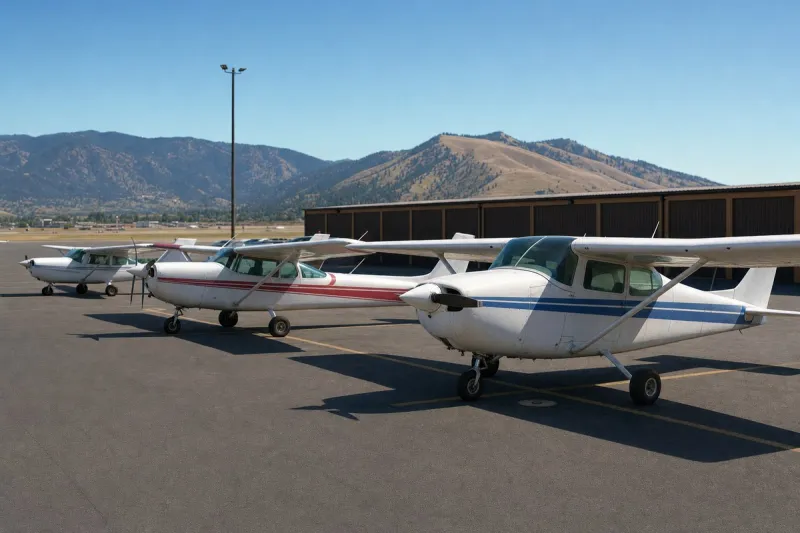
Cessna's 172 Skyhawk is marking 70 years since it took to the skies. Cessna introduced the aircraft in 1955, with production beginning in 1956. Textron, which owns Cessna, states that about 45,000 Skyhawks have been delivered to customers worldwide, more than any other aircraft in the industry. The next-closest totals are the Soviet Ilyushin Il-2 Sturmovik with 36,183 built and the Messerschmitt Bf 109 with 34,852.
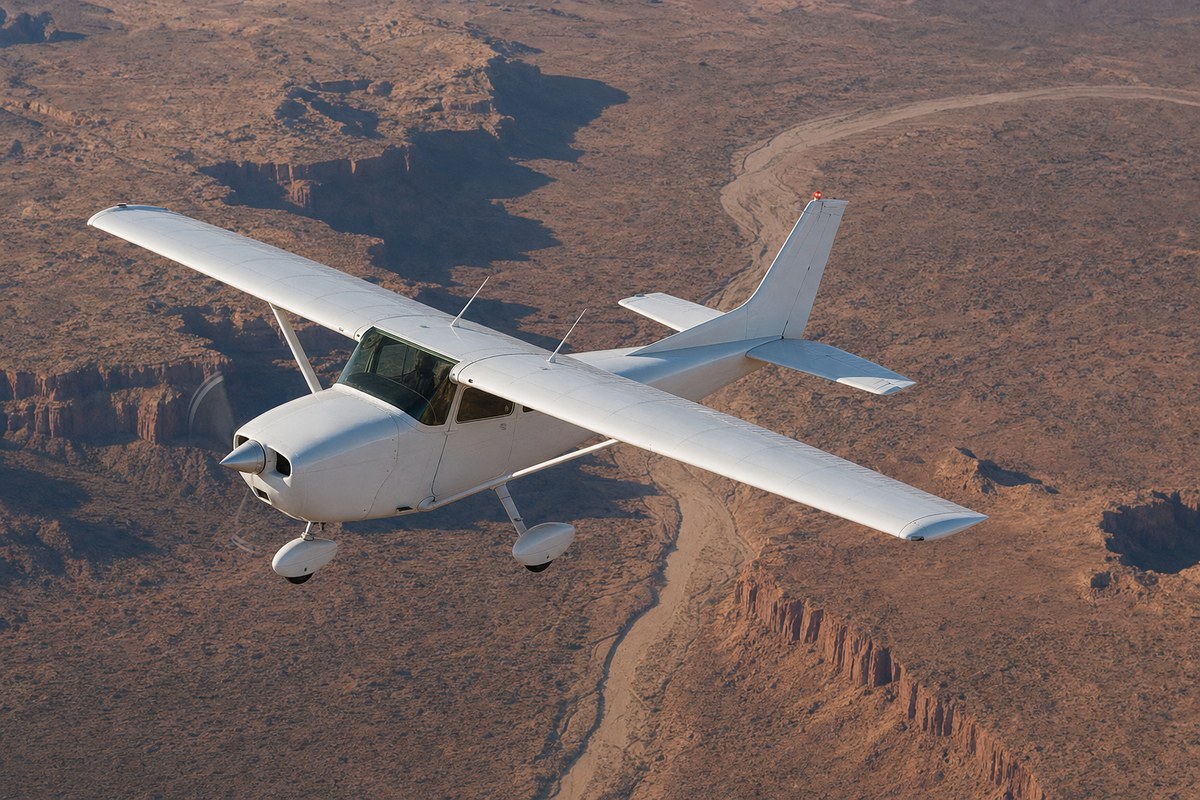
The 172 was based on the earlier Cessna 170 and developed as a tricycle-gear version of it. Cessna engineer Harry Clements recalled that sales were so strong that the 170 line was essentially discontinued. Cessna Aircraft traces its roots to September 7, 1927, when Clyde Cessna and Victor Roos formed the Cessna-Roos Aircraft Company. General Dynamics bought the company in 1985 and Textron Aviation acquired it in 1992.
The aircraft has gone through about 20 models. The 172A through 172I of the 1960s added a swept-back tail, a streamlined cowling, an autopilot, electric flaps and the Lycoming O-320 engine. The 172L through 172N of the 1970s added a tubular landing gear strut and the Lycoming O-320-H2AD engine, and the 172P of the 1980s used the 160-horsepower Lycoming O-320-D2J. The 172R and 172S NAV III models brought avionics upgrades including the Garmin G1000 glass cockpit, GPS and advanced autopilot systems.
The current production model is the 172S, with a Lycoming IO-360-L2A engine producing 180 hp and a Garmin G1000 or G1000 NXi avionics suite. It seats four and has a maximum takeoff weight of 2,550 pounds, a maximum cruise speed of 124 ktas, a maximum range of 640 nm and a service ceiling of 14,000 feet. A new 172 generally costs between $450,000 and $550,000, while older models range from $300,000 to $400,000. Cessna maintains an inventory of 140,000 parts, offers a 12-month warranty and reports a 99% same-day shipping rate for in-stock parts.
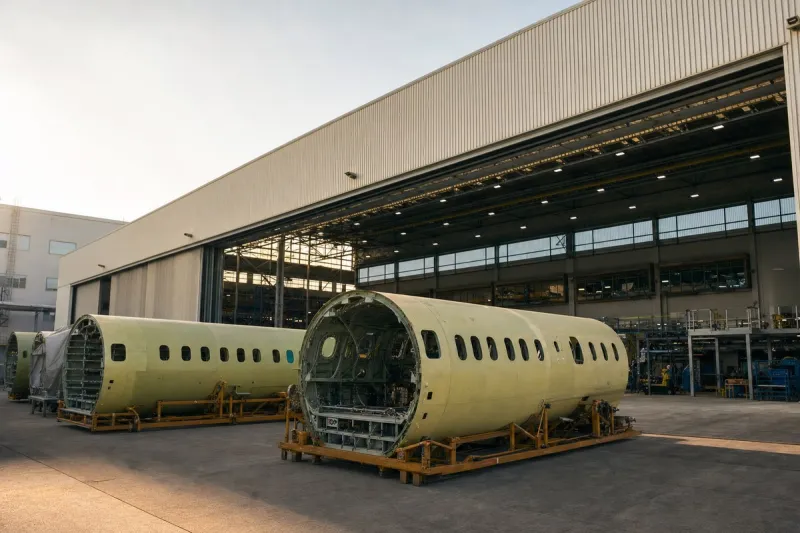
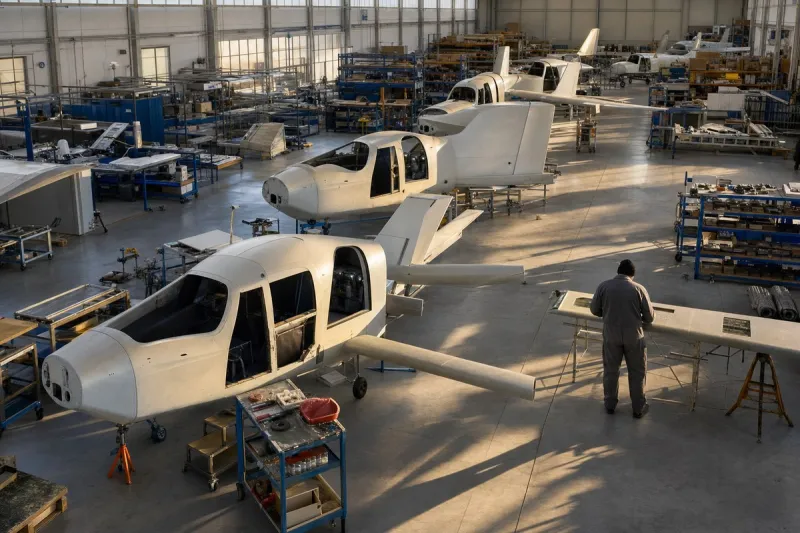
Textron builds the 172 Skyhawk, 182 Skylane and 206 Stationair at its 500,000-square-foot facility in Independence, Kansas.
Training demand behind the numbers
The aircraft remains central to flight training. The FAA's Aerospace Forecast 2026–2046 states that the number of US student pilots rose from 128,501 in 2016 to 370,286 by the end of 2025. Obtaining a Private Pilot Certificate generally requires 50 to 70 flight hours and can take three to 12 months.
Airports Council International reported 9.8 billion passengers worldwide in 2025, and Boeing forecasts a need for 660,000 new pilots over the 20 years to 2044.
Industry impact & what to watch
A production run that spans 70 years and 20 model variants points to how the light-piston segment works. Buyers in this segment are paying for continuity: a familiar airframe, a long-established engine family, and a parts and service network that keeps training fleets flying. The upgrade path described here, from steam-gauge panels to the Garmin G1000, was incremental rather than a redesign, which lets flight schools and owners keep a common type across aircraft of very different ages.
The training pipeline is the demand engine. With the FAA counting 370,286 US student pilots at the end of 2025 and Boeing projecting a need for 660,000 new pilots over the 20 years to 2044, entry-level trainers sit at the base of a supply chain that eventually feeds airline and business-aviation cockpits. That makes parts availability, such as the 140,000-part inventory and 99% same-day shipping rate for in-stock items Cessna cites, a competitive asset as much as the airframe itself.
Pricing also shapes the segment. A new 172 at $450,000 to $550,000 against $300,000 to $400,000 for older models leaves a wide used-market band, so fleet renewal decisions at flight schools hinge on the gap between those two ranges and on how long existing airframes stay airworthy.