California's Central Coast Promotes Itself as Hub for Autonomous Systems and Advanced Aircraft Industry
Why It MattersRegions now compete for advanced-aircraft firms by bundling test ranges, airports, university research and manufacturing talent, and the Central Coast pitch shows how places package those assets.
What happened
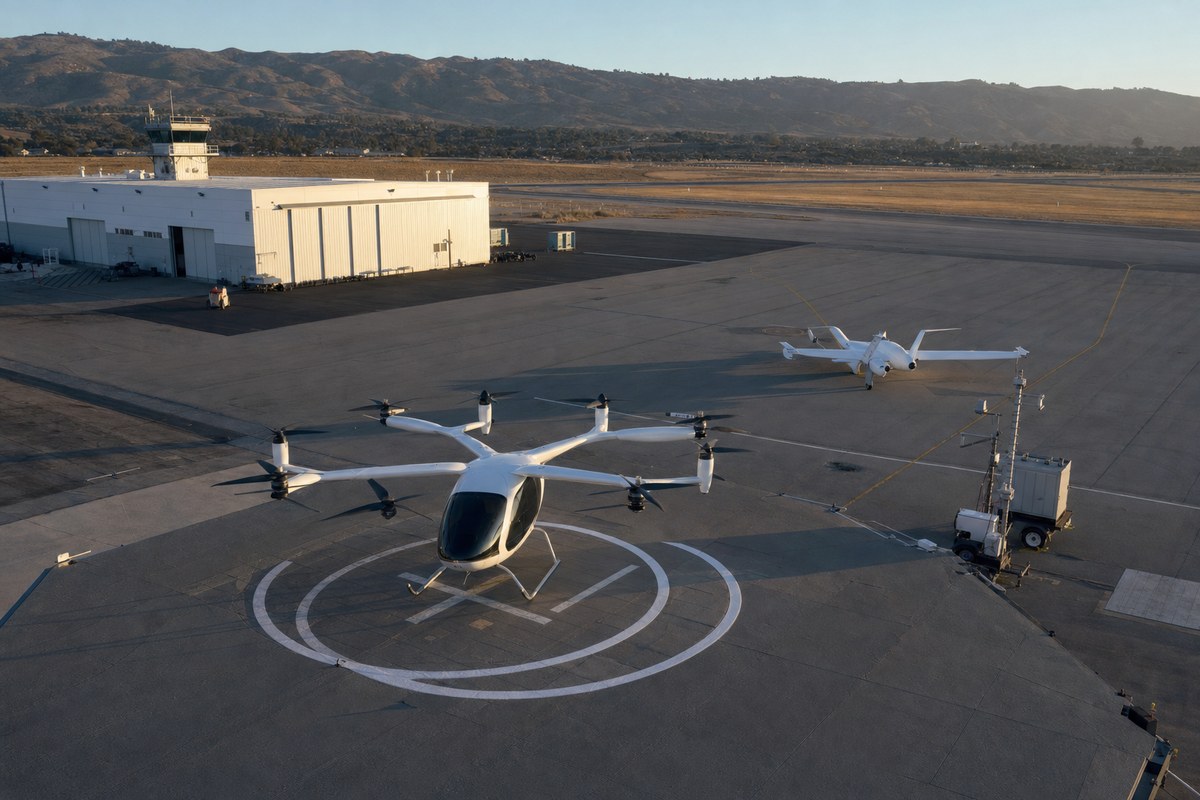
California's Central Coast, spanning six counties from Santa Cruz in the north to Ventura in the south, is presenting itself as a regional hub for the emerging Advanced Aircraft industry. That industry covers electric vertical take-off and landing (eVTOL) vehicles, hydrogen-fueled aircraft, and drones or uncrewed aerial systems (UAS). The pitch combines eVTOL and UAS firms, dual-use research assets, testing environments and an engineering and precision manufacturing talent base.
The region is divided into subregions with distinct roles. San Luis Obispo and Santa Barbara drive aerospace innovation, engineering talent and advanced systems development. Ventura County provides defense infrastructure, testing assets and advanced manufacturing. The Monterey Bay region anchors multi-airport operations, real-world testing and integration, defense research and advanced aviation R&D.
Testing assets include general aviation airports across the six counties, plus military facilities: the Point Mugu Sea Range at Naval Base Ventura County, Camp Roberts and Fort Hunter Liggett. Point Mugu is used for UAS testing and evaluation and as a hub for testing and development of uncrewed underwater vehicles (UUVs).
The California Advanced Air Mobility Corridors Initiative (CAAMCI), led by MBEP, is an FAA-aligned, multi-airport network of public-use general aviation airports designed to support eVTOL and UAS planning, testing and integration. On talent, the region cites seven decades of aerospace and precision manufacturing activity, apprenticeship, community college and high school STEM programs, and engineering research at UC Santa Cruz, Cal Poly San Luis Obispo and UC Santa Barbara.
Market projections and use cases
Over the next decade, the global eVTOL market is projected to grow to $80 billion and the UAS market to $157 billion. Accelerated market adoption is expected across a range of uses over the next 10-20 years.
The airspace within 5,000 feet above the ground is described as the "low-altitude economy." Use cases named for it are passenger air taxi, cargo transport, national security, infrastructure inspection, wildfire abatement, public safety and emergency response.
Industry impact & what to watch
Economic-development campaigns like this one show how advanced-aircraft regions are built: a manufacturer weighing a site looks at test airspace, airport access, military range time, university research and a trained workforce together, and a single region rarely holds all of them. The Central Coast case leans on a division of labour between subregions, with design talent in San Luis Obispo and Santa Barbara, defense testing and manufacturing in Ventura County, and multi-airport integration around Monterey Bay.
For the eVTOL and UAS segments, access to controlled test environments is a gating factor between prototype and certification, which is why the emphasis falls on ranges such as Point Mugu and on an FAA-aligned airport network. The market figures cited are projections for the next decade, and adoption across uses is expected to take 10-20 years, so the region is competing for firms well ahead of commercial revenue.
The next dated markers would be named companies siting test or production work in the region, and operating milestones from CAAMCI as it supports planning, testing and integration across its airports.