Aviapages Details How APIs Connect Charter Sales Tools, Citing Quoting Workflow Covering About 1,000 Aircraft
Why It MattersCharter sales is shifting from calls, emails and spreadsheets toward structured data exchange between systems, with marketplace calculations feeding quoting while commercial judgement and operational confirmation stay with people.
What happened
Aviapages, a private jet industry marketplace, has published a paid-content piece describing how application programming interfaces (APIs) are changing the workflow of charter sales desks. The company says that after Covid-19 a surge of new private aviation customers pushed operators and brokers to their limits and exposed reliance on calls, emails, manual spreadsheets and copying data between systems.

An API lets a CRM or scheduling system send a charter request — origin, destination, aircraft type and passenger count — directly to another service, which returns structured data that can be used inside the system. The Aviapages Flight Time and Charter Cost Calculator returns aircraft-specific flight time, routing, fuel consumption and charter cost. Aviapages says such figures account for factors beyond great-circle distance and average speed, including winds, payload, technical stops and aircraft performance. It adds that a calculated charter price is not a final commercial offer from an operator and that a flight calculation is not an operational flight plan.
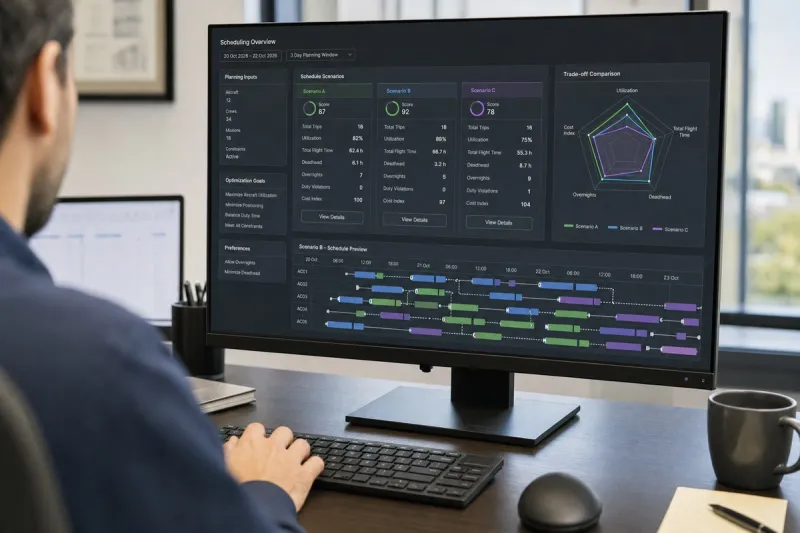
Aviapages lists five uses of a marketplace API. The first is automated fleet quotations, with a single workflow currently covering around 1,000 aircraft and feeding flight time and fuel burn into a quotation engine. The second is pricing and operator selection inside broker platforms, where the system identifies operators that could realistically fly a mission and can generate an estimated price per operator's aircraft at the lead stage. The third is supplying structured aviation data and calculation results to AI aviation platforms. The fourth is integration into SaaS, scheduling and planning systems, including FL3XX, MySky, Stack Aero and Leon.
The company argues that direct data exchange between systems reduces errors from manual copying, such as wrong airport codes or mistyped aircraft registrations, and makes it easier to trace where data came from and when it was last updated. It says charter sales remains a human business: salespeople still judge whether a quote makes commercial sense, operations specialists confirm a mission can be flown, and brokers still deal with clients.
Industry impact & what to watch
The workflow described sits in the lead-to-quote stage of charter sales, where speed and consistency of the first price indication often decide whether a request turns into a booking. Replacing re-keyed spreadsheets with a call to a shared calculation service moves that first estimate away from individual desk habits and toward a common data source. The same logic explains why scheduling and planning systems are named as integration targets: the value is in the data landing where the sales or operations team already works.
The limits Aviapages itself states define where this stops. An estimated price per aircraft is a screening tool, and the commercial offer and the operational flight plan remain separate steps owned by the operator and its operations staff. For brokers and operators, the practical question is therefore how much of the quote-to-confirmation chain a system can handle before a human has to take over, and how clearly the tool marks that handover.
The source is a paid-content piece from a vendor describing its own product, so the 1,000-aircraft workflow is a company claim. The next evidence worth looking for is adoption: which brokers and which of the named scheduling platforms actually run the calculator inside live quoting, and how its estimates compare with operators' final offers.