Global Aircraft De-Icing Market Forecast to Grow From USD 1.45 Billion in 2025 to USD 2.55 Billion by 2035
Why It MattersDe-icing spending is shifting from fluid purchases toward automation, biodegradable chemistry and on-board protection, so supplier advantage depends on regulatory compliance and sustainable product development as much as on fluid volume.
What happened
Strategic Revenue Insights Inc. has released a report on the global aircraft de-icing market covering product types, fluid types, applications, end users and regions for 2026 to 2035. Lead analyst Anirudh Singh prepared it. The research combines primary interviews with de-icing fluid producers, equipment manufacturers, airports and ground handlers, and airlines with secondary data across the regions covered.
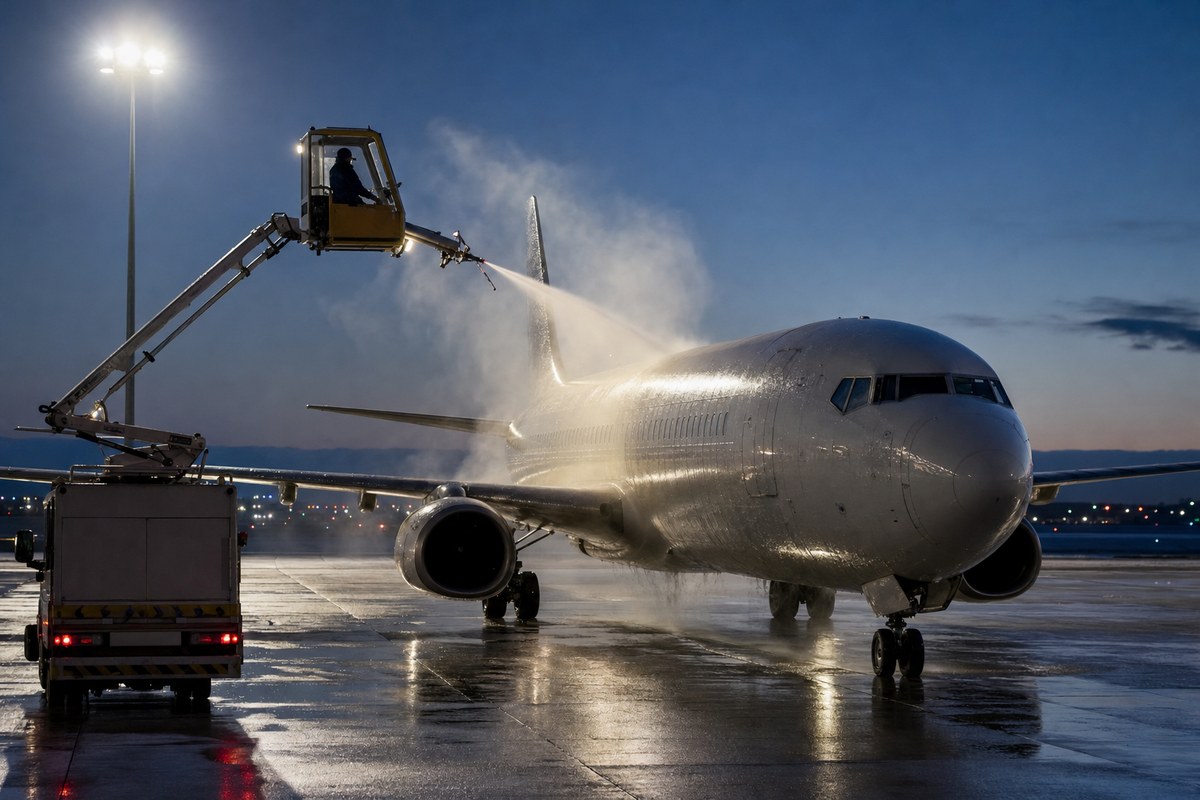
The market was valued at USD 1.45 billion in 2025 and is projected to reach USD 2.55 billion by 2035, a compound annual growth rate of 5.80%.
By segment, de-icing fluids are the largest type, while on-board ice protection systems are the fastest-growing. Commercial aviation is the largest application, and airports and ground handlers are the largest end user. North America is the largest region, while Asia Pacific is the fastest-growing. The fluid coverage spans Type I, Type II, Type III and Type IV, and applications include commercial aviation, military aviation, and general and business aviation. End users covered are airports and ground handlers, airlines and aircraft OEMs.
The report names stringent regulations requiring de-icing to prevent ice buildup, demand for safety and operational efficiency, more frequent extreme weather linked to climate change, advances in automated systems and eco-friendly fluids, and aviation growth in emerging markets as growth drivers. Restraints include the high cost of developing and deploying advanced de-icing technologies, costly regulatory compliance that can disadvantage smaller firms, raw material price volatility, and the R&D spending required for sustainable solutions.
Companies and trends named
Key companies listed are Clariant AG (Switzerland), Dow Inc. (United States), Cryotech Deicing Technology (United States, a General Atomics subsidiary), Kilfrost Limited (United Kingdom), LNT Solutions Ltd. (United Kingdom) and JBT Corporation (United States).
Trends cited include a shift toward biodegradable, less toxic fluids, the use of IoT and AI for real-time monitoring and predictive maintenance, rising demand in Asia Pacific, localized production and distribution, and more automated manufacturing.
Industry impact & what to watch
De-icing is a regulation-driven, weather-dependent service. Demand tracks safety rules and winter operating conditions more than aircraft utilisation alone, which is why a 5.80% annual growth rate for a mature category is plausible. Growth comes from changing how ice is handled, not from a sudden expansion in what is bought.
The pairing of the largest segment, fluids, with the fastest-growing one, on-board ice protection, points to a gradual substitution at the margin. Fluid suppliers face pressure to reformulate toward biodegradable, less toxic products, and that reformulation work is the same R&D burden the report lists as a restraint. Smaller suppliers carry that compliance and development cost with less room to absorb it, while ground-handling and airport buyers weigh equipment automation against labour and fluid-use costs.
The regional split matters for where capacity gets built. North America holds the largest share today, while Asia Pacific is growing fastest, and localized production and distribution is itself a named trend. The next signal worth tracking is whether new fluid-production and distribution capacity appears in Asia Pacific, and whether the biodegradable shift shows up in ground-handler purchasing.