FAA Clears Teterboro Airport Expansion With New Hangars on 22 Acres, Filling 11 Acres of Wetlands
Why It MattersThe project shows how business-aviation capacity growth at constrained hub airports depends on private operator funding, while wetland impacts and remaining permits determine how fast that capacity actually arrives.
What happened
The Federal Aviation Administration issued a finding of no significant impact on September 30 for an expansion of Teterboro Airport in New Jersey. The decision clears a major regulatory hurdle for the Port Authority of New York and New Jersey and Signature Aviation. The expansion would add new hangars and aircraft parking across 22 acres of land.
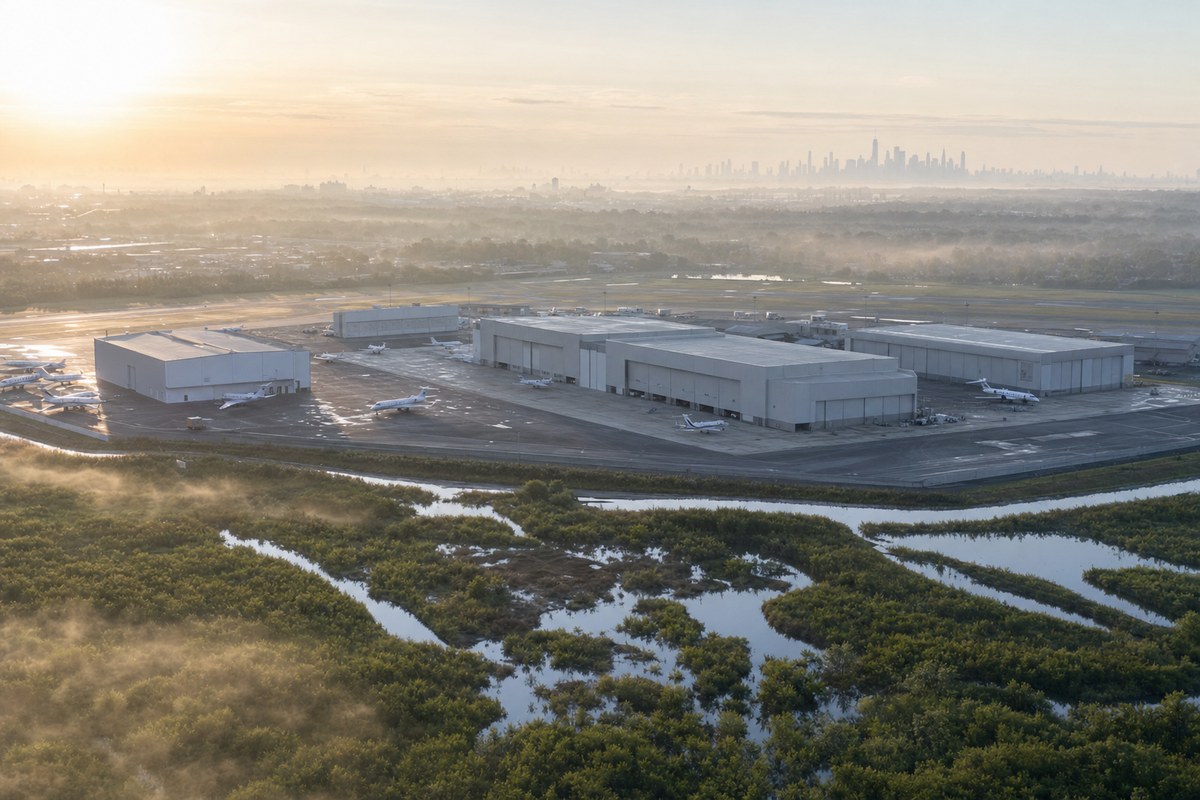
The development covers two sites. The hangars total 135,500 square feet, and the plan includes nearly 400,000 square feet of aircraft apron space. Signature Aviation is funding the project and says the added capacity will reduce congestion and eliminate thousands of unnecessary ferry flights each year. Those repositioning flights occur when aircraft must leave the airport after dropping off passengers because suitable parking is unavailable.
More than 11 acres of wetlands would be filled. The Hackensack Meadowlands wetlands are described as helping absorb floodwaters and protect surrounding neighborhoods in a flood-prone region. Environmental advocates argue that replacing their functions cannot fully compensate for losing the existing natural landscape. Signature plans to purchase wetland mitigation credits and install underground stormwater detention systems, with permeable pavement used where appropriate.
Construction remains subject to additional state and federal permits. Work is expected to begin in early 2027.
Industry impact & what to watch
At a congested business-aviation airport, the binding constraint is often ramp and hangar space rather than runway capacity. When aircraft cannot park, they reposition elsewhere after dropping off passengers, adding flights that serve no commercial purpose. Privately funded facility expansion by an FBO operator is one way capacity gets added at such airports, with the airport authority granting the land and the operator carrying the capital cost.
The wetland question shows the other side of that arrangement. Land near major metropolitan hubs is scarce, and filling more than 11 acres of floodplain-adjacent wetland draws opposition that a federal no-significant-impact finding does not end. Mitigation credits and stormwater detention are the standard tools for answering it, and advocates have already argued that they cannot replace the lost natural landscape.
The next milestones are the additional state and federal permits that still have to be issued before the early 2027 construction start. Those decisions, rather than the FAA finding alone, will determine whether the schedule holds.