Aircraft Interface Devices Evolve Into Cockpit Data Hubs as Operators Face Cybersecurity and Governance Challenges
Why It MattersAs aircraft data reaches commercial tablets, the segment's bottleneck moves from physical connectivity to who governs, secures and audits that data across the whole service life of the installation.
What happened
Aircraft Interface Devices (AIDs) have evolved from simple hardware adapters into central avionics hubs. They link certified aircraft systems such as Flight Management Systems (FMS) and ARINC data buses with commercial-off-the-shelf Electronic Flight Bags (EFBs) and bring-your-own-device hardware. They feed real-time positional, atmospheric and operational data to flight crews and support moving-map displays, automated flight logging and dynamic performance calculators. Future capabilities point toward onboard edge computing and real-time air-to-ground synchronization.
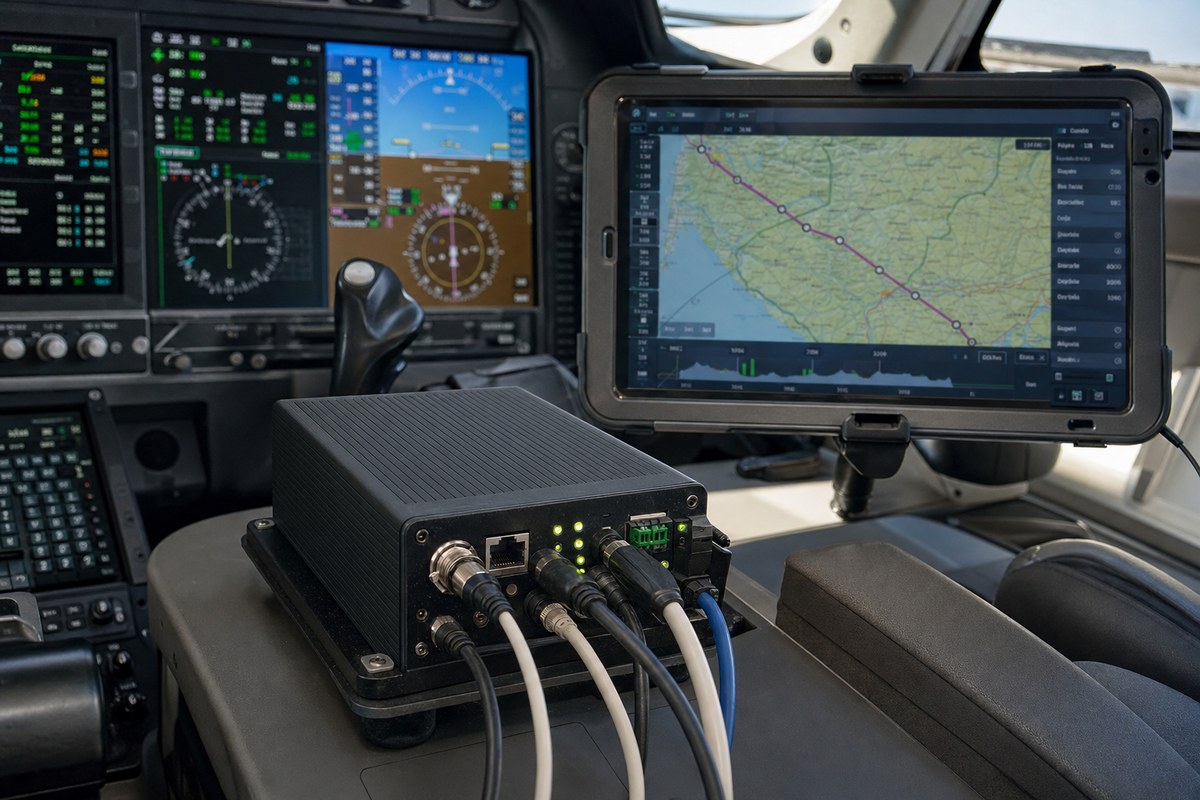
The growing capabilities bring engineering and operational challenges. Connecting commercial mobile hardware to safety-critical avionics creates complex cybersecurity issues that require strict domain isolation and defense-in-depth protocols. Operators also face steep integration challenges when retrofitting legacy fleets not designed for IP-based networks, as well as compatibility problems from proprietary software interfaces and vendor lock-in. As data volumes grow, the industry's main concern has shifted from physical connectivity to data governance.
Klaus Olsen, CEO and EFB Administrator at EFB Admin Services Int., described the current state of the technology in an interview with Aerospace Innovations. He has more than two decades of aviation technology experience and supports operators under EASA and FAA frameworks. His company does not manufacture AIDs but helps airlines implement, gain regulatory approval for and operate EFB programs. Olsen said operators must still decide which applications may receive aircraft data, how it may be used, and how configuration changes are controlled.
Olsen said modern AIDs can interface with ARINC 429, ARINC 717, discrete signals, serial data, avionics Ethernet and, depending on aircraft architecture, higher-bandwidth IP-based networks. They can distribute selected data to installed systems, airline-controlled tablets, portable EFBs, maintenance devices and, in some cases, ground systems via cellular or satellite links. Typical data delivered to EFB applications include position, altitude, heading, groundspeed, airspeed, wind, outside-air temperature, fuel information, weight and balance data, flight phase and engine parameters.
He said most portable EFB integrations remain predominantly aircraft-to-EFB rather than bidirectional, because sending data from a portable device back into safety-critical systems creates different certification and cybersecurity exposure. Bidirectional exchange is possible in controlled architectures with strong separation, validation and explicit system authority. FAA guidance distinguishes operational EFB applications from aircraft-installed equipment.
Security and operator responsibility
Olsen cautioned against calling any connected system 'entirely secure'. The aim, he said, is to reduce risk, maintain defense in depth and ensure that compromise of an external device cannot propagate into safety-critical domains. Controls he listed include segregation of aircraft control, airline information and passenger networks; preferably one-way data flows; allow-listing; authenticated and encrypted communications; certificate and key lifecycle management; secure boot with signed software and controlled firmware updates; and restricted physical and maintenance access.
He said operator responsibility does not end once an AID is certified and installed. Security assumptions made at certification must remain valid in service, which requires control of EFB operating-system and application versions, device enrollment, certificates, connectivity profiles and supplier changes. Olsen described cybersecurity as a shared lifecycle responsibility and cited RTCA DO-326/ED-202, DO-356/ED-203 and DO-355/ED-204, as well as EASA AMC 20-42. That guidance addresses asset identification, attack paths, safety consequences, mitigations, residual risk and continued protection.
What pilots ask for and what the AID does
The FMS-related data most requested by pilots, Olsen said, includes present position, track, heading, altitude and groundspeed; active flight-plan and route progression; origin, destination and alternate information; estimated times, distance-to-go and fuel predictions; gross weight and fuel on board; wind and temperature data; departure and arrival runway information; and aircraft state or flight phase. These data support moving maps, airport situational awareness, chart positioning, weather applications, turbulence reporting, flight-log automation, electronic operational flight plans and performance calculations.
Olsen added that an AID does more than convert physical protocols. It may acquire data from different avionics buses, validate parameters, apply scaling and unit conversion, timestamp data, filter it to the approved data set and expose it through a controlled interface. He said the key questions are the source and integrity of the data, how current it is, and what the pilot may safely use it for.
Industry impact & what to watch
The shift Olsen describes moves the hard problem in cockpit connectivity away from cabling and protocols. Once certified aircraft data can reach airline-controlled tablets and, in some cases, ground systems, the open questions are about authority and accountability: which application may see which parameter, who approves a software or certificate change, and who answers for a supplier update that alters a security assumption made at certification.
For operators, that turns an installation into a service-life programme. Legacy fleets built without IP-based networks face retrofit effort, and proprietary interfaces add vendor lock-in on top of it. The practical test of an AID architecture is therefore whether separation between aircraft control, airline information and passenger networks still holds after the tenth software release, not only on the day it is approved.
The next dated markers are not given, but the direction is stated: onboard edge computing and real-time air-to-ground synchronization. Each would widen the data flowing beyond the cockpit, and with it the governance and cybersecurity burden that Olsen places on the operator.