Narrowing Europe-Asia Airspace and Jet Fuel Up 111% Weigh on Charter Operations Amid US-Iran War
Why It MattersLonger Europe-Asia tracks, fuel stops and record-pace fuel inflation show that charter economics now hinge on airspace access and refuelling geography, so conflict-driven routing costs reach every long-range quote.
What happened
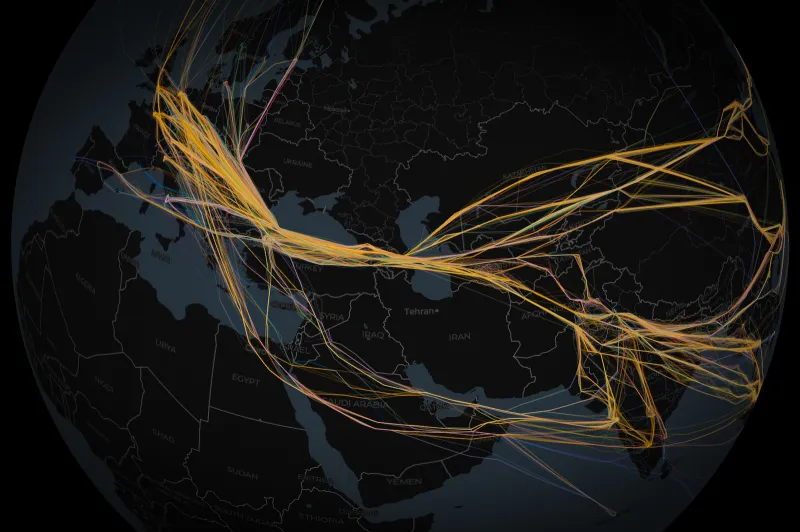
Private and charter aviation faces a more constrained global operating picture than at any point since the US-Iran war began in late February, though the constraints are uneven. Iranian airspace has been closed since the war began, and Western operators are also avoiding Iraqi and Russian airspace. Europe-Asia traffic has been pushed onto a northern routing through Central Asia and the Caucasus or a southern routing over the Gulf states and northern Saudi Arabia.

The southern option is now the flashpoint. A Houthi missile strike on Riyadh's King Khalid International Airport killed at least 12 people and injured more than 300, and attacks on Saudi targets have continued since. Riyadh was reported closed until at least October 17, with airlines cancelling into Riyadh, Dammam and Jeddah on rolling dates through October 18 and 19, and no confirmed resumption dates for several carriers. Saudi airspace itself has not been reported shut. The FAA has warned operators to exercise caution when flying to or over Saudi Arabia.
IATA puts roughly 1.35 million square miles of airspace in the closed, restricted or avoided category, lengthening effective flight distances on key Europe-Asia routes by 5 to 20 per cent and raising operating costs by around 2 to 10 per cent. Scheduled operators are adding technical stops; the Perth-London service now refuels in Singapore to stay clear of the conflict zone. Average worldwide jet fuel for the week ending October 9 was reported 111 per cent higher than a year earlier, driven by disruption of Gulf refined product flows through the Strait of Hormuz and compounded by Russian refinery outages. Hormuz remains contested, with at least ten ships attacked in recent days, the highest daily rate since the war began, alongside a US naval blockade of Iranian ports.
Documentation and regional hazards
Israel's restriction on foreign pilots and flight attendants holding dual nationality of 32 countries applies to any flight transiting the Israel FIR, not only flights to Israel. South Africa has reinstated temporary visa concessions for foreign nationals affected by airspace closures involving Iran, Iraq, Syria, Qatar, Bahrain, Kuwait, Lebanon, Saudi Arabia, the UAE, Israel, the Palestinian Territories, Jordan and Oman, valid until November 30, 2026 or until travel resumes following a ceasefire.
In Asia-Pacific, a restricted area of around 600 kilometres near Beijing, based on a document dated October 1, has not been confirmed as a routine requirement. Indonesian forest-fire haze is the most widespread regional hazard, with Singapore's 24-hour Pollutant Standards Index reaching 229 in the central region and Malaysia's index in the very unhealthy range in Johor. Tropical Storm Champi is forecast to approach the Philippines early in the coming week, and volcanic activity is reported in the Philippines and Indonesia. Thai flooding continues, with conflicting death tolls.
Industry impact & what to watch
Routing is the cost driver here. When the southern Europe-Asia corridor narrows, aircraft previously quoted nonstop on Western Europe to South and Southeast Asia pairings have to be re-planned with a fuel stop, and crew duty limits re-checked against the longer track miles. Fuel at 111 per cent above a year earlier compounds that, so a quote built on last year's fuel price and direct track is likely to be wrong on both inputs.
The uneven nature of the constraints matters for the segment. Saudi airspace has not been reported shut, yet airport closures at Riyadh, Dammam and Jeddah and an FAA caution mean access risk sits at the destination and alternate level, not only at the border. Operators routing Gulf-adjacent trips are effectively pricing diversion options as much as the sector itself.
Three variables decide the next phase: whether Riyadh reopens and holds, whether Houthi targeting extends further into the Gulf states carrying the southern flow, and whether the US midterm cycle changes the tempo of the Iran confrontation. FAA and national advisories on Saudi overflight and GNSS interference along the Gulf corridor are the documents most likely to move planning first. The WMO also assesses near-certain persistence of a strong El Niño through February 2027, which implies density-altitude penalties at hot and high fields.