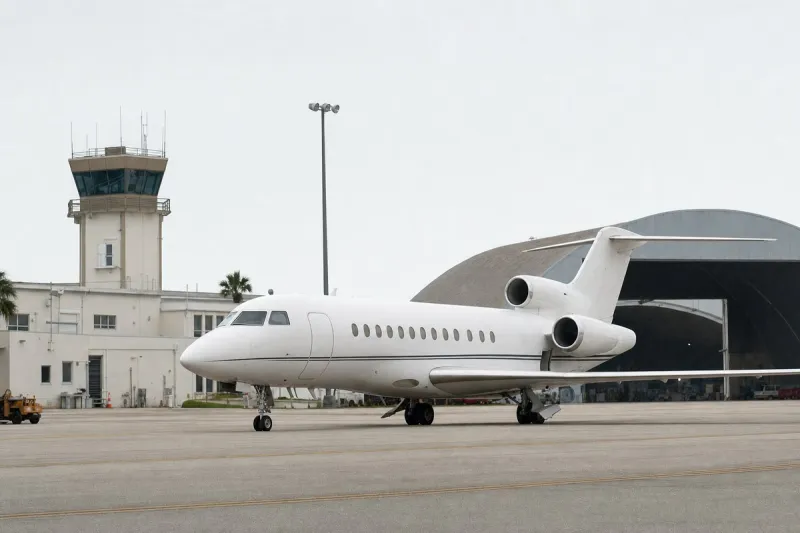
Airstat Flight Activity Jumps 80.5% Over 30-Day Period, Reaching 231 Movements as KCAE Adds 33 Operations
Why It MattersAggregated flight-activity counts can flag where business-jet operators are scaling activity without themselves revealing whether growth comes from new contracts, base expansion or fleet management deals.
What happened
Business-jet flight-activity records show that Airstat, Inc. recorded 231 total flights in the 30-day period from August 20 to September 18, 2026, up 103 flights — an increase of 80.5% — from the 128 flights logged in the preceding 30-day window of July 21 to August 19, 2026.
By airport, the largest single gain came from KCAE, which rose from 47 to 80 airport-associated movements, adding 33. Other notable increases included KORL (6 to 16), KJQF (0 to 12), and KTYS (0 to 10). Four airports were tied for the fifth-largest gain, each adding 8 movements: KCLT (4 to 12), KTMB (2 to 10), KACY (0 to 8), and KRYY (0 to 8); because of this four-way tie, no single fifth-place airport can be identified without an additional ranking rule.
Under the counting methodology used, each complete flight is counted as one operation, and any airport serving as either the departure or arrival point is credited one airport-associated movement for that flight. As a result, the sum of airport-associated movements across all airports does not equal Airstat's total flight count, and same-airport touch-and-go records cannot be individually deduplicated from the aggregated departure/arrival data.
Industry impact & what to watch
Sudden jumps in an operator's flight counts are a recurring feature of business-jet activity data, and they typically show up first at the airport level before any commercial explanation becomes public. Tracking services can capture the volume and its geographic distribution but cannot, from movement counts alone, distinguish a new client contract, a base relocation, or an aircraft management agreement — all of which produce the same signature of concentrated growth at one or two airports.
That is the case here: the gain is distributed across multiple airports, with KCAE accounting for the largest single increase, but the records are insufficient to attribute the 80.5% rise to any specific driver. This is a structural limit of flight-tracking data rather than a gap in this particular report — movement counts describe where aircraft flew, not why an operator flew them.
Whoever manages Airstat's fleet, or contracts with it, would be the party able to confirm what changed at KCAE and the other airports showing new activity. Until such a statement surfaces, the next useful signal is whether the elevated pace at KCAE and KORL persists through the following 30-day window or proves to be a one-time spike.