Predictive Maintenance vs Scheduled Maintenance: ROI Comparison for Aviation Fleets in 2026
Why It MattersThe comparison signals a broader fleet-economics shift toward predictive, sensor-driven maintenance strategies as carriers seek to close the ROI gap left by fixed-interval scheduled maintenance.
Unplanned aircraft maintenance is costing the aviation industry an estimated $33 billion annually, driven by Aircraft on Ground (AOG) events, emergency parts shipments, crew repositioning, flight cancellations, and compensation payouts, many of which stem from failures detectable weeks in advance. A single AOG event on a widebody aircraft can cost an airline between $10,000 and $150,000 per hour, depending on aircraft type, route, and season.

Scheduled maintenance replaces or inspects components at fixed calendar or cycle intervals regardless of actual component condition, so a component assigned a 3,000-cycle replacement interval is swapped out at that interval whether it has 500 cycles of useful life remaining or was already degrading at 2,600 cycles, a practice that accumulates into millions of dollars annually in wasted parts, unnecessary labor, and undetected risk across a fleet.
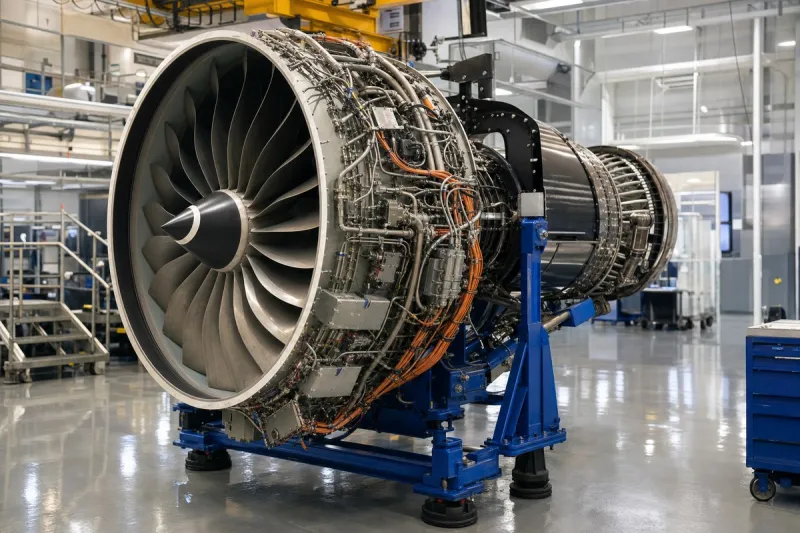
Predictive maintenance instead uses real-time sensor data, physics-based models, and machine learning to estimate Remaining Useful Life, generating a window such as 340 to 410 cycles remaining rather than a fixed replacement date, driving material pre-positioning, workscope planning, MRO slot booking, and parts procurement before an aircraft is grounded. Engines on platforms such as the Boeing 737 MAX and Airbus A320neo generate thousands of data parameters per flight, transmitted via ACARS or broadband SATCOM to ground platforms including Airbus's Skywise and GE Aerospace's flight analytics tools, which combine physics-based models with machine learning to flag component-level alerts covering failure modes such as hydraulic actuator degradation, turbine blade erosion, avionics cooling fan wear, landing gear stress accumulation, and fuel system sensor drift.
Network carriers and operators of large legacy fleets record the highest returns from predictive maintenance, while the economics shift for low-cost and regional operators. Outcome-based service contracts such as Rolls-Royce TotalCare transfer financial risk from airlines to OEMs, changing how maintenance ROI is calculated, though transitioning to predictive maintenance requires onboard connectivity infrastructure and workforce retraining that transition plans frequently underestimate.