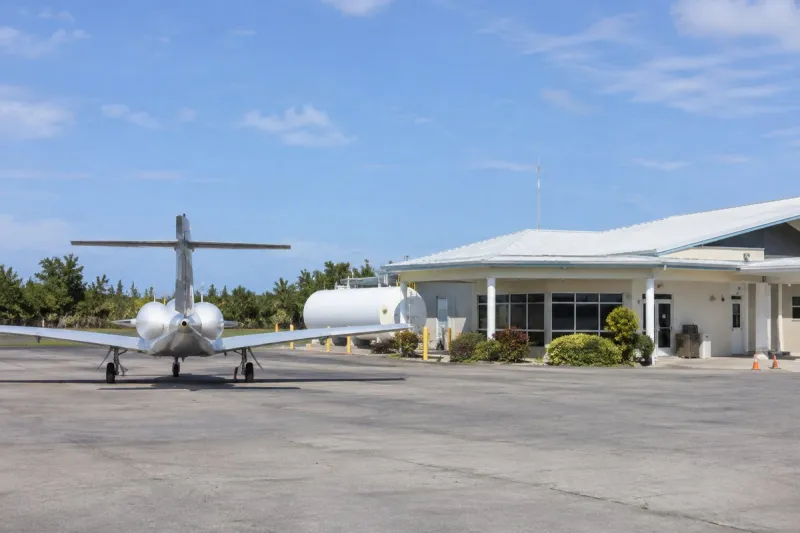
HFB 320 Hansa Jet: The Only Civilian Jet Built With Forward-Swept Wings
Why It MattersThe Hansa Jet shows how an engineering advantage such as a clear cabin can be outweighed by noise, fuel burn and runway demands in a segment dominated by established light-jet competitors.
What happened
The HFB 320 Hansa Jet, built by Hamburger Flugzeugbau (HFB) in Hamburg-Finkenwerder, remains the only civilian jet ever to fly with a forward-swept wing. The twin-jet business aircraft seated up to 12 passengers and was powered by two General Electric CJ610 turbojets, the same engine used by the Learjet. Chief designer Hans Wocke had earlier worked on the Junkers Ju 287, the jet bomber that first flew a forward-swept wing in 1944.

The forward sweep let designers place the wing's main spar box behind the cabin, leaving a cabin about 15 feet long and 69 inches high with nothing in the way. Wind tunnel testing ran to roughly 2,600 hours. The prototype, D-CHFB, first flew on 21 April 1964, taking off from Finkenwerder and landing at Lemwerder 73 minutes later. On 12 May 1965 the first prototype entered a deep stall that became a flat spin during flight testing in Spain, and the company's chief test pilot was killed. HFB then modified the stall warning system and added a stick pusher.
The Hansa Jet sold poorly. Its CJ610 engines were loud and thirsty, and it needed around 5,900 feet of balanced field length at maximum weight. Production ended in 1973 after 47 aircraft (some sources say 45), against competition from the Learjet, Sabreliner and Hawker Siddeley 125. A planned turbofan-powered stretch, the HFB 330, never flew.
The German Air Force was the largest customer with 16 aircraft: six flew government VIPs with the Flugbereitschaft until Canadair Challengers took over in the 1980s, and eight were delivered between 1976 and 1982 as electronic warfare trainers that served until 1994. Civil examples later became freighters, and an operator in Turkey flew them until the early 2000s. The last active Hansa Jet in the United States crashed in St. Louis in 2004 on a maintenance flight, after the pitch trim had been rigged in reverse and not checked before take-off. In 2010 a club, Ein Hansa Jet für Hamburg, was involved in efforts concerning the type's preservation.
Industry impact & what to watch
The Hansa Jet's record is a reminder of how business-jet programmes are decided. A genuine cabin advantage, here an unobstructed 15-foot cabin made possible by moving the spar box aft, counts for little when operating economics point the other way. Noisy, fuel-hungry engines and a balanced field length of around 5,900 feet at maximum weight narrowed the aircraft's usable airport set at a time when rivals offered the same engine in lighter airframes.
It also shows how small the volume can be for a type that is technically distinctive but commercially marginal. A run of 47 aircraft, against competition from the Learjet, Sabreliner and Hawker Siddeley 125, left little scope to fund the turbofan stretch that might have addressed the engine complaints; the HFB 330 never flew. The pattern in the type's later life, a government customer taking the largest share and civil airframes drifting into freight work, is a common route for aircraft that miss their original market.
The safety record carries a separate lesson. The 1965 deep stall led to a modified stall warning system and a stick pusher, and the 2004 St. Louis accident traced back to pitch trim rigged in reverse and not checked before take-off. Both point to the same discipline: unconventional aerodynamics raise the cost of any error in configuration or maintenance, and the documentation of what was rigged and checked matters as much as the design itself.