Near Earth Autonomy's RUC-60 Black Hawk Demonstrates Autonomous Obstacle Avoidance in Tennessee
Why It MattersRetrofitting existing Black Hawks for crewless cargo work shows autonomy moving into rotorcraft logistics through upgrades to current airframes, with civilian firefighting automation developing in parallel through a rival program.
What happened
Near Earth Autonomy announced Monday that its optionally piloted RUC-60 Black Hawk helicopter completed a series of autonomous flight exercises on Nov. 19 at Tullahoma Regional Airport in Tennessee. The exercises demonstrated the aircraft's ability to detect and avoid obstacles and to adapt to changes in mission objectives while airborne.
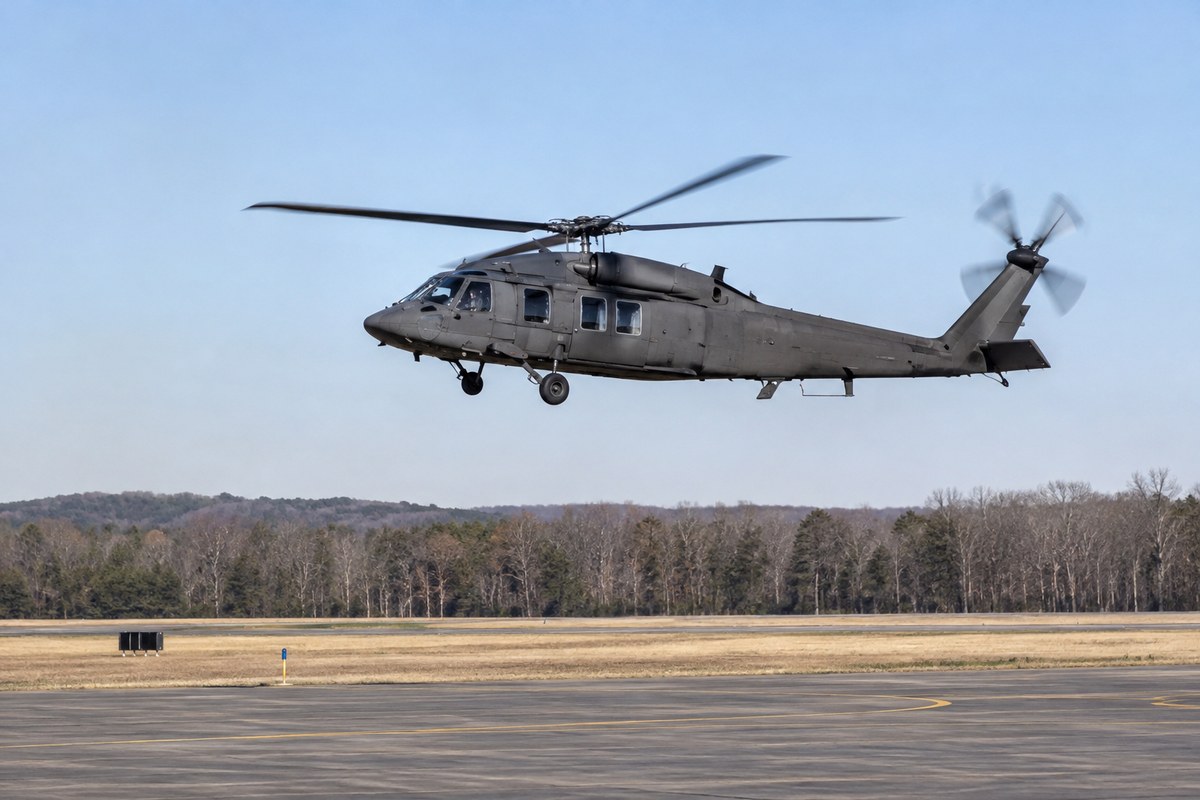
Ground-based operators directed the helicopter through missions beyond visual line of sight, issuing holding commands from distances exceeding 45 nautical miles. The aircraft performed autonomous takeoffs and landings, followed terrain at 300 feet above ground level, and evaluated unimproved landing areas for slopes and other hazards. A long-range lidar sensor let it detect obstacles at greater distances and adjust its flight path accordingly.
The exercises build on earlier demonstrations this year involving autonomous cross-country flights and landings in unimproved areas. Near Earth is working with Honeywell, Moog and XP Services under a U.S. Army initiative to retrofit existing UH-60L Black Hawks for autonomous cargo operations. The RUC-60 incorporates Near Earth's Captain autonomous flight system and is being developed to carry payloads of up to 8,000 pounds without onboard crew or continuous communications with ground operators.
Other efforts to automate Black Hawk operations include Sikorsky's MATRIX technology, which is also being developed for civilian aerial firefighting applications. Near Earth plans further RUC-60 flight demonstrations in 2027.
Industry impact & what to watch
The program's design choice is the notable part: instead of a clean-sheet unmanned cargo aircraft, the Army initiative converts UH-60L airframes already in service. For the rotorcraft segment, that route leans on proven airframes and existing maintenance and parts channels, and it puts the integration work on avionics, actuation and sensing suppliers. The partner list of Honeywell, Moog and XP Services points in that direction.
The pairing of Near Earth's Captain system with Sikorsky's MATRIX also shows two separate autonomy stacks targeting the same helicopter type. Sikorsky's work is aimed partly at civilian aerial firefighting, so autonomy on medium-lift helicopters is not confined to military logistics. Missions that are repetitive, hazardous or remote are where operators of such aircraft would first weigh the economics of removing the crew.
The next dated milestone is Near Earth's planned set of further RUC-60 flight demonstrations in 2027. The 8,000-pound payload target, flight without onboard crew and operation without continuous communications links are the capabilities those flights would need to show.