Supersonic Airliner Programs Face Five Commercialization Gates; Only Boom Overture and NASA X-59 Verified for Comparison
Why It MattersSupersonic revival turns on certification, noise law, binding orders and manufacturing capacity, so flight-test milestones alone say little about whether a commercial service can be built and sold.
What happened
Whether supersonic passenger flight returns depends on five commercialization tests rather than speed records: engine certification, overland noise rules, order firmness, production scale and emissions. Of the announced civil supersonic programs, only two clear the verification bar for a full comparison: Boom Supersonic's Overture and NASA's X-59.
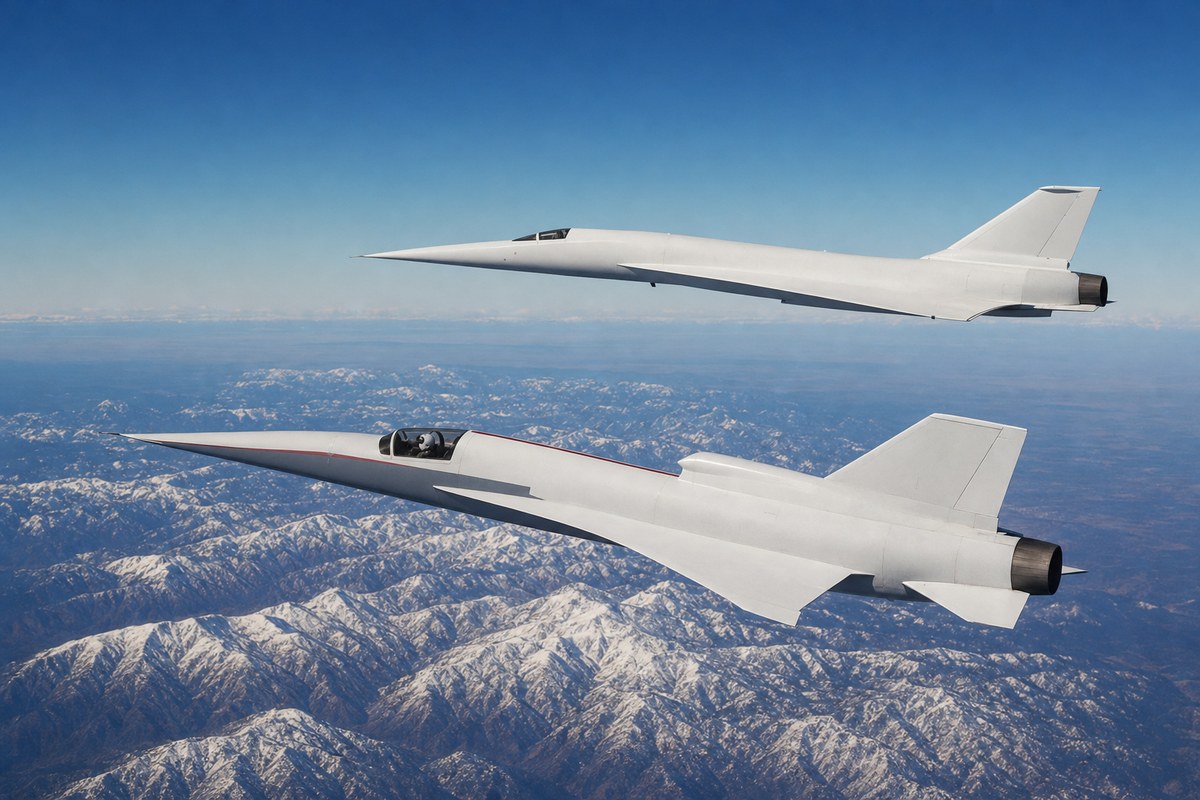
Boom's XB-1 demonstrator exceeded Mach 1 in January 2025, and NASA and Lockheed Martin's X-59 QueSST made its first flight in October 2025. Both are engineering proof points rather than commercial milestones. Overture is claimed at Mach 1.7 with 60 to 80 seats. The X-59 is a research aircraft with no passenger cabin, no sales and no in-service plan. Concorde stopped carrying passengers in 2003.
FAA material names United Airlines, American Airlines and Japan Airlines as delivery-contract holders for Overture and describes passenger service as expected in 2029. The verified milestones and regulatory documents cited date from January 2025 through October 2025. NASA and Lockheed Martin information was not directly retrieved in the available source set.
Engine and noise rules
A new engine earns an FAA type certificate only after meeting the airworthiness standards in 14 CFR Part 33, including extra provisions written for supersonic engines. Boom's Symphony is a clean-sheet engine, and no primary source reviewed verifies its certification schedule, certification basis or core-test status.
Under 14 CFR 91.817, issued in 1973, civil aircraft may not fly faster than Mach 1 over land in the United States without special permission. The FAA has proposed replacing the speed limit with a performance standard capping sonic-boom overpressure at the surface at 0.11 pound per square foot.
The X-59 is intended to supply community-response acoustic data behind that figure. ICAO may draw on the same evidence for international rules, but FAA authority over US operations does not depend on ICAO.
Orders, production and emissions
The record contains no order counts, deposit amounts, delivery dates or cancellation rights for Overture, so whether the airline commitments are firm or conditional is unverified.
No primary source reviewed verifies a 33-aircraft-per-year production target for Boom's North Carolina facility, nor the capital spending, tooling, staffing or ramp schedule behind it.
No verified like-for-like comparison exists between Overture's emissions and those of a conventional wide-body jet, and no primary source confirms a required sustainable aviation fuel blend or dependency.
Industry impact & what to watch
The five gates show why supersonic programs are judged differently from conventional aircraft launches. A demonstrator breaking Mach 1 proves the airframe can fly; it does not settle whether an engine can be certified, whether a route network over land is legal, or whether a factory can deliver aircraft at a rate that supports airline fleet planning. Each gate can stall the others, and a program that clears one says little about the rest.
The overland question is the one most dependent on a regulator rather than a manufacturer. Because current US rules bar supersonic flight over land, the value of any aircraft sold into that market depends on the proposed overpressure standard being adopted, and the X-59's acoustic data is the evidence meant to support it. Transoceanic routes face no such constraint, which is why order books and route economics can look sound while the broader market stays closed.
The next milestones that would settle the picture are the ones the record leaves blank: a disclosed certification basis for Symphony, the terms behind the three airlines' contracts, and any finalized noise standard. The 2029 service date is a program projection, and nothing in the current record sets a date for bookable supersonic flights.