Bahamas Investigators Issue Two Safety Recommendations After North Andros Cessna 402 Crash That Killed Ten
Why It MattersThe case shows that small-island charter safety depends on regulators scaling oversight to seasonal demand peaks, a gap that earlier crashes had already exposed without producing lasting structural change.
What happened
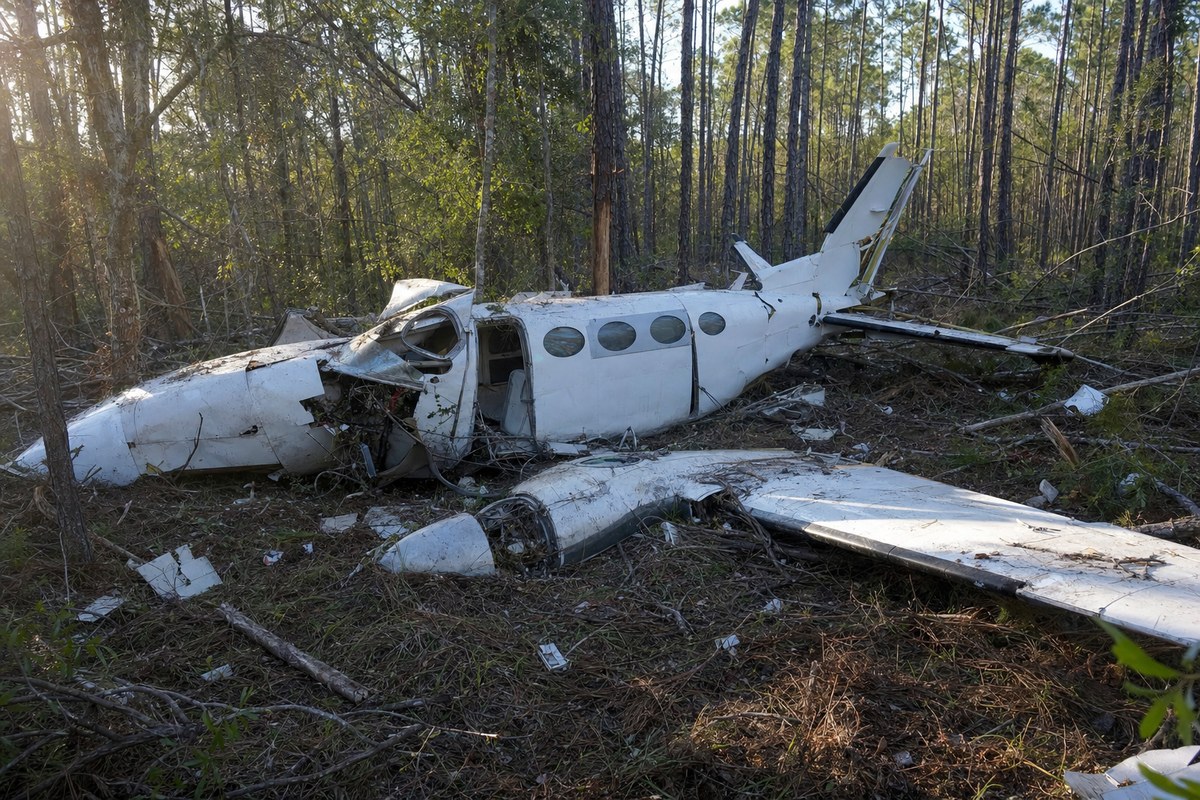
The Aircraft Accident Investigation Authority (AAIA) has issued two safety recommendations to the Civil Aviation Authority of The Bahamas (CAAB) in its latest update on the crash of a Flamingo Air Cessna 402 in a pine forest in North Andros. The accident occurred during the 53rd Independence celebrations and killed all ten people on board, the pilot and nine passengers.
The first recommendation calls for the CAAB to establish and implement a documented, risk-based internal safety event triggering and escalation mechanism for regulated entities, based on the number, frequency, severity and pattern of safety-related events within a defined period. The AAIA said the CAAB had supplied its existing risk-based surveillance methodology, which analyses occurrence trends, compliance histories, audit findings and corrective action performance to prioritise oversight. The CAAB also said it is formalising a documented triggering and escalation mechanism.
The second recommendation asks the CAAB to develop a formal, risk-based mechanism to identify periods of significantly increased domestic aviation activity, such as public holidays, regattas, festivals and homecomings, and apply enhanced safety oversight during them. The CAAB advised that, effective September 2026, satellite office surveillance coverage was expanded from a general 9am to 5pm schedule to 7am to 6pm, including weekends and public holidays, while retaining risk-based prioritisation. The AAIA called the expanded coverage a positive and relevant measure.
Dr Anthony Hamilton, president of the Bahamas Association of Air Transport Operators and administrative chief at Southern Air Charter, told Tribune Business that the industry must break its silos and not respond only when a crisis occurs. He said all stakeholders have a responsibility and that reform will require commitment and sacrifice.
Captain Butler, a former Civil Aviation official, noted that a similar call for greater oversight during holidays and peak travel periods followed the June 2022 crash of a US-registered Piper Navajo at Deadman's Cay, Long Island, which killed one person. In February 2023 the AAIA raised a safety concern with the US Federal Aviation Administration (FAA) about enhanced surveillance of US-registered aircraft operating in The Bahamas, and the FAA responded that enhanced efforts would be undertaken with the CAAB.
Industry impact & what to watch
The two recommendations target how a regulator allocates attention rather than any single aircraft or operator. A trigger mechanism turns scattered occurrence reports into a defined point at which oversight intensifies, while a peak-period mechanism recognises that domestic demand in an island archipelago is highly seasonal. Public holidays, regattas and homecomings concentrate flying into short windows, and charter operators serving those routes carry the exposure.
The 2022 Long Island crash and the 2023 exchange with the FAA show that calls for holiday-period oversight have surfaced before. Whether this round differs depends on documentation: the CAAB says it is formalising its escalation mechanism, and the AAIA said further evidence is still needed on the second recommendation. The point to track is the CAAB's formal response and the evidence it files against each recommendation, since the expanded 7am to 6pm coverage is the only concrete change reported so far.